
DFB Laser Diodes for Wavelength-Critical Optical Systems
Lumi supplies DFB laser diodes for TDLAS gas sensing, optical communications, coherent measurement, fiber-optic instrumentation and OEM photonic integration. The portfolio spans compact TO-can devices, temperature-controlled butterfly lasers and fiber-pigtailed configurations.
Choose a DFB laser by its required wavelength and tuning range, output power, linewidth, SMSR, thermal control and optical interface—not by the nominal wavelength alone.
What Is a DFB Laser Diode?
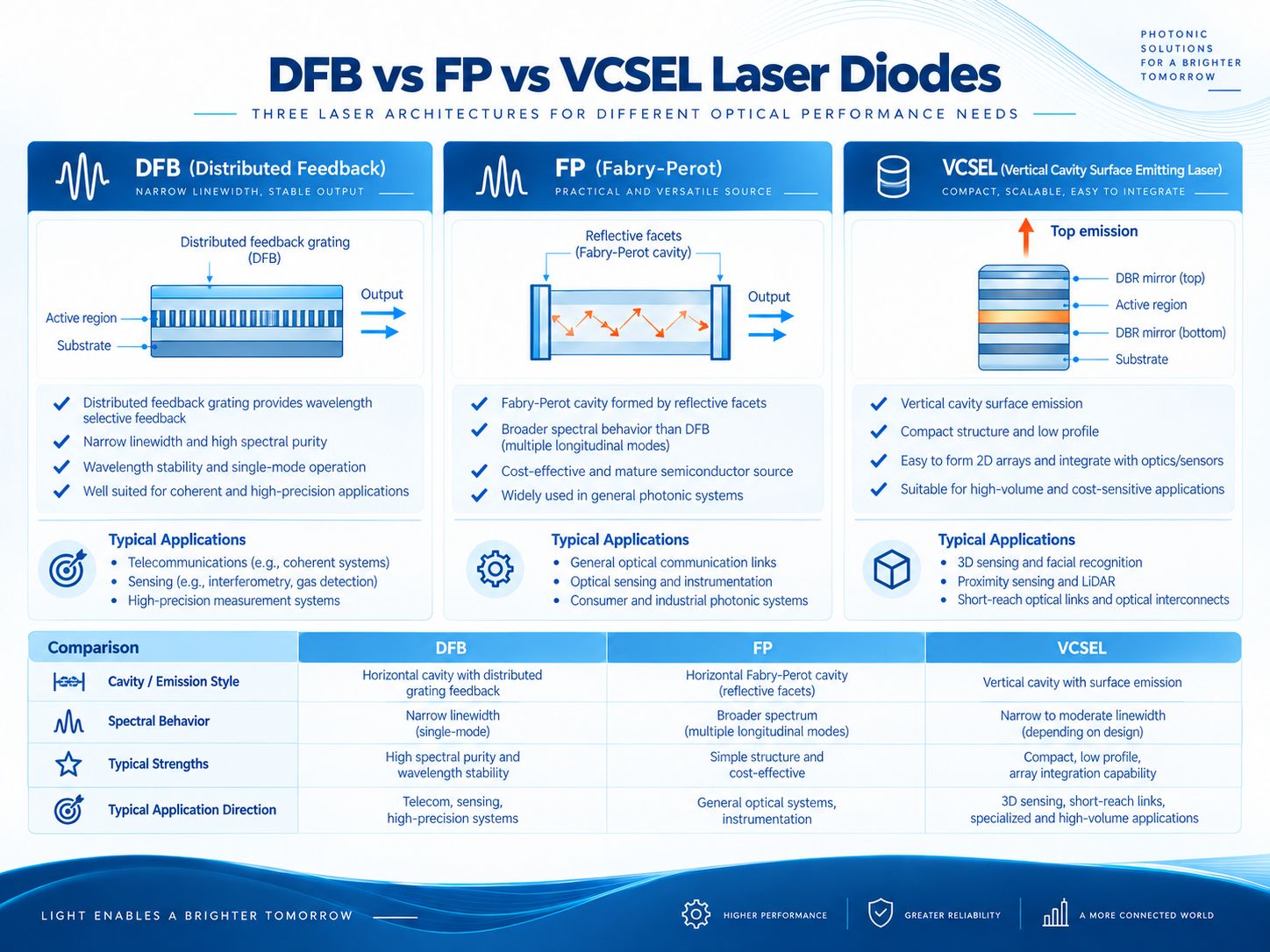
A distributed feedback (DFB) laser diode is a semiconductor laser whose optical waveguide incorporates a periodic grating for wavelength-selective optical feedback. Unlike a conventional Fabry–Pérot laser that relies primarily on reflective chip facets, the distributed grating is engineered to favor a particular longitudinal lasing mode.
This architecture is valuable when an optical system needs a defined spectral line, controlled tuning behavior or strong side-mode suppression. DFB technology is widely used for wavelength-specific molecular absorption measurements, fiber-optic communication and precision sensing.
The actual spectral linewidth, center wavelength, mode-hop behavior and tuning coefficients must always be confirmed for the individual product under its specified operating conditions.
Read the Laser Diode Fundamentals Guide →Wavelength Selectivity
Grating feedback favors an intended longitudinal mode.
Side-Mode Suppression
High SMSR reduces unwanted competing laser modes.
Electrical Tuning
Drive-current changes can support controlled wavelength scans.
Thermal Tuning
Heater or TEC options support application-specific wavelength control.
When Should You Choose a DFB Laser?
DFB is not automatically the best laser for every application. It is usually selected when wavelength discrimination or controlled spectral behavior contributes directly to system performance.
TDLAS & Gas Analysis
Scan an appropriate molecular absorption feature by controlling laser current and temperature. The chosen spectral line and the device tuning window must overlap.
Optical Communication
Use wavelength-defined sources for optical links and instrumentation where output stability, channel selection and side-mode suppression matter.
Precision Optical Measurement
Apply specified narrow-linewidth DFB models to systems where wavelength stability or coherent performance is important.
Engineering perspective: If the application does not require wavelength-specific emission or high side-mode suppression, an FP laser may offer a simpler alternative. Compare the FP range →
DFB Laser Diode Package Options
DFB describes the optical cavity architecture; TO-can, butterfly and fiber-coupled describe package and output-interface choices. These can be combined according to your design requirements.
TO-Can DFB Lasers
Compact metal-can configurations for optical sensing and OEM modules. Selected products integrate TEC control or heater-based tuning.
Explore TO-Can Lasers →Butterfly DFB Lasers
Precision packaging with space for thermoelectric control, temperature feedback, optical monitoring and factory-aligned fiber.
Explore Butterfly Lasers →Fiber-Coupled DFB Lasers
Pigtailed TO and butterfly formats help deliver light into SM or PM fiber interfaces for sensing and fiber-optic systems.
Explore Fiber-Coupled Lasers →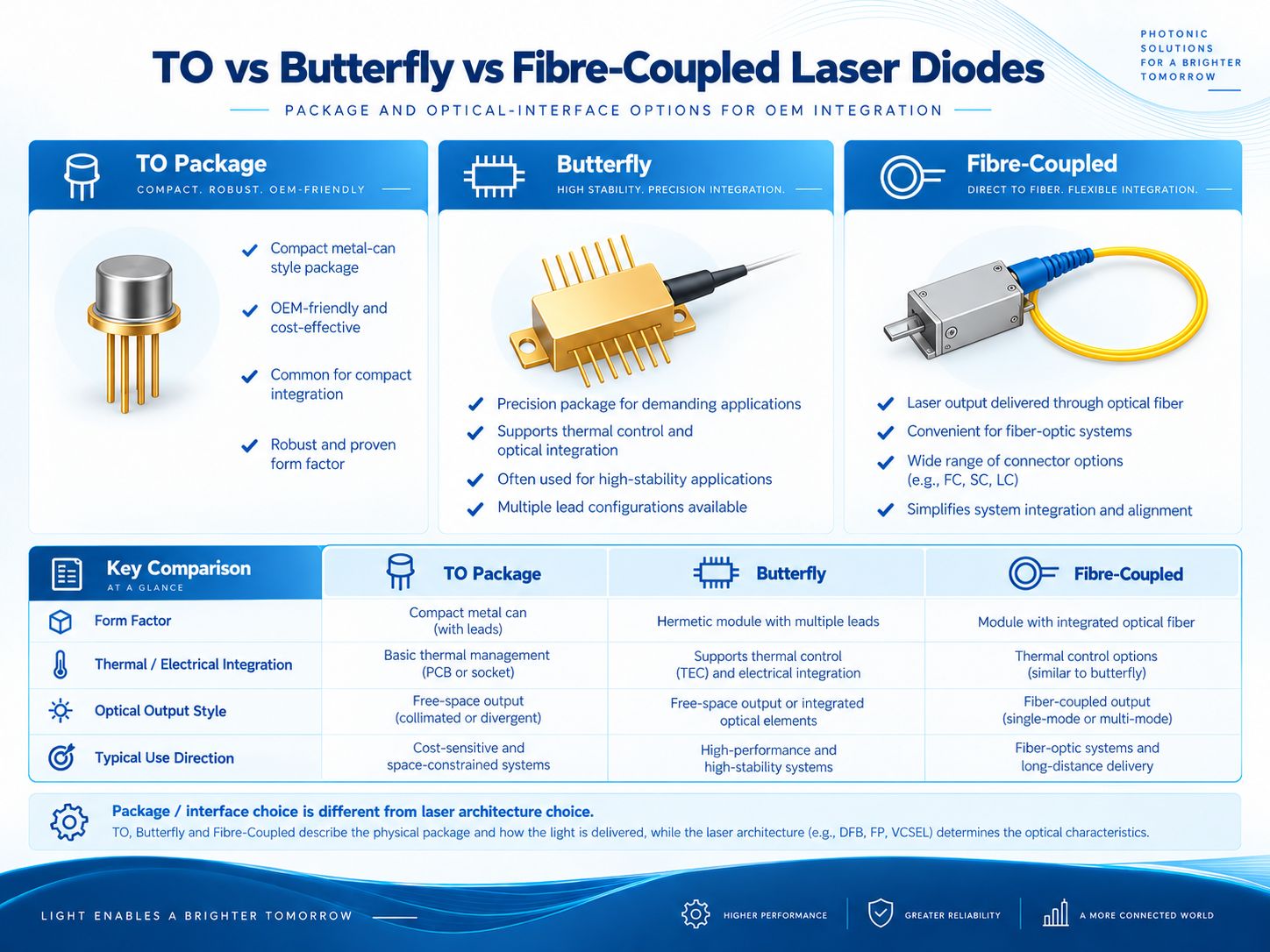
DFB Wavelength Selection Guide
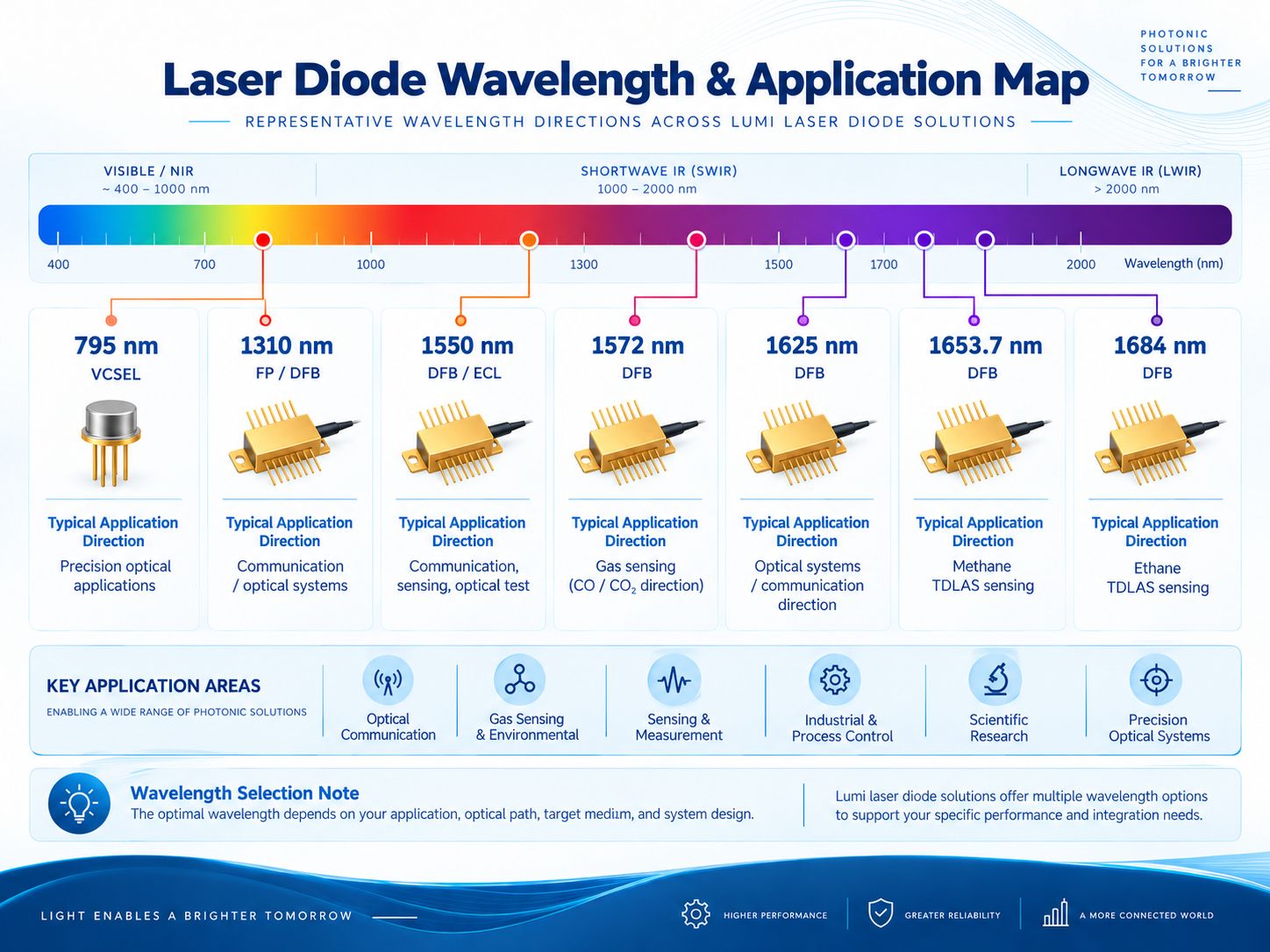
Wavelength selection depends on the target medium, system architecture and operating conditions. The following examples represent current Lumi product directions and are not interchangeable solely because their nominal wavelengths are close.
| Wavelength | Product Direction | Engineering Consideration |
|---|---|---|
| 1273–1531nm | Selected gas-sensing DFB families | Confirm target absorption line for the exact configured wavelength. |
| 1310nm | Butterfly / fiber-optic DFB | Optical communication, characterization and fiber instrumentation. |
| 1550nm | Standard, narrow-linewidth and tunable DFB | Communication, coherent measurement, optical test and selected sensing. |
| 1572nm region | TO package for selected gas-sensing projects | Verify the actual molecular line and tuneable range; do not assume all CO/CO₂ transitions fit. |
| 1650.9nm | Heater-controlled methane DFB | Confirm scan range, electrical drive and heater strategy. |
| 1653.7nm | TEC-controlled methane DFB | Temperature stabilization and line-center alignment for CH₄ TDLAS. |
| O / C / L Bands | Tunable butterfly DFB configurations | Specify actual tuning span, fiber interface and linewidth requirement. |
DFB Lasers for Tunable Diode Laser Absorption Spectroscopy
TDLAS detects molecular absorption by scanning the laser wavelength across a selected absorption feature and measuring transmitted optical power. DFB emission, laser tuning, the gas cell and the photodetector must operate together as one measurement system.
01 / Absorption Line
Identify the gas species, transition wavelength and acceptable interference from other molecules.
02 / Laser Tuning
Ensure the full scan crosses the required line at expected drive and temperature conditions.
03 / Optical Path
Size the cell path length, windows and optics around the needed detectable absorbance.
04 / Detection
Match photodiode spectral response, analog front-end and modulation processing to the source.
What to Verify Before Ordering
- Target molecular absorption line and tuning margin
- Current and temperature tuning coefficients
- Mode-hop behavior and side-mode suppression
- Output power at the defined operating point
- Package thermal design, drive conditions and detector match
Examples from Current Lumi Models
| Product | Temperature tuning | Current tuning |
|---|---|---|
| 1572nm DFB | 0.1nm/°C typ. | 0.039nm/mA typ. |
| 1653.7nm TEC DFB | 0.1nm/°C typ. | 0.02nm/mA typ. |
| 1650.9nm Heating DFB | 0.1nm/°C typ. | 0.02nm/mA typ. |
Representative model values only; consult the corresponding product for measurement conditions and specification limits.
Explore Lumi DFB Laser Diodes
Browse current WooCommerce products across gas-sensing, narrow-linewidth, butterfly and fiber-pigtailed DFB sources. New products in this category appear automatically based on the selected sorting order.

Methane and Gas-Sensing DFB Product Directions
1653.7nm TEC-Cooled DFB
TO-package DFB laser with integrated TEC for temperature-controlled methane absorption spectroscopy. Representative values include 6mW typical output and 35dB typical SMSR.
View Product →1650.9nm Heating-Type DFB
Compact heating-type TO56 source for selected CH₄ TDLAS designs. Representative values include 6mW typical output and 35dB typical SMSR.
View Product →1572nm DFB TO-Series
TO56/TO60 gas-analysis source. Confirm absorption-transition suitability against the actual wavelength tuning window before selecting it for CO₂ or other target gases.
View Product →1310nm and 1550nm DFB Laser Sources
The Lumi range also includes butterfly DFB devices and selected high-output narrow-linewidth sources for optical communication, fiber testing, instrumentation and precision measurement. Their linewidth and other spectral claims apply only to the specifically qualified model.
1310nm Butterfly DFB
10mW-class source with SM fiber, TEC, thermistor and monitor photodiode for optical communication and test systems.
View Product →1550nm Narrow-Linewidth TO
High-output TO DFB source with 90mW typical output and model-specific 100–150kHz linewidth direction for precision photonics.
View Product →1550nm Narrow-Linewidth Butterfly
Precision butterfly configuration with 100mW typical output and a specified narrow-linewidth operating range for coherent and measurement-related systems.
View Product →DFB vs FP Laser Diodes
A laser architecture should be chosen for the required optical function rather than presumed superiority. A DFB cavity incorporates distributed wavelength-selective feedback; a conventional FP cavity is primarily defined by its end facets.
| Selection Point | DFB | FP |
|---|---|---|
| Optical feedback | Distributed wavelength-selective grating | Predominantly facet-defined Fabry–Pérot cavity |
| Longitudinal behavior | Designed to favor one mode with high SMSR | May support multiple modes |
| Spectral control | Often preferred for narrow wavelength-specific output | Often suitable where stringent spectral selection is unnecessary |
| TDLAS | Frequently a strong choice for line-specific spectroscopy | Usually not the initial choice for narrow absorption-line scans |
| Selection rationale | Optical-line targeting and mode discrimination | Output requirements, simplicity and cost-performance fit |
Technical Requirements for a DFB Laser RFQ
DFB sourcing starts with a clear optical specification. Lumi can discuss configuration requirements for package type, target wavelength, control method, optical power and fiber connectivity based on the intended system.
- Exact target wavelength or gas absorption transition
- Tuning range, linewidth and SMSR requirements
- Output power and allowable operating conditions
- TO-can, butterfly or fiber-pigtailed package
- TEC / heater, thermistor and monitor photodiode
- SM or PM fiber, length and connector
- Prototype quantity and estimated annual demand
DFB Laser Diode Applications
Gas Absorption Sensing
Wavelength-selective optical sources for methane and other molecular absorption measurements where a compatible transition is identified.
Fiber Communication
1310nm, 1550nm and tunable sources for defined optical communication channels and photonic link designs.
Coherent Measurement
Selected narrow-linewidth sources for coherent detection and measurement, subject to linewidth, feedback and noise specifications.
Optical Testing
Precision wavelength sources for testing detectors, components and fiber-optic instrumentation.
DFB Laser Diode FAQ
What does DFB stand for?
DFB stands for Distributed Feedback. It describes the grating-based optical feedback architecture within the laser waveguide.
Why are DFB lasers used in TDLAS?
DFB sources provide wavelength-selective optical emission and controllable tuning. When the tuning range overlaps a target molecular absorption feature, the source can support absorption spectroscopy.
Does DFB always mean narrow linewidth?
No. DFB architecture supports strong spectral selectivity, but the actual linewidth depends on chip design, operating point, thermal stability and optical feedback. Confirm the exact model specification.
What is SMSR in a DFB laser?
Side-mode suppression ratio compares the power of the main lasing mode with the strongest competing side mode, commonly expressed in decibels.
Can a DFB laser come in TO or butterfly packaging?
Yes. DFB is the laser architecture; TO-can and butterfly describe packaging formats. Optical fiber can also be coupled to suitable packages.
What is the difference between TEC-cooled and heater-type methane DFB lasers?
Both use temperature to control wavelength, but their thermal-control structures and operating ranges differ. The right choice depends on the required absorption-line alignment, scan method and ambient conditions.
How should I choose a wavelength for gas detection?
Determine the target gas and exact absorption transition first, then verify the laser tuning window, interfering absorbers, optical power, detector response and temperature-control capability.
Can Lumi support custom DFB laser requirements?
Project discussions can cover selected wavelengths, packages, control schemes, fiber interfaces and performance specifications. Availability and configuration depend on the actual device and order requirements.
Need a DFB Laser for Your Project?
Share the application, wavelength, spectral performance, package preference and approximate order volume. Our team can help evaluate an appropriate laser-source configuration.