

A laser diode is a semiconductor device that converts electrical current into laser light. When current is injected into its active semiconductor region, electrons and holes recombine and generate photons. Under the right conditions, those photons trigger stimulated emission, are amplified inside an optical resonator, and leave the device as a directional laser beam.
Laser diodes are also commonly called semiconductor lasers or diode lasers. Unlike an ordinary LED, a laser diode is designed to provide optical feedback and enough gain for laser oscillation. This produces light with much higher directionality and coherence and, depending on the laser architecture, can also produce a very narrow optical spectrum.
That combination of compact size, direct electrical pumping and controllable optical output is why semiconductor laser diodes are used in optical communication, gas sensing, spectroscopy, LiDAR, precision measurement, medical systems and industrial photonics.
For OEM engineers, however, understanding a laser diode requires more than knowing that it “makes laser light.” The semiconductor structure, optical cavity, wavelength, thermal behavior and final package all influence how the device performs inside a real system.
What Does “LASER” Mean?
The word LASER comes from:
Light Amplification by Stimulated Emission of Radiation
Each part describes an important aspect of laser operation.
- Light is carried by photons.
- Amplification means the optical field becomes stronger as additional photons are generated.
- Stimulated emission is the physical process that allows an incoming photon to trigger the emission of another photon with closely related optical properties.
- Radiation refers to electromagnetic radiation—in this case, light.
A semiconductor laser creates the conditions needed for stimulated emission inside a very small electrically pumped device.
In technical literature, the term laser diode can refer broadly to the semiconductor laser device itself, whether it is a bare die or packaged component. In practical B2B sourcing, laser chip often means the bare semiconductor die, while packaged laser diode refers to a device that has already been mounted, electrically connected and prepared for integration.
For OEM projects that need the upstream component, Lumi provides laser chip supply and project-based OEM support in addition to packaged laser diodes.
What Is Inside a Semiconductor Laser Diode?
A semiconductor laser diode is built from multiple carefully engineered material layers rather than a simple block of semiconductor.

A simplified edge-emitting laser diode normally includes a p-type region, an n-type region, an active region, optical confinement layers, electrical contacts and an optical resonator.
P-Type Semiconductor
The p-type region contains a high concentration of holes, which behave as positive charge carriers.
When the device is forward biased, holes are injected toward the active region.
N-Type Semiconductor
The n-type region contains a high concentration of electrons.
Under forward bias, electrons are also injected toward the active region from the opposite side.
Active Region
The active region is where optical gain is generated.
Electrons and holes are brought together in this region. When an electron makes an energy transition and recombines with a hole, energy can be released as a photon.
Modern semiconductor lasers commonly use heterostructures and quantum-well designs to confine carriers and optical energy more effectively in this region.
Cladding and Optical Confinement Layers
A practical laser diode needs to keep both the charge carriers and the optical field concentrated near the active region.
Layers surrounding the active region can create a refractive-index structure that acts as an optical waveguide. This helps confine the generated light so that it travels through the gain region rather than spreading away from it.
Optical Cavity
An edge-emitting laser diode needs optical feedback.
In a basic Fabry–Pérot laser diode, the two end facets of the chip form a resonant cavity. Light travels back and forth between these facets and repeatedly passes through the gain region.
One side can be designed to provide high reflection while the output side allows part of the amplified light to escape.
Electrical Contacts
Metal contacts allow current to be driven through the semiconductor structure.
A laser diode is a current-driven device, so the external driver and current-control method are important to stable operation. Excessive current, voltage transients or electrostatic discharge can damage a laser diode.
How Does a Laser Diode Work?
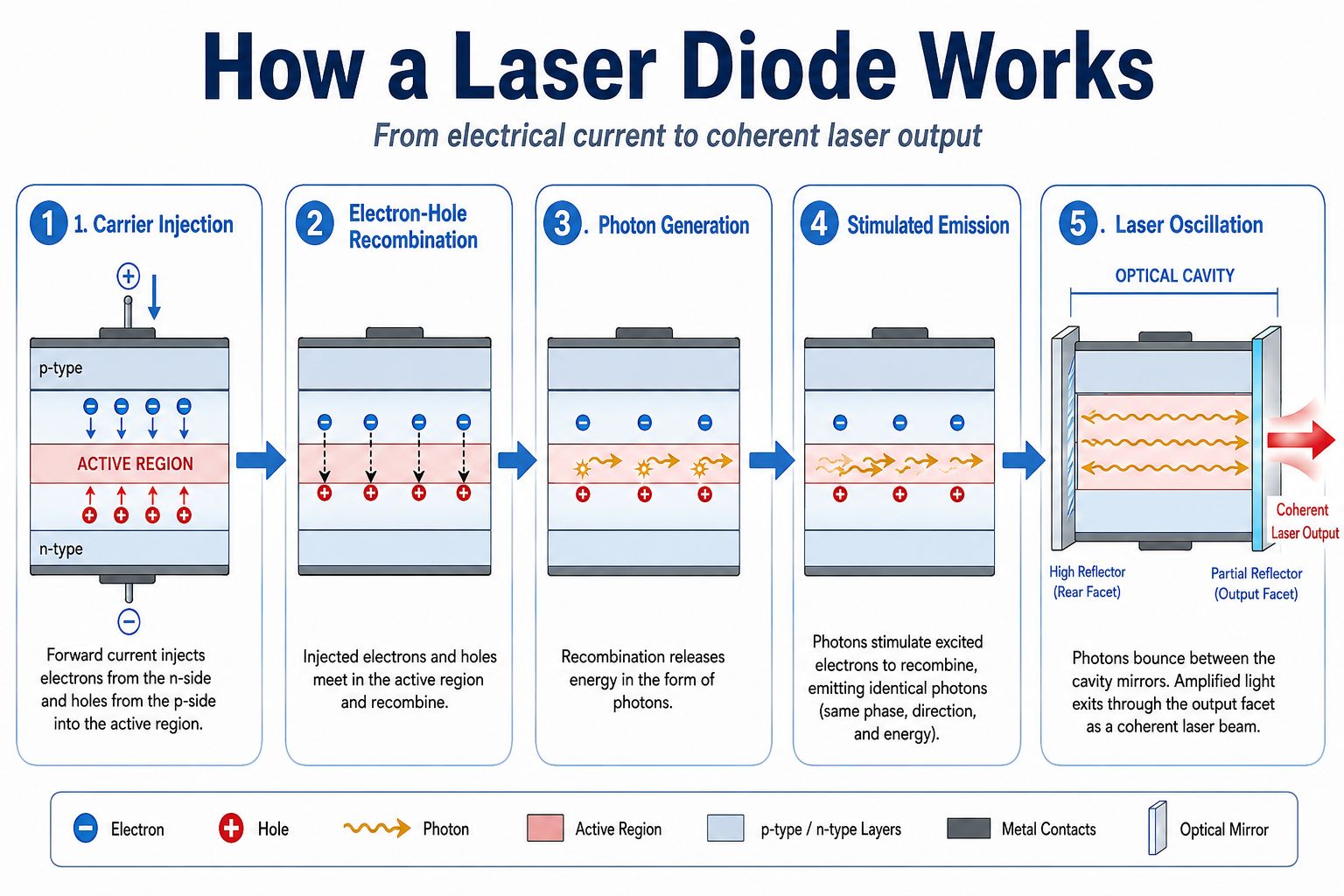
The operation of a semiconductor laser can be understood as a five-stage process.
Step 1: Forward Bias Injects Electrons and Holes
When a forward current is applied across the p-n junction, electrons from the n-side and holes from the p-side are driven toward the active region.
This electrical injection creates the carrier population required for light generation.
Step 2: Electron-Hole Recombination Generates Photons
Electrons can recombine with holes and release energy as photons.
At low injection levels, much of this light is produced through spontaneous emission. The photons do not yet form the highly organized output associated with laser oscillation.
The photon energy is related to the energy difference involved in the semiconductor transition. This is one reason semiconductor material composition and device design strongly influence the wavelength a laser diode can produce.
Step 3: Photons Trigger Stimulated Emission
Once photons are present in the active region, a photon with the appropriate energy can stimulate an excited carrier transition that generates another photon.
The new photon is correlated with the stimulating optical field in frequency, phase, polarization and direction according to the laser mode.
This is the key mechanism that allows light to be amplified.
For a more detailed description of semiconductor optical gain, the RP Photonics Encyclopedia article on semiconductor lasers provides useful technical background.
Step 4: The Optical Cavity Amplifies the Light
Photons traveling along the laser cavity are reflected and pass through the active region repeatedly.
Every pass gives the optical field another opportunity to experience gain through stimulated emission.
At the same time, the device also has losses from absorption, incomplete reflection, scattering and the intentional output coupling.
Step 5: The Laser Reaches Threshold
A laser does not immediately begin full laser oscillation as soon as current flows.
The injection level must become high enough that the optical gain can overcome the total cavity losses for a supported laser mode.
The corresponding drive current is commonly called the threshold current.
Above threshold, stimulated emission becomes dominant in the lasing mode and a strong laser beam exits through the output facet.
Spontaneous Emission vs Stimulated Emission
Understanding the difference between spontaneous and stimulated emission helps explain why an LED and a laser diode behave so differently.
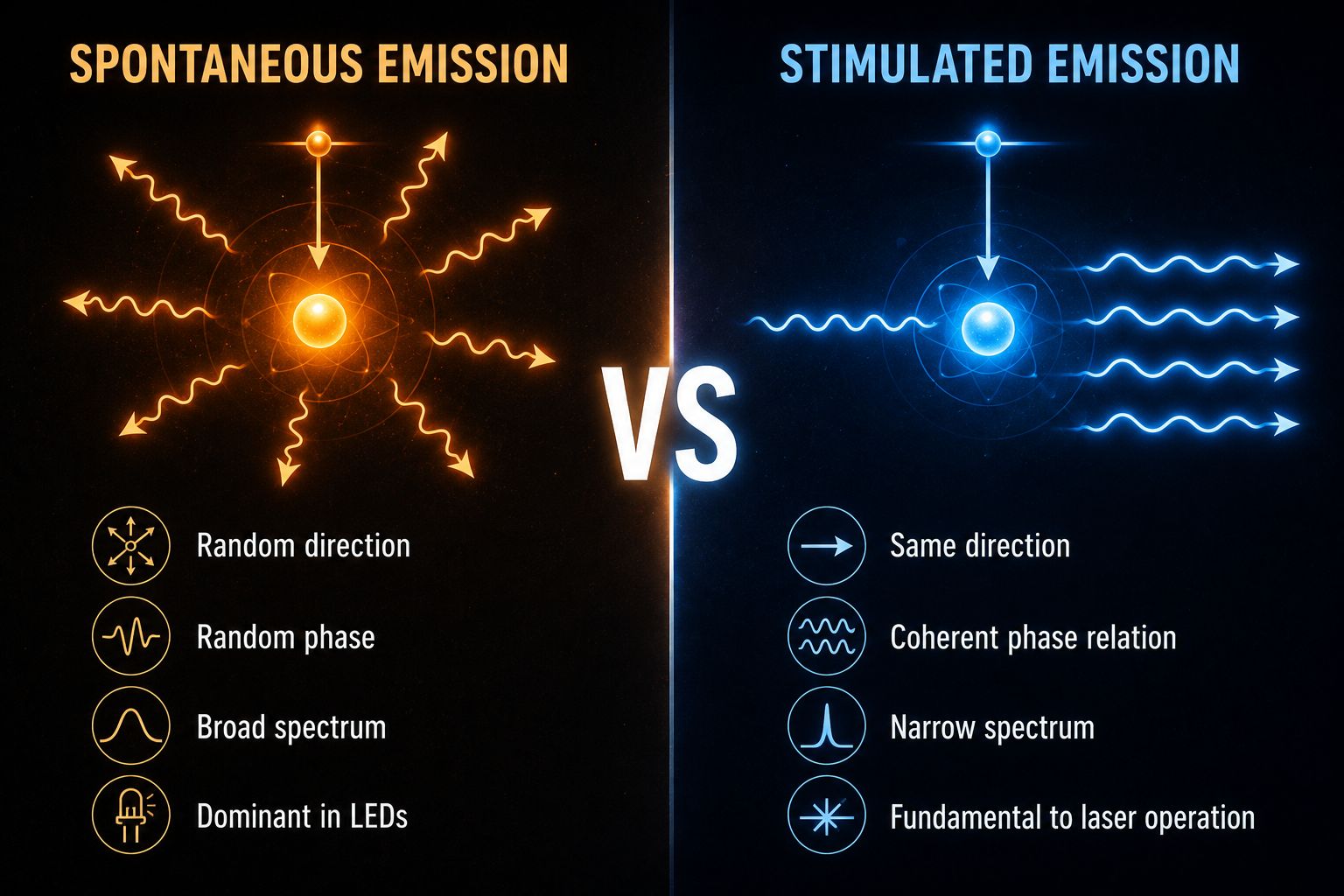
| Characteristic | Spontaneous Emission | Stimulated Emission |
|---|---|---|
| Trigger | Carrier recombination occurs without a stimulating photon | An existing optical field stimulates another transition |
| Direction | Emission can occur into many directions and modes | Emission is coupled to the stimulating optical mode |
| Phase relationship | No fixed phase relationship between independently emitted photons | New emission is phase-correlated with the stimulating field |
| Spectrum | Generally broad | Enables selective amplification of laser modes |
| Typical role | Dominant mechanism in LEDs | Fundamental mechanism for laser gain |
A useful simplification is that spontaneous emission starts the light, while stimulated emission provides the amplification required for laser action.
However, a real laser diode is more complex than a collection of perfectly identical photons. Its spectral width, phase noise and mode behavior depend on cavity design, current, temperature, material properties and optical feedback.
Why Is Laser Diode Light Different from LED Light?
Laser diode light has several characteristics that make it useful in photonic systems.
Higher Directionality
The optical cavity and waveguide constrain laser emission into defined spatial modes.
This allows a laser diode to produce a much more directional beam than a conventional indicator LED, although an edge-emitting diode can still have significant and asymmetric divergence before external optics are added.
Higher Coherence
Laser oscillation creates a much stronger phase relationship within the lasing mode than spontaneous-emission sources provide.
Coherence is important for interferometry, coherent detection, precision measurement and other applications that rely on optical phase.
Narrower Spectral Output
Laser diode emission is generally much narrower than LED emission, but not every laser diode has the same linewidth.
A Fabry–Pérot diode can oscillate on multiple longitudinal modes. A well-designed DFB laser can strongly favor one longitudinal mode and achieve much higher spectral purity.
High Optical Intensity from a Small Source
Laser diodes can deliver concentrated optical power from a very small semiconductor emitter.
This makes them useful where efficient focusing, fiber coupling or high optical power density is required.
Fast Electrical Modulation
Because semiconductor laser output responds directly to electrical drive conditions, many laser diodes can be modulated at high speeds.
This property is central to applications such as optical communication and some sensing techniques.
Laser Diode vs LED
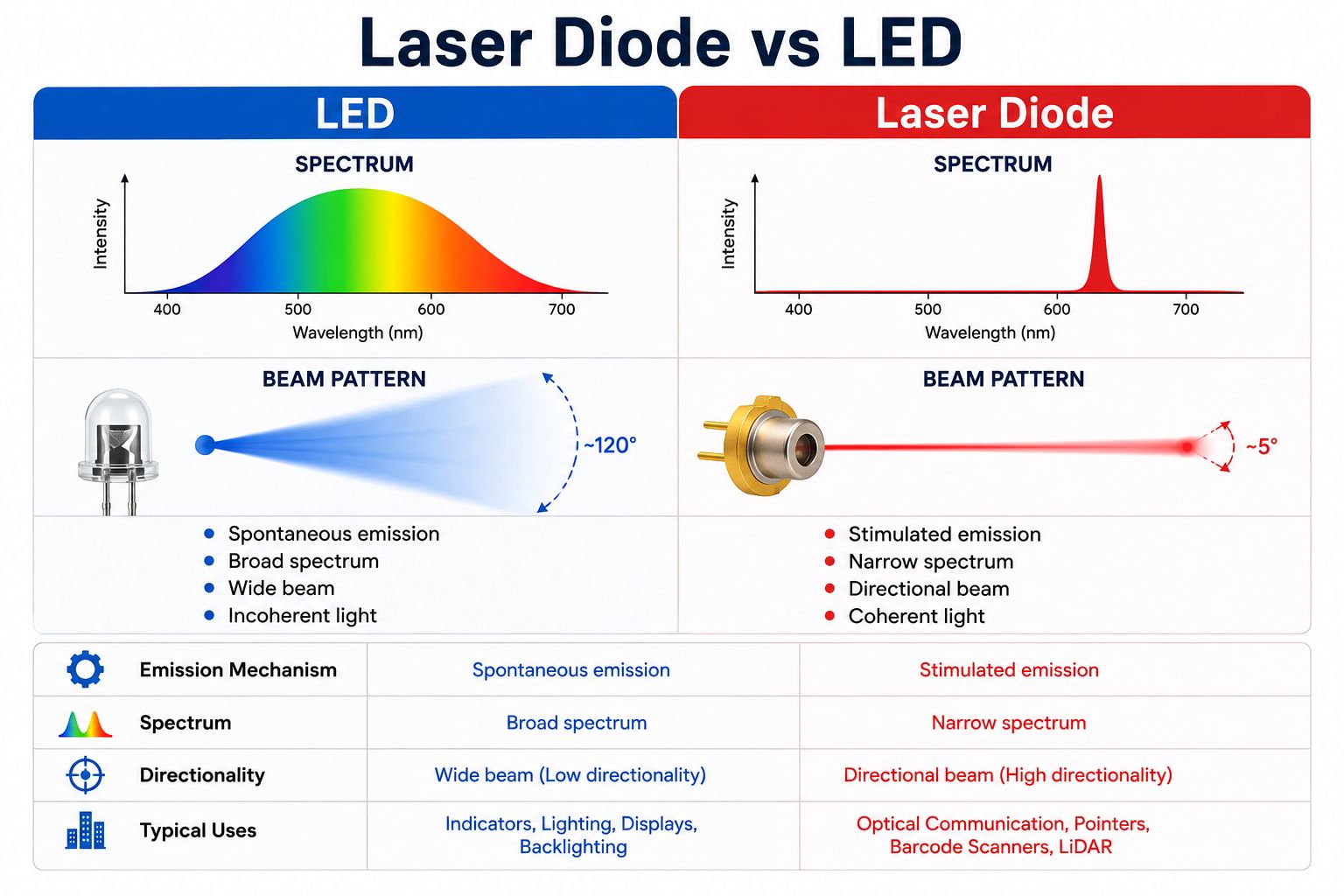
A laser diode and an LED are both semiconductor light sources, and both can use electron-hole recombination to generate photons. Their operating behavior is nevertheless very different.
| Characteristic | Laser Diode | LED |
|---|---|---|
| Main optical mechanism | Stimulated emission above threshold | Mainly spontaneous emission |
| Optical cavity | Yes, for laser feedback | No laser resonator |
| Threshold behavior | Has a lasing threshold | No laser threshold |
| Spectrum | Usually much narrower | Broad |
| Directionality | High compared with an LED | Wide emission |
| Coherence | High in the lasing mode | Low |
| Beam coupling | Well suited to focused optics and fiber coupling | Generally less efficient for tight coupling |
| Electrical drive | Requires controlled laser-diode current drive | Usually simpler |
| Typical applications | Telecom, sensing, measurement, LiDAR, spectroscopy | Indicators, lighting, displays, illumination |
A laser diode is therefore not simply a brighter LED.
The optical resonator and stimulated-emission process fundamentally change how the device produces light.
What Determines a Laser Diode’s Wavelength?
The emission wavelength starts with the semiconductor material system and band structure, but the final operating wavelength also depends on the complete device architecture.
Important influences include:
- Semiconductor material composition
- Bandgap energy
- Quantum-well design
- Waveguide and cavity structure
- Grating design in wavelength-selective lasers
- Chip temperature
- Injection current
Common compound-semiconductor material systems include GaAs-based, InP-based and GaN-based families, with different compositions supporting different spectral regions.
This is one reason a laser diode cannot simply be “adjusted” to any desired wavelength after fabrication. Temperature and current provide useful tuning over a limited range, while substantially different wavelength requirements may require another chip design or material composition.
Lumi’s current photonic portfolio includes laser chips and packaged laser diodes across multiple wavelength regions for communication, gas sensing and other OEM applications. Buyers can review the current laser diode products and discuss application-specific wavelength requirements with the engineering team.
Main Types of Semiconductor Laser Diodes
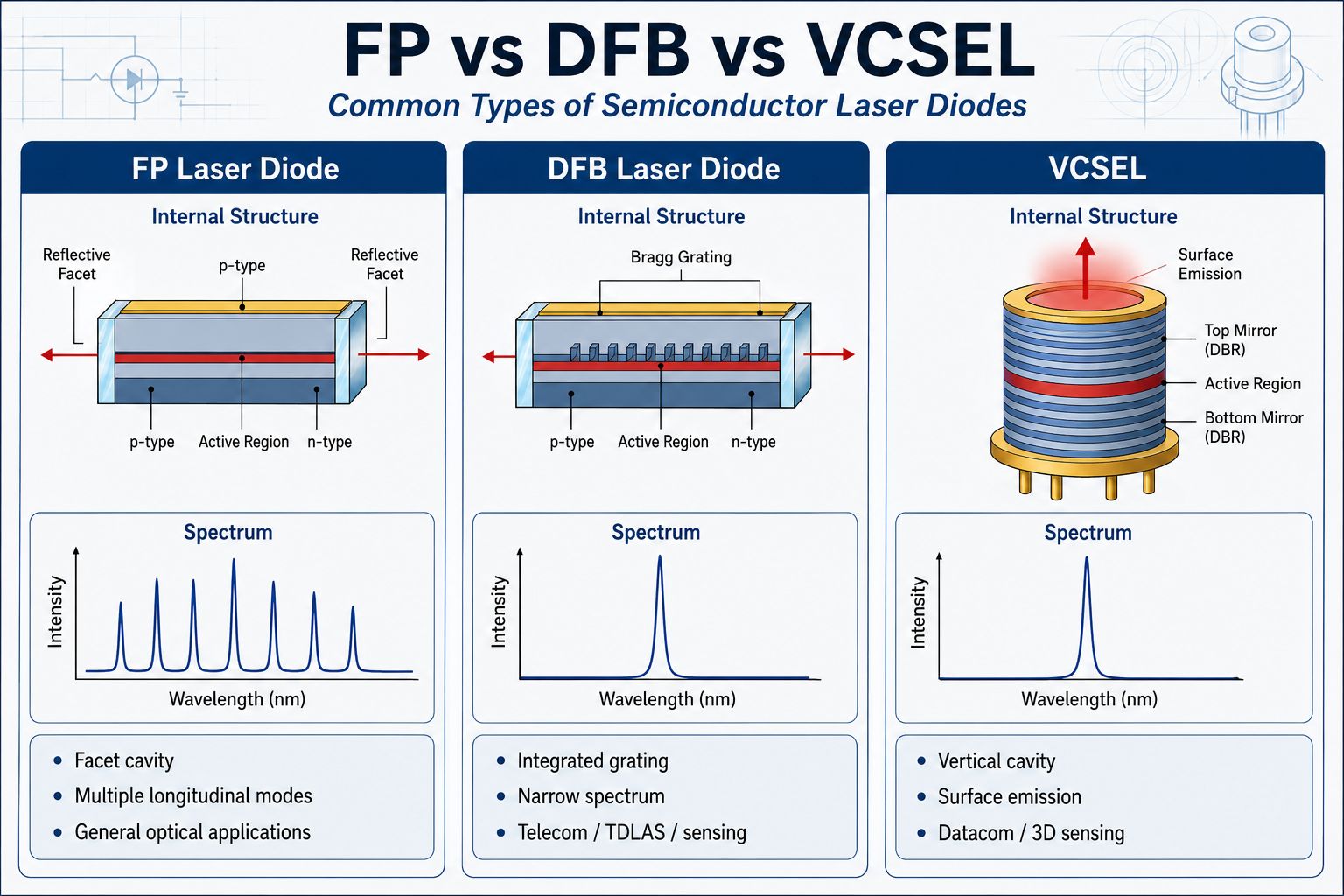
“Laser diode” describes a broad device family. The optical cavity can be designed in several ways.
Fabry–Pérot Laser Diode
A Fabry–Pérot (FP) laser diode typically uses the cleaved or coated facets at the two ends of the semiconductor chip to form the resonator.
Because several longitudinal cavity modes can satisfy the resonance condition, an FP laser may produce multiple spectral peaks.
Typical characteristics can include:
- Simple edge-emitting cavity structure
- Multiple longitudinal modes
- Wider optical spectrum than a single-mode DFB source
- Strong optical output for many general applications
- Relatively straightforward device architecture
FP devices can be appropriate when high spectral purity is not the primary design constraint.
For an example of Lumi’s current FP portfolio, see the 1625 nm single-mode high-power FP laser diode in a QCW TO package.
DFB Laser Diode
A distributed feedback (DFB) laser diode adds a periodic grating structure that provides wavelength-selective optical feedback along the laser cavity.
This distributed feedback strongly favors the intended resonant mode and is widely used when the application requires:
- Stable single-longitudinal-mode operation
- Narrow spectral output
- High side-mode suppression
- Controlled wavelength tuning
- Precision optical sensing
- Fiber-optic communication
- TDLAS spectroscopy
DFB describes the laser feedback architecture, not the external package.
A DFB chip may be integrated into a TO-can, butterfly package or a fiber-pigtailed assembly.
RP Photonics describes semiconductor DFB lasers as devices that can use an integrated grating structure to provide distributed feedback. See the RP Photonics Encyclopedia article on Distributed Feedback Lasers for additional technical detail.
Lumi supplies several DFB configurations, including a 1550 nm narrow-linewidth DFB laser diode in a TO package and a 1653.7 nm cooled DFB laser diode for methane gas sensing.
For engineers choosing between the two cavity architectures, see Lumi’s detailed DFB Laser Diode vs FP Laser Diode selection guide.
DBR Laser Diode
A distributed Bragg reflector (DBR) laser also uses wavelength-selective Bragg reflection, but the Bragg reflector is located outside the main gain region rather than providing distributed feedback throughout it.
DFB and DBR should therefore not be treated as interchangeable terms.
DBR lasers are useful in applications where narrow spectral operation and controlled wavelength behavior are required, but the exact device design differs from a DFB structure.
VCSEL
A vertical-cavity surface-emitting laser (VCSEL) emits light perpendicular to the surface of the semiconductor wafer rather than from a cleaved edge.
Typical VCSEL characteristics include:
- Very short vertical optical cavity
- Surface-normal emission
- Ability to fabricate dense arrays
- Low threshold current for many designs
- Circular or near-circular output geometry
- Strong use in datacom, proximity sensing and 3D sensing
VCSEL is a laser architecture, just as FP and DFB describe internal optical structures.
It should not be confused with TO-can, butterfly or fiber-coupled terminology, which describes how a laser device is packaged or optically interfaced.
Laser Architecture and Package Type Are Not the Same Thing
This distinction is important for anyone new to semiconductor lasers.
FP, DFB, DBR and VCSEL describe how the laser itself is designed to generate and control optical feedback.
TO-can, butterfly and fiber-coupled describe the physical package or optical interface used to integrate the laser into a system.
For example:
- A DFB laser chip can be packaged in a TO-can.
- A DFB laser chip can also be mounted in a 14-pin butterfly package with TEC and fiber output.
- An FP laser can be supplied in a TO package.
- A TO package does not automatically tell you whether the internal chip is FP or DFB.
Keeping these two classification levels separate makes product selection much easier.
From a Laser Chip to a Packaged Laser Diode
A bare semiconductor laser chip is only the starting point for many OEM products.
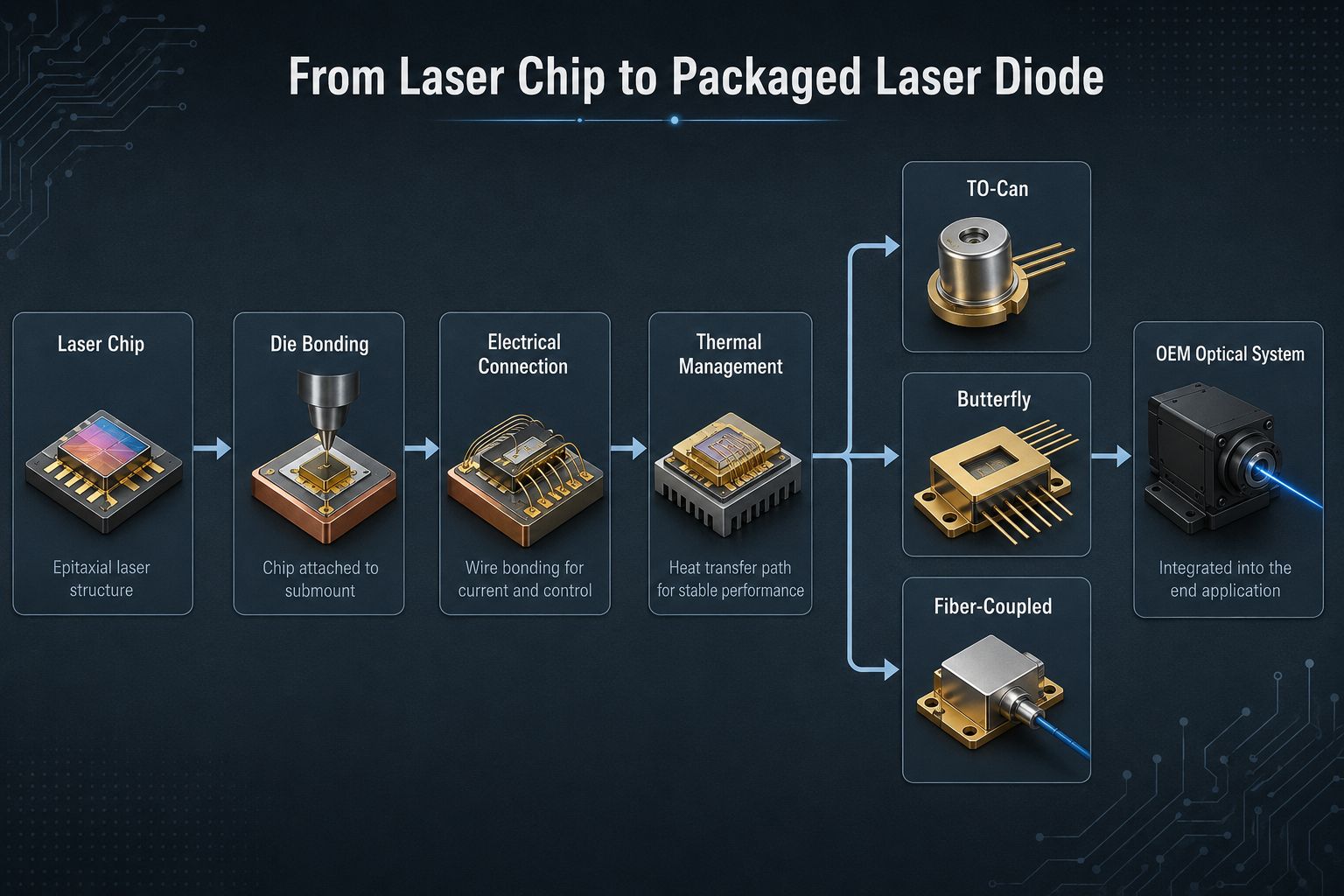
Laser Chip
The laser chip contains the semiconductor gain structure and cavity needed to generate laser light.
At this stage, the die usually still needs careful mounting, electrical connection, thermal management and optical integration.
Bare chips are particularly relevant to customers that want more control over:
- Package design
- Optical coupling
- Mechanical dimensions
- Thermal path
- Downstream module architecture
- High-volume OEM integration
This is the focus of Lumi’s Laser Chip OEM offering.
Die Bonding and Electrical Connection
The chip must be attached to an appropriate submount or package base.
The assembly process must provide:
- Accurate positioning
- Low-resistance electrical connection
- Stable mechanical attachment
- Controlled thermal resistance
- Protection of sensitive semiconductor surfaces
Wire bonding or other interconnection methods then connect the laser chip to external package pins or contacts.
Thermal Management
The laser junction generates heat during operation.
A good thermal path removes heat from the chip and limits junction-temperature rise. Depending on the performance requirements, the package may use:
- Passive heat spreading
- A metal submount
- Thermistor monitoring
- Integrated TEC cooling
- Controlled heating
Thermal design is not just about preventing failure. Temperature directly affects optical wavelength, threshold current, efficiency and spectral behavior.
Optical Alignment
Some packaged diodes require an optical window, lens or fiber to be aligned to the emitting region.
Fiber-coupled devices place particularly high demands on alignment because small positional changes can reduce coupling efficiency.
Final Package
After packaging, the laser becomes easier for an OEM to handle and integrate.
Common forms include:
- TO-can laser diode
- Butterfly laser diode
- Fiber-pigtailed laser diode
- Fiber-coupled optical assembly
For example, Lumi’s 1550 nm 10 mW DFB butterfly laser diode combines a DFB source with a butterfly package, TEC, thermistor, monitor photodiode and single-mode fiber output for fiber-optic and precision measurement applications.
Common Laser Diode Package Types
TO-Can Laser Diode
TO-can packages are compact metal packages widely used for semiconductor emitters and detectors.
Depending on the configuration, a TO-packaged laser diode may provide:
- Free-space optical output
- Window or lens
- Monitor photodiode
- Thermistor
- TEC
- Heater
- Fiber pigtail
TO packages are attractive when compact size, established mechanical interfaces and straightforward OEM integration are priorities.
Lumi currently supplies TO-packaged FP and DFB devices as part of its laser diode portfolio.
Butterfly Laser Diode
Butterfly packages provide more internal space for optical, electrical and thermal components.
A typical precision butterfly configuration may integrate:
- Laser chip
- TEC
- Thermistor
- Monitor photodiode
- Fiber pigtail
- Optical isolator in some designs
- Multiple electrical pins for independent control
Butterfly packaging is common in communication, spectroscopy and precision sensing systems where stable fiber output and controlled chip temperature are important.
Lumi also offers a 1273–1653 nm DFB pigtailed butterfly laser diode for gas detection.
Fiber-Coupled and Fiber-Pigtailed Laser Diodes
A fiber-coupled laser delivers its optical output directly into an optical fiber.
This can simplify system integration because the OEM does not need to repeatedly align a free-space beam to the next optical component.
The specification should still define:
- Single-mode, polarization-maintaining or multimode fiber
- Fiber length
- Connector type
- Coupling efficiency
- Polarization requirements
- Back-reflection management
- Output power measured at the fiber end
One example is Lumi’s 1290–1653 nm cooled TO-CAN laser diode with fiber pigtail, which combines a compact package with fiber delivery and temperature-control components.
Important Laser Diode Parameters
A laser diode datasheet contains many parameters, but the following are especially useful for understanding device behavior.
Wavelength
The wavelength indicates the spectral region in which the laser operates.
For some applications, a nominal wavelength is sufficient. For spectroscopy, TDLAS and wavelength-sensitive communication systems, the center wavelength, tolerance and tuning behavior can be critical.
Output Power
Optical output power describes how much laser power the device delivers under specified operating conditions.
Always check where the power is measured:
- Directly from the chip
- At the package window
- After a collimating optic
- At the fiber output
These values are not interchangeable.
Threshold Current
Threshold current is the approximate current at which optical gain becomes sufficient for laser oscillation.
Below threshold, the device can still emit spontaneous light, but it does not operate as a normal laser oscillator.
Operating Current and Voltage
These values help define the laser-driver and electrical design.
Laser diodes should normally be operated with a properly controlled current source rather than a simple uncontrolled voltage supply.
Slope Efficiency
Slope efficiency describes how rapidly optical output power increases as drive current rises above threshold.
It is commonly expressed as optical power change per unit of current.
Spectral Linewidth
Linewidth describes the spectral width of the emitted laser light.
The relevant definition and measurement method depend on the laser architecture and application. A multimode FP laser and a single-frequency DFB laser can have very different spectral behavior.
SMSR
Side-mode suppression ratio (SMSR) indicates how strongly the dominant longitudinal mode exceeds unwanted side modes.
SMSR is particularly relevant to DFB and other wavelength-selective lasers used in communication and sensing.
Beam Divergence
A bare edge-emitting laser typically has different divergence angles along its fast and slow axes.
Collimating optics or fiber coupling may be required when a particular beam geometry is needed.
Temperature Tuning
Changing the chip temperature changes semiconductor properties and optical-cavity conditions, so the emission wavelength shifts.
Temperature tuning can therefore be used intentionally in applications such as spectroscopy, but it also creates a stability challenge if thermal conditions are uncontrolled.
Why Temperature Matters in a Laser Diode
Temperature influences almost every important aspect of semiconductor laser performance.
As junction temperature changes, engineers can see changes in:
- Center wavelength
- Threshold current
- Optical efficiency
- Output power at a given current
- Spectral behavior
- Reliability and operating lifetime
For general illumination, small wavelength shifts may not matter. For a TDLAS gas analyzer, a small spectral shift can move the laser relative to the molecular absorption feature being measured.
This is why many precision DFB packages include a TEC and thermistor.
The thermistor measures package or chip-related temperature, while the TEC allows the control system to move heat into or out of the package to maintain a setpoint.
Other designs use controlled heating rather than active cooling when the target operating wavelength and ambient conditions make that approach practical.
For a deeper OEM example, Lumi’s guide on cooled vs heated DFB laser diodes for methane gas sensors explains how the thermal strategy affects a TDLAS instrument.
Where Are Laser Diodes Used?
Laser diodes have become fundamental components in modern optical systems because semiconductor manufacturing allows compact electrically driven sources to be integrated directly into equipment.
Optical Communication
Laser diodes are widely used in fiber-optic communication because they can combine:
- High-speed modulation
- Fiber coupling
- Wavelength control
- Compact size
- Stable output
1310 nm and 1550 nm are widely used wavelength regions in fiber-optic systems, while the exact source architecture depends on transmission distance, modulation method and network design.
TDLAS Gas Sensing
Tunable diode laser absorption spectroscopy (TDLAS) uses a narrow-linewidth laser that is scanned across a selected molecular absorption feature.
The system measures how much laser light is absorbed and uses that information to determine gas concentration.
Laser requirements can include:
- Correct center wavelength
- Narrow spectral output
- Stable single-mode operation
- Predictable current tuning
- Predictable temperature tuning
- Sufficient optical power
- Low noise
For selecting molecular absorption features, engineers commonly use spectroscopic data from resources such as HITRANonline.
For methane-related development, Lumi offers the 1653.7 nm cooled DFB laser diode and other DFB package options intended for sensing integration.
LiDAR and Ranging
Laser diodes can be used as optical transmitters in ranging systems.
Depending on the architecture, LiDAR may require high peak power, fast pulses, precise wavelength control, low timing jitter or array-compatible emitters.
The optimum semiconductor laser architecture varies considerably between short-range 3D sensing, automotive ranging and scientific measurement.
Spectroscopy and Precision Measurement
Narrow-linewidth and wavelength-stable laser diodes are used in:
- Absorption spectroscopy
- Interferometric measurement
- Optical metrology
- Fiber sensing
- Laboratory instrumentation
In these applications, spectral purity and thermal stability can matter more than maximum optical output power.
Medical and Life-Science Systems
Semiconductor laser sources are used in medical aesthetics, diagnostic instruments, analytical equipment and other life-science systems.
Selection can depend on:
- Target wavelength
- Tissue or molecular absorption
- Output power
- Delivery fiber
- Duty cycle
- Thermal management
- Finished-equipment safety requirements
The laser diode is only one component in the finished system, and system-level laser safety and regulatory compliance must be evaluated separately.
Industrial Photonics
Industrial laser diodes can be used in sensing, alignment, pumping, optical inspection and integrated laser systems.
High-power applications place strong emphasis on heat removal, electrical efficiency, mounting, duty cycle and long-term reliability.
Lumi’s broader application directions include optical communication, LiDAR, gas sensing, automotive, precision measurement, medical aesthetics and industrial photonics.
Advantages and Limitations of Semiconductor Laser Diodes
Advantages
Laser diodes offer several important engineering benefits:
- Compact semiconductor construction
- Direct electrical pumping
- High electrical-to-optical efficiency for many designs
- High optical intensity from a small emitting region
- Fast modulation capability
- Wide wavelength availability across different material systems
- Compatibility with optical fibers
- Scalable semiconductor manufacturing
- Ability to integrate into compact OEM products
Limitations
They also require careful engineering:
- Sensitive to excessive current and electrical transients
- Sensitive to ESD during handling
- Performance changes with temperature
- Often require controlled current drivers
- Edge-emitting beams can be highly divergent and asymmetric
- High-precision applications may require TEC control
- Back-reflections can disturb some narrow-linewidth lasers
- Packaging and heat sinking can significantly affect usable performance
- Laser safety requirements apply at the final equipment level
The correct source is therefore not simply the diode with the highest output power. It is the device whose optical, electrical, thermal and package characteristics fit the application.
How Do You Choose the Right Laser Diode?
For an OEM project, start with the application and work backward toward the component.
A useful sequence is:
- Define the application. Communication, gas sensing, spectroscopy, LiDAR and industrial pumping need very different sources.
- Choose the wavelength. Determine the wavelength region and required tolerance.
- Define optical power. Include where the power must be measured.
- Specify spectral performance. Decide whether FP performance is sufficient or a DFB/other narrow-linewidth architecture is required.
- Define tuning requirements. Include current and temperature tuning if wavelength scanning is required.
- Choose the package. Consider TO-can, butterfly, fiber-pigtailed or custom integration.
- Define thermal control. Passive cooling, heater or TEC may be required.
- Specify the optical interface. Free-space, SM fiber, PM fiber or MM fiber.
- Define the operating environment. Temperature, vibration, duty cycle and lifetime influence component selection.
- Plan sample and production requirements. OEM projects should consider test data, MOQ, lead time and batch consistency.
For a purchasing-focused framework, read Lumi’s Laser Diode Manufacturer: OEM & Custom Selection Guide.
Frequently Asked Questions
Is a laser diode the same as a semiconductor laser?
In most practical contexts, yes. A laser diode is a semiconductor laser in which electrical current injects carriers into the semiconductor gain region. The broader term “semiconductor laser” can also include semiconductor lasers that are optically pumped rather than electrically injected.
How does a laser diode generate light?
Forward current injects electrons and holes into an active semiconductor region. Their recombination can generate photons. Once sufficient optical gain is reached, stimulated emission and optical feedback in the resonator amplify a supported laser mode until coherent laser output emerges from the device.
What is the active region of a laser diode?
The active region is the semiconductor region where carriers are confined and optical gain is produced. Electron-hole recombination and stimulated emission occur in or around this region.
Why does a laser diode need an optical cavity?
The optical cavity feeds light back through the gain region so that it can be amplified repeatedly. The cavity also determines which optical modes can oscillate. When gain exceeds total loss for a supported mode, laser oscillation begins.
What is threshold current in a laser diode?
Threshold current is the approximate drive current at which optical gain becomes sufficient to sustain laser oscillation. Below threshold, spontaneous emission still occurs, but normal laser action has not yet been established.
What is the difference between a laser diode and an LED?
Both are semiconductor emitters, but an LED mainly relies on spontaneous emission. A laser diode adds optical feedback and operates above a lasing threshold so stimulated emission becomes dominant in the selected laser mode. This gives laser light much greater directionality, coherence and spectral concentration.
What is the difference between FP and DFB laser diodes?
An FP laser diode usually forms its cavity with reflective chip facets and can support several longitudinal modes. A DFB laser integrates a periodic grating that provides wavelength-selective feedback and is commonly used when stable single-mode or narrow-linewidth output is required.
Is DFB a laser diode package type?
No. DFB describes the internal feedback architecture of the laser. TO-can and butterfly describe package formats. A DFB laser chip can be integrated into either a TO package or a butterfly package.
What is the difference between a laser chip and a laser diode?
In OEM sourcing, “laser chip” usually means the bare semiconductor die before final packaging. A packaged laser diode adds mounting, electrical connections, thermal management and often optical components that make the semiconductor source easier to integrate into equipment. Technically, however, the term laser diode may also be used broadly for the semiconductor laser device itself.
From Understanding Laser Diodes to Selecting the Right Device
The basic operating principle of a laser diode is straightforward:
Electrical carrier injection → photon generation → stimulated emission → optical amplification → laser output.
The engineering challenge begins after that principle is understood.
Wavelength, cavity architecture, linewidth, output power, thermal behavior, package and optical interface all determine whether a laser diode will work reliably in the final system.
Lumi focuses on upstream laser chips and packaged laser diode solutions for B2B and OEM projects. Current product directions include bare laser chips, FP and DFB laser diodes, TO packages, butterfly packages and fiber-coupled configurations for communication, sensing and other photonic applications.
Explore the Lumi laser diode portfolio, review laser chip OEM options, or contact Lumi with your target wavelength, optical power, package, fiber requirement and application for project evaluation.
