
C-Band AWGR Wavelength Routers
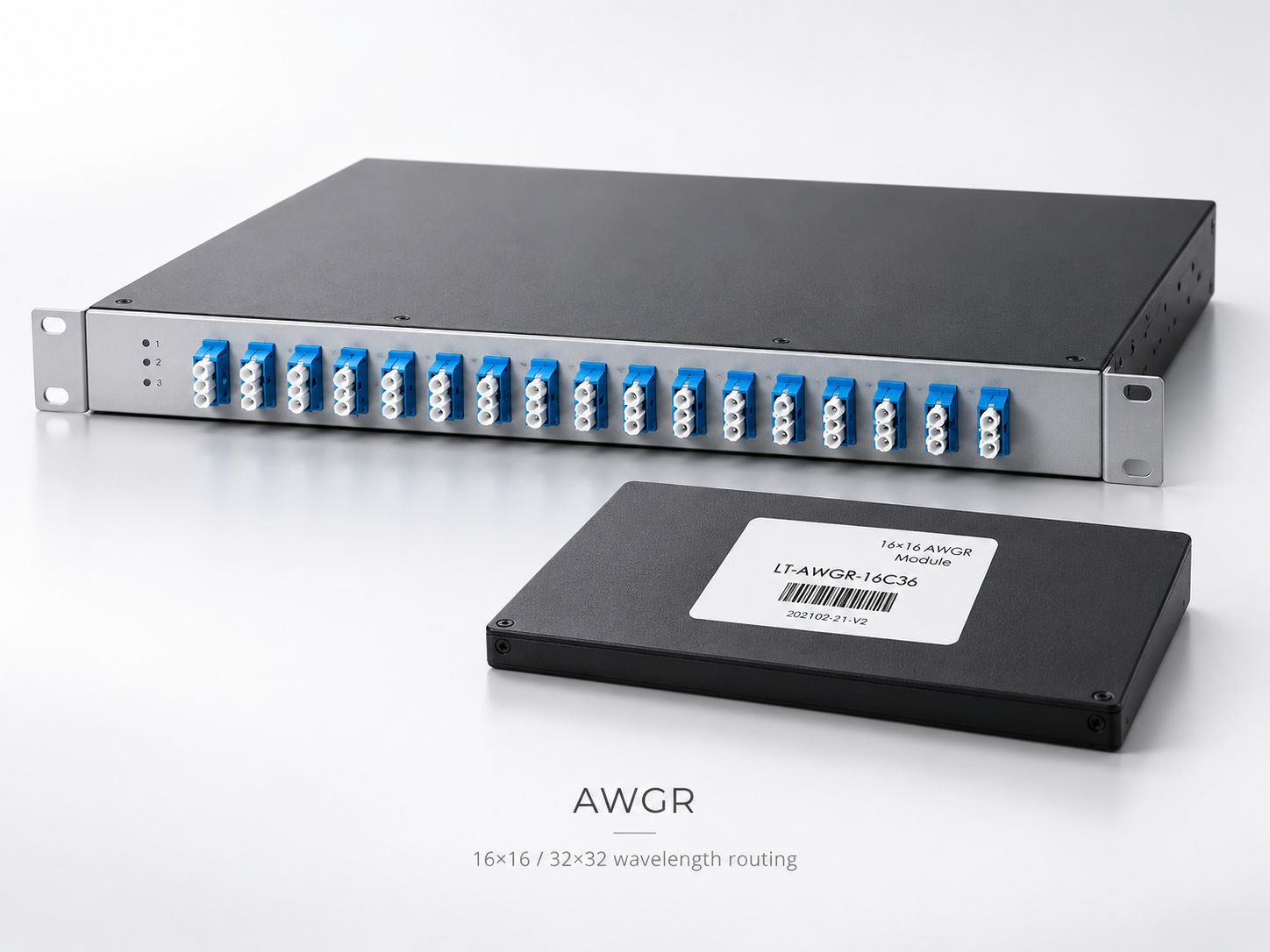
Lumi supplies 16×16 and 32×32 Arrayed Waveguide Grating Routers for C-band, 100 GHz cyclic wavelength routing. Choose compact modules for embedded OEM designs or equipment-level assemblies for system and laboratory deployment.
Our AWGR portfolio supports optical network designs that route signals based on the combination of wavelength and input port. This page connects the routing principle, current product formats and practical selection requirements.
What Is an AWGR?
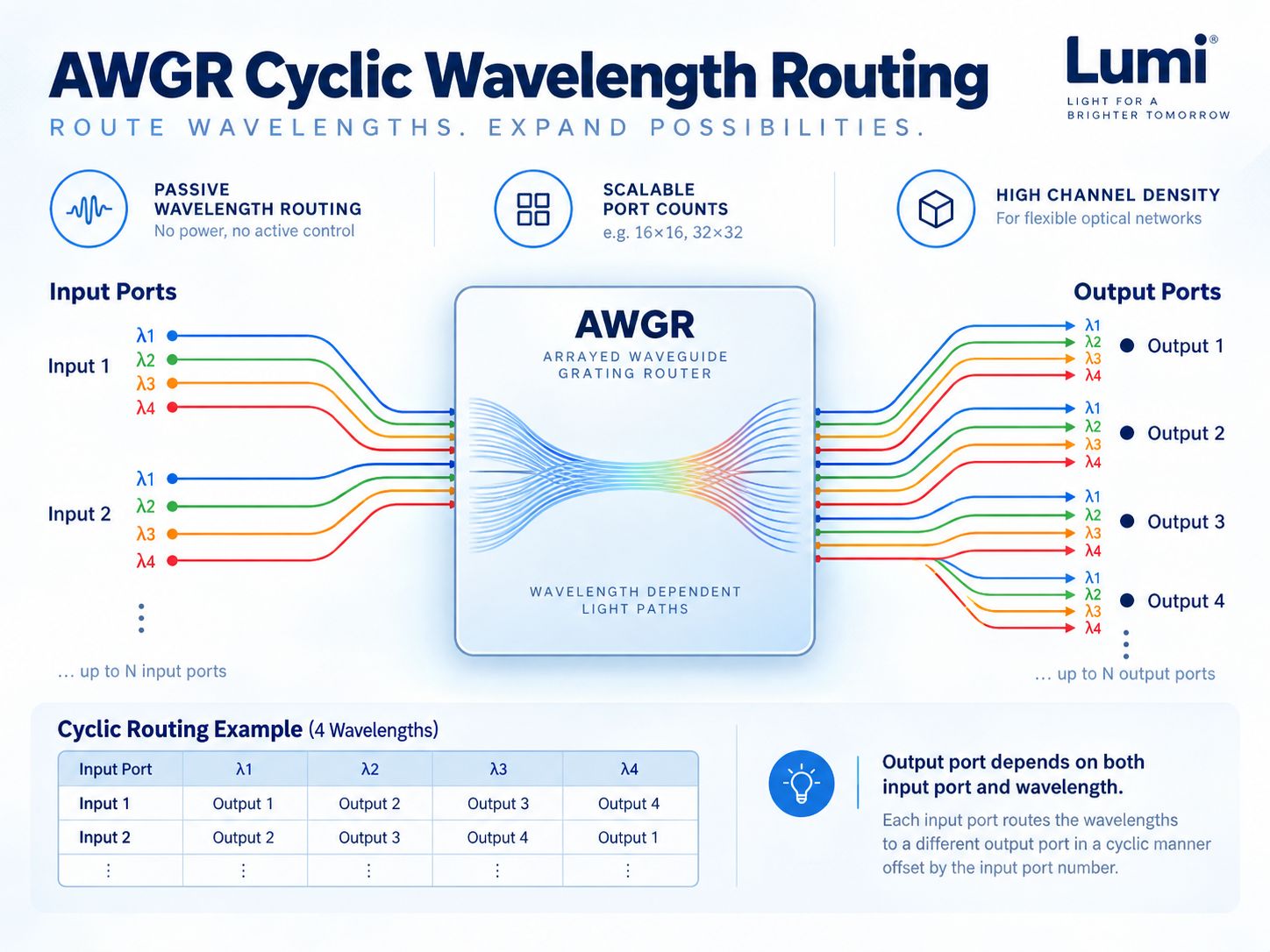
AWGR means Arrayed Waveguide Grating Router. This multi-input, multi-output optical device uses wavelength-dependent phase relationships in arrayed waveguides to direct each input wavelength toward a defined output port.
Routing is deterministic: the same wavelength may reach a different output when it enters through a different input port. Unlike a packet switch, an AWGR does not read Ethernet frames or decide traffic paths electronically.
- Passive optical routing mechanism
- Multi-port wavelength-dependent connections
- Cyclic wavelength-to-output mapping
- Suitable as a routing component in larger photonic systems
Engineering distinction: “passive routing” describes the wavelength-routing mechanism. Some packaged AWGR products may also include thermal-stabilization electronics such as a TEC.
Browse the Current AWGR Portfolio
Four current product formats cover two optical-port densities and two integration styles. Product availability, exact optical performance and connector options should be checked against the relevant product specification.
AWGR Modules
Compact 150 × 64 × 16 mm format for integration into an OEM optical subsystem or customer-designed chassis.
AWGR Equipment
484 × 250 × 45 mm enclosed units suited to system deployment, rack-oriented layouts and laboratory access to multiple ports.

16×16 vs 32×32 AWGR: Technical Comparison
Choosing more ports increases connectivity, but the optical insertion-loss allowance must remain compatible with the link budget. The following specifications describe Lumi's current C-band 100 GHz configurations.
| Parameter | 16×16 AWGR | 32×32 AWGR |
|---|---|---|
| I/O Ports | 16 input / 16 output | 32 input / 32 output |
| Channel Spacing | 100 GHz | 100 GHz |
| Operating Band | C-band | C-band |
| Insertion Loss | 2–6 dB | 3–7 dB |
| Adjacent Isolation | ≥25 dB | ≥25 dB |
| Non-adjacent Isolation | ≥30 dB | ≥30 dB |
| Return Loss | ≥25 dB | ≥25 dB |
| PDL | ≤0.5 dB | ≤0.5 dB |
| PMD | ≤0.15 ps | ≤0.15 ps |
| Module Dimensions | 150 × 64 × 16 mm | 150 × 64 × 16 mm |
| Equipment Dimensions | 484 × 250 × 45 mm | 484 × 250 × 45 mm |
Use the optical budget and wavelength plan—not matrix size alone—to choose 16×16 or 32×32. The specified 32×32 insertion-loss range is 1 dB higher at both ends.
Module or Equipment: Two Integration Options
Compact AWGR Module
Suitable when the customer designs the external enclosure, fiber routing, thermal management and supporting system. Both module configurations use the published 150 × 64 × 16 mm outline.
Enclosed AWGR Equipment
Designed for easier access to numerous optical ports at the equipment level, with a published outline of 484 × 250 × 45 mm.
AWG vs AWGR: What Is the Difference?
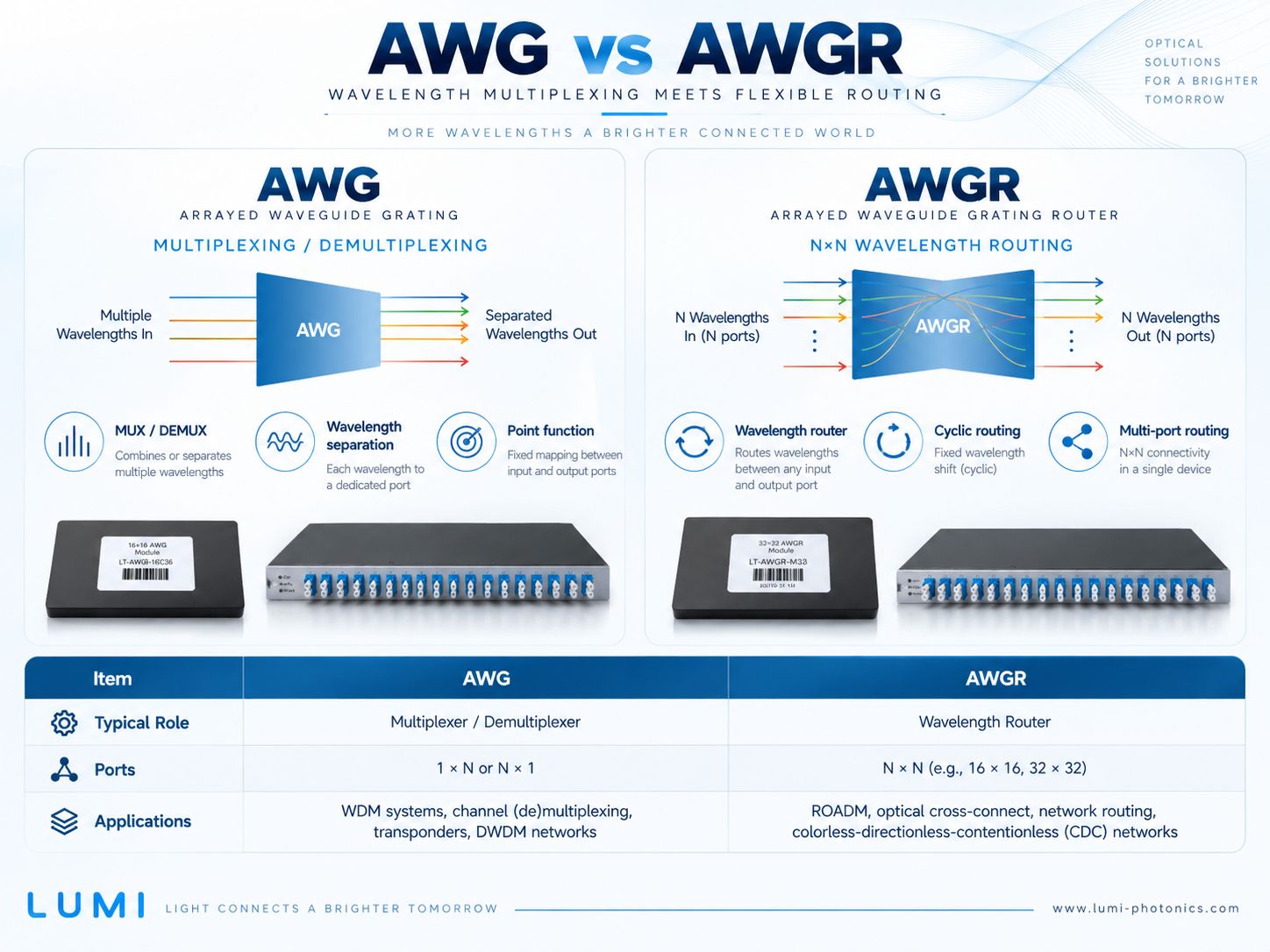
An AWG commonly serves as a wavelength multiplexer or demultiplexer, combining or separating channels. An AWGR provides a multi-input / multi-output wavelength-routing matrix where output mapping depends on both the wavelength and input port.
| Selection point | AWG | AWGR |
|---|---|---|
| Typical Function | Multiplex / Demultiplex | Multi-port Wavelength Routing |
| Typical Port Form | 1×N / N×1 | N×N |
| Optical Relationship | Wavelength-to-channel separation | Wavelength + input-to-output mapping |
| Common Use | DWDM MUX/DEMUX | Optical routing fabrics |
Engineering Specifications That Matter
Optical Loss Budget
Include AWGR insertion loss together with connectors, fibers, splitters and other optical components.
Wavelength Plan
Verify the ITU grid, channel spacing, wavelength accuracy and transmitter control range.
Channel Isolation
Evaluate adjacent and non-adjacent channel isolation against receiver sensitivity and crosstalk.
Thermal & Polarization
Confirm temperature operating range, TEC integration, PDL, PMD and return loss.
AWGR performance must be evaluated at the system level. Wavelength alignment, connector reflection and fiber management can affect results outside the AWGR specification itself.
Applications for Multi-Port Wavelength Routing
AWGR devices serve as optical building blocks in wavelength-managed systems. Their system role depends on transmitter, receiver and network control architecture.
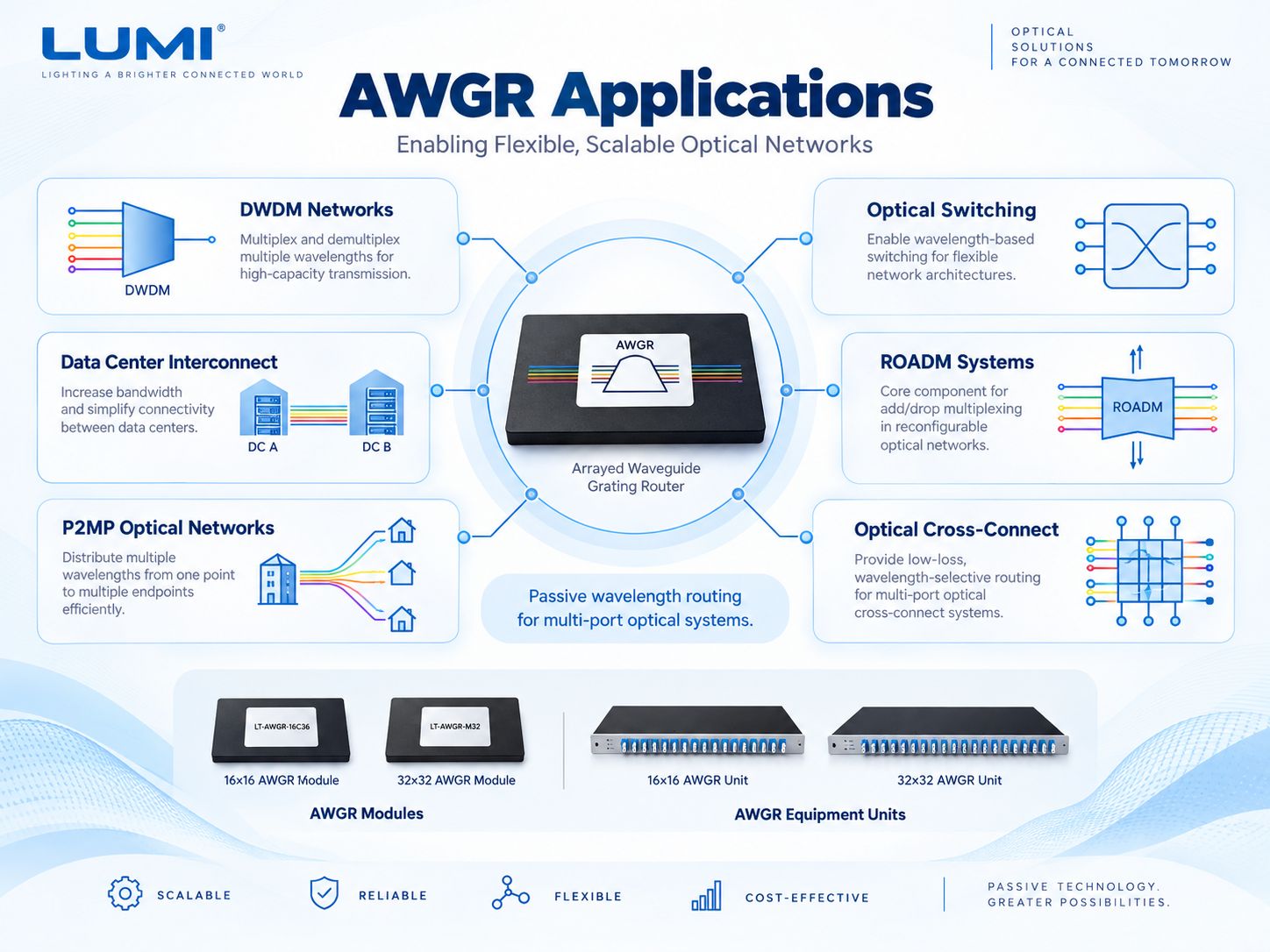
DWDM Routing
Map wavelength channels between multiple optical directions.
Optical Switching Architectures
Combine passive AWGR routing with tunable transmitters or wavelength control.
ROADM / Wavelength Management
Use AWGR as part of a larger optical routing and wavelength-management subsystem.
Optical Test Platforms
Enable repeatable access to wavelength-dependent paths in research and characterization.
Data Center Interconnect
Explore optical fabrics using wavelength-selected paths between optical endpoints.
Optical Cross-Connect
Use cyclic multiport routing for photonic network-connectivity studies.
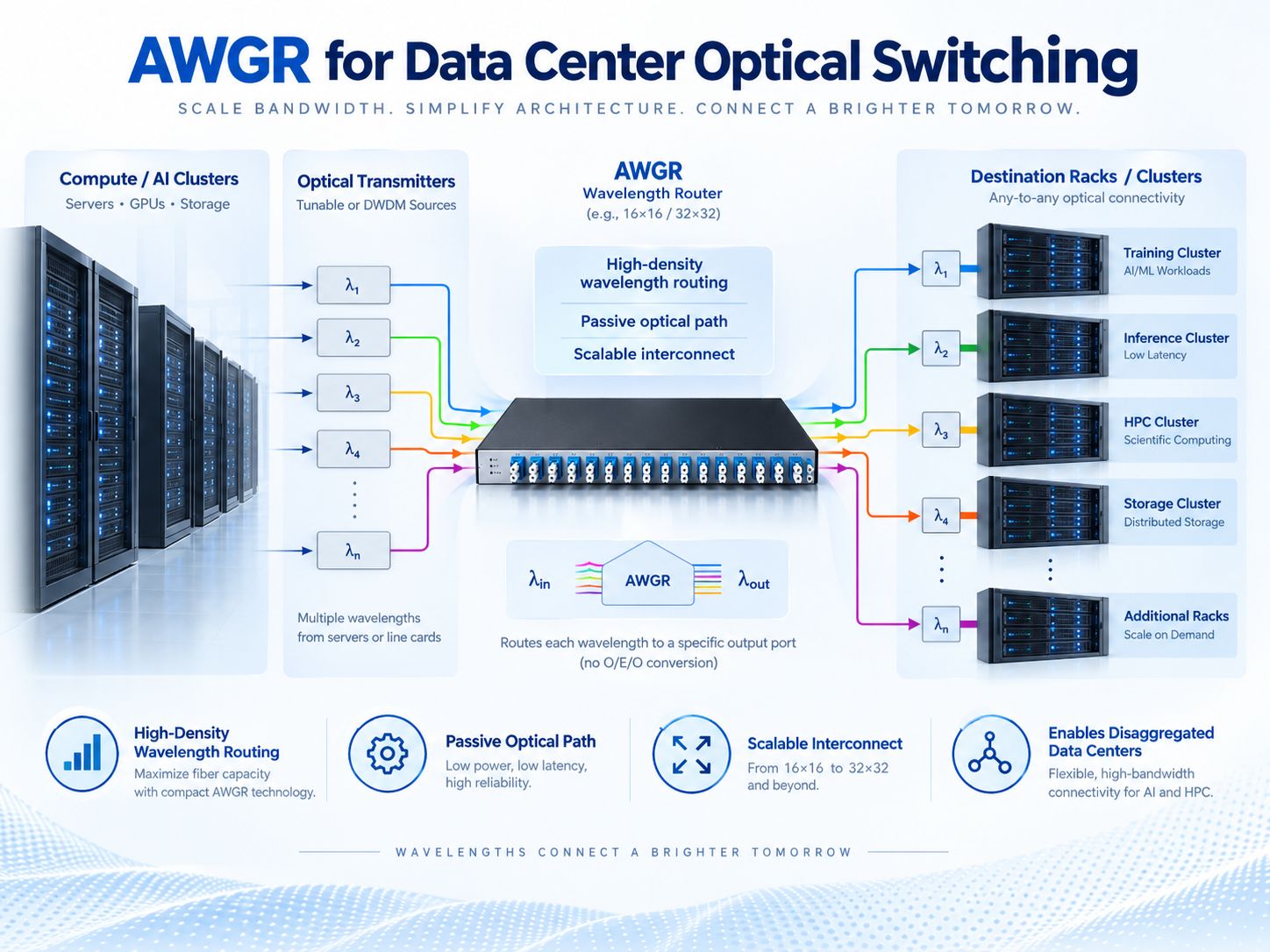
AWGR in Data-Center Optical Fabrics
A wavelength-routed optical fabric can use an AWGR between groups of optical transmitters and receivers. An external wavelength selection or control function determines which optical path is used, while the AWGR supplies passive mapping between ports.
The AWGR is not a complete replacement for an Ethernet switch. Traffic buffering, protocol handling, network orchestration, and transceiver functionality remain in the surrounding system.
Review link budget, channel plan and control-plane architecture before choosing an AWGR for high-density interconnect research or an OEM platform.
How to Specify an AWGR for an OEM Project
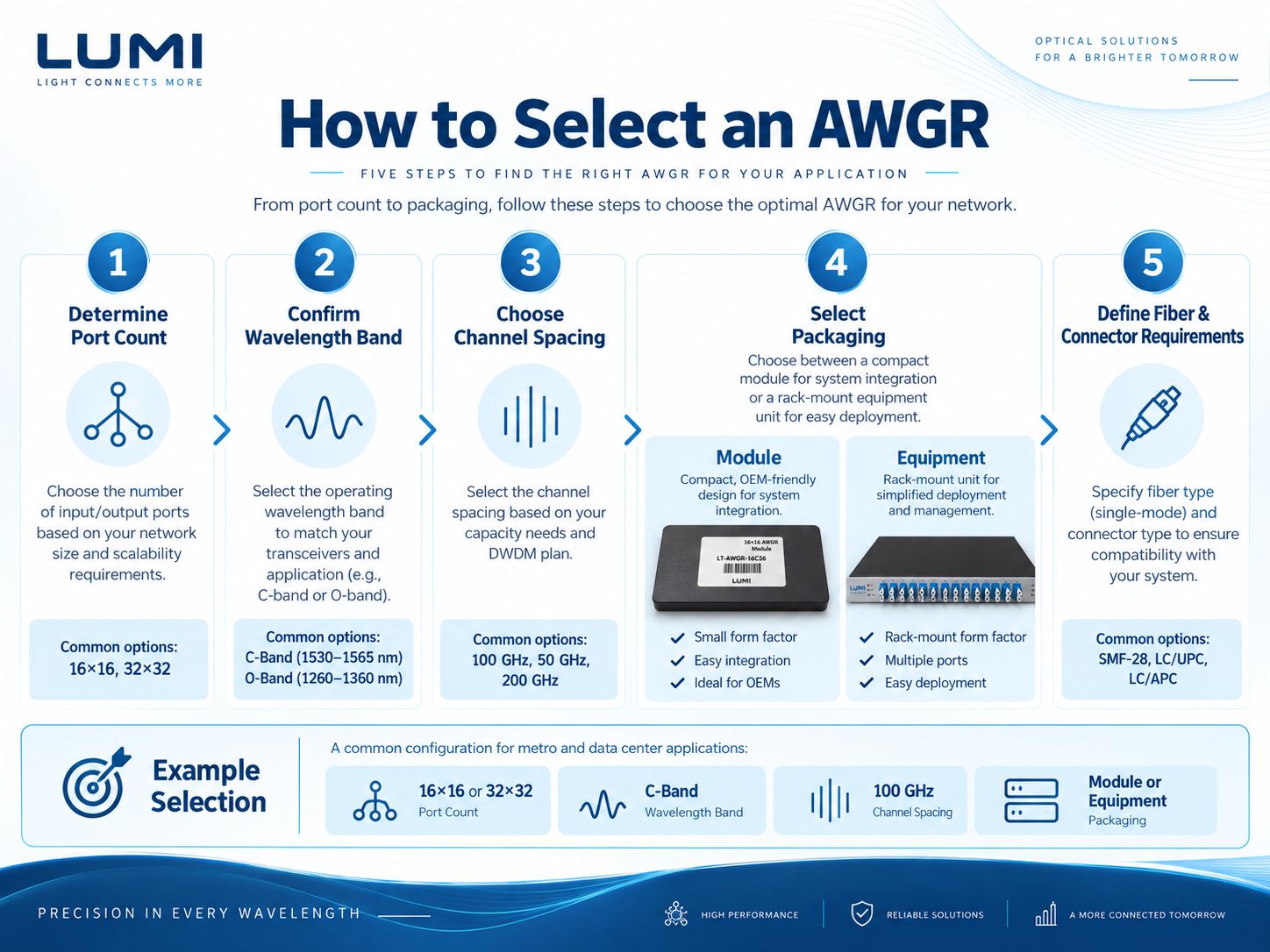
Provide these project details when requesting a configuration. The exact route map and fiber interface must be confirmed before ordering.
- Matrix Size16×16 or 32×32 I/O configuration.
- Wavelength GridOperating band, starting ITU channel and 100 GHz compatibility.
- Loss & IsolationAcceptable insertion loss, return loss, PDL and crosstalk.
- Mechanical InterfaceModule or equipment, connector family, polish and fiber length.
Frequently Asked AWGR Questions
What does AWGR stand for?
Arrayed Waveguide Grating Router. It routes optical wavelengths between multiple input and output ports.
How does cyclic wavelength routing work?
Output mapping changes with both optical wavelength and the physical input port according to the device routing design.
What is the difference between 16×16 and 32×32?
They provide different port densities; the 32×32 version also has a higher specified insertion-loss range.
Is AWGR an active network switch?
No. Its wavelength-routing mechanism is passive. Any packet-level or network-control behavior must be implemented elsewhere in the optical system.
Does “passive” mean no electrical interface?
Not necessarily. Some packaged units list a TEC for temperature stabilization, while routing itself is optical.
Should I buy a module or equipment?
Choose a module for compact OEM integration or equipment format when a larger enclosure and easier multiport access suit the project.
Discuss Your Wavelength-Routing Project
Tell us the target optical architecture, 16×16 or 32×32 routing requirement, channel plan and preferred mechanical form. We can review the available configuration and quotation requirements.
For detailed configurations, include channel allocation, starting ITU channel, connector and fiber routing requirements.