
TO-Can Laser Diodes for Optical Sensing, Fiber Testing & OEM Integration
Lumi supplies compact TO-can laser diode solutions spanning DFB and Fabry–Perot architectures, with selected VCSEL configurations. Choose among CW and QCW laser sources, uncooled, heater-controlled or TEC-stabilized designs, and free-space or fiber-pigtailed outputs.
Our portfolio includes near-infrared 808/940nm emitters, 1310–1625nm FP sources, 1550nm narrow-linewidth DFB lasers and methane-sensing DFB options near 1650.9/1653.7nm. Every TO configuration should be selected against its own optical, thermal and mechanical specifications.
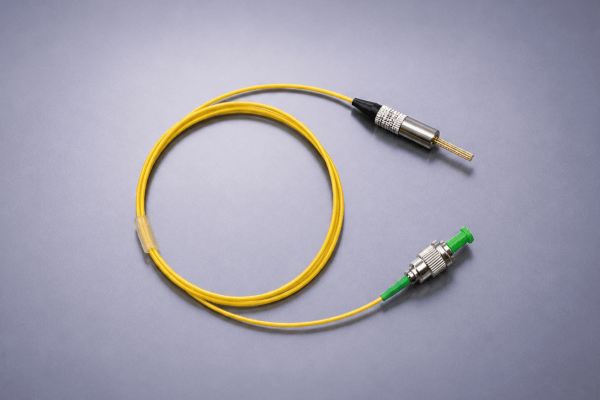
What Is a TO-Can Laser Diode?
A TO-can laser diode contains a semiconductor laser die within a metal Transistor Outline-style package. The package supplies mechanical protection, electrical leads and a defined thermal path. Depending on the model, it may also contain a window, lens, monitor photodiode, thermistor, heater, thermoelectric cooler (TEC) or fiber pigtail.
TO-can describes the package—not the laser architecture. DFB, FP and VCSEL identify different resonator and emission designs. Fiber coupling describes how the optical output is delivered. These choices can be combined within one product.
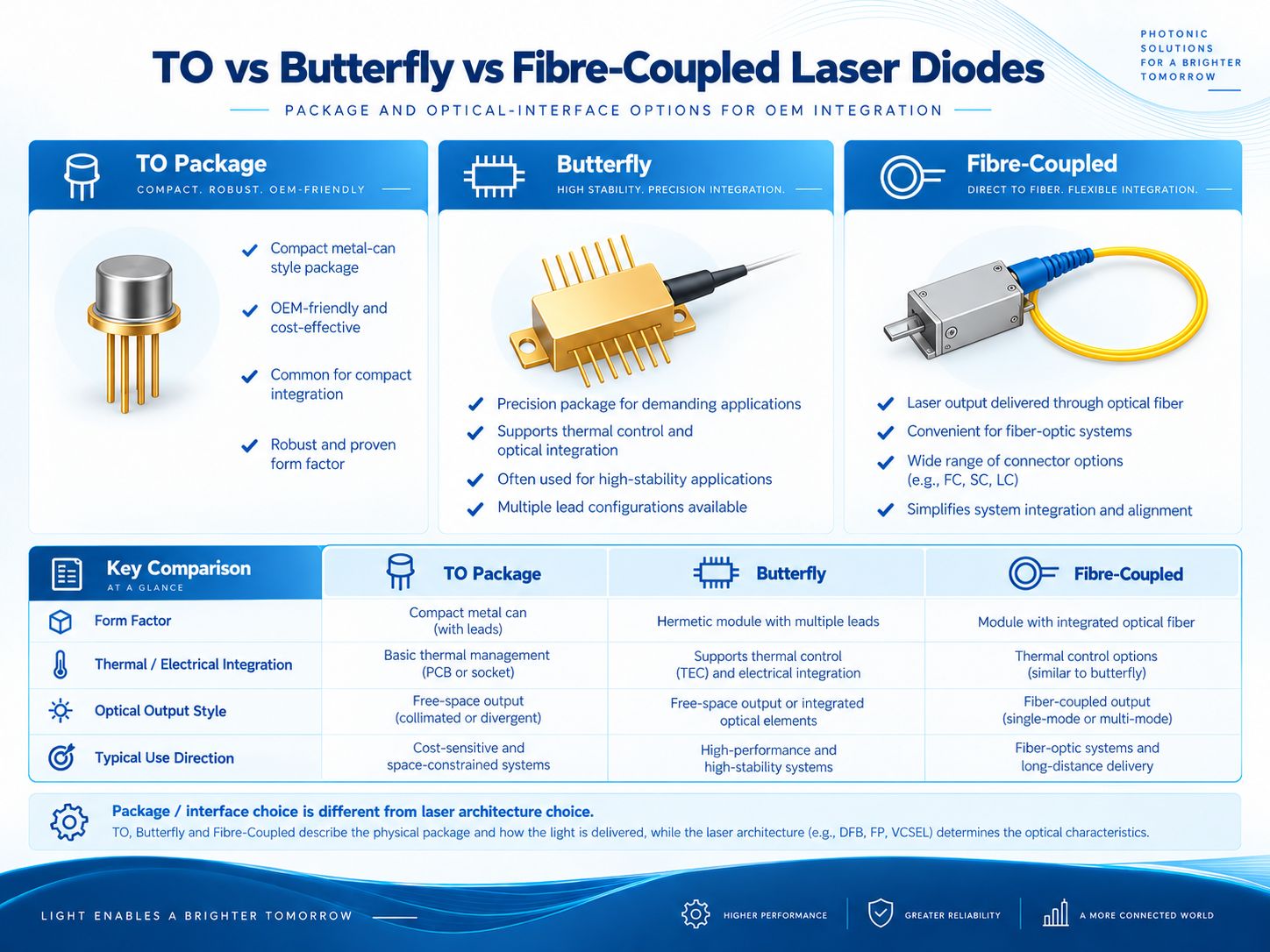
Laser Architectures Available in TO Packages
One package family can support substantially different optical functions. The correct choice depends on required spectral behavior, output power, emission geometry and control electronics.
DFB + TO-Can
Distributed-feedback lasers provide wavelength-selective emission for TDLAS, precision sensing, communication and narrow-linewidth measurement. Heater or TEC integration can support wavelength control.
Explore DFB Laser Diodes →FP + TO-Can
Fabry–Perot lasers cover practical CW and QCW applications. When comparing QCW models, keep peak optical power, pulse width and duty cycle separate from continuous-wave output.
Explore FP Laser Diodes →VCSEL + TO-Can
Selected VCSEL devices use TO housings where stable mounting, a discrete optical interface or additional temperature control is required—for example, 795nm precision photonics.
Explore VCSEL Laser Diodes →Explore Lumi TO Package Laser Diodes
Browse our current TO Package Laser Diode catalogue. Product photos, titles and specifications are taken from their individual WooCommerce listings and update as new models are added.

FP TO-Can Lasers: 808nm to 1625nm
Lumi's FP TO portfolio includes compact 808nm and 940nm 50mW continuous-wave emitters, alongside high-peak-power QCW options around 1310nm, 1550nm and 1625nm. These support OEM optical instruments, fiber testing, ranging and related systems when matched to the required duty cycle and thermal design.
Important: a 515mW QCW peak-output specification measured under short pulses does not mean 515mW continuous-wave operation. Compare peak power only at the specified pulse width, duty cycle and temperature.
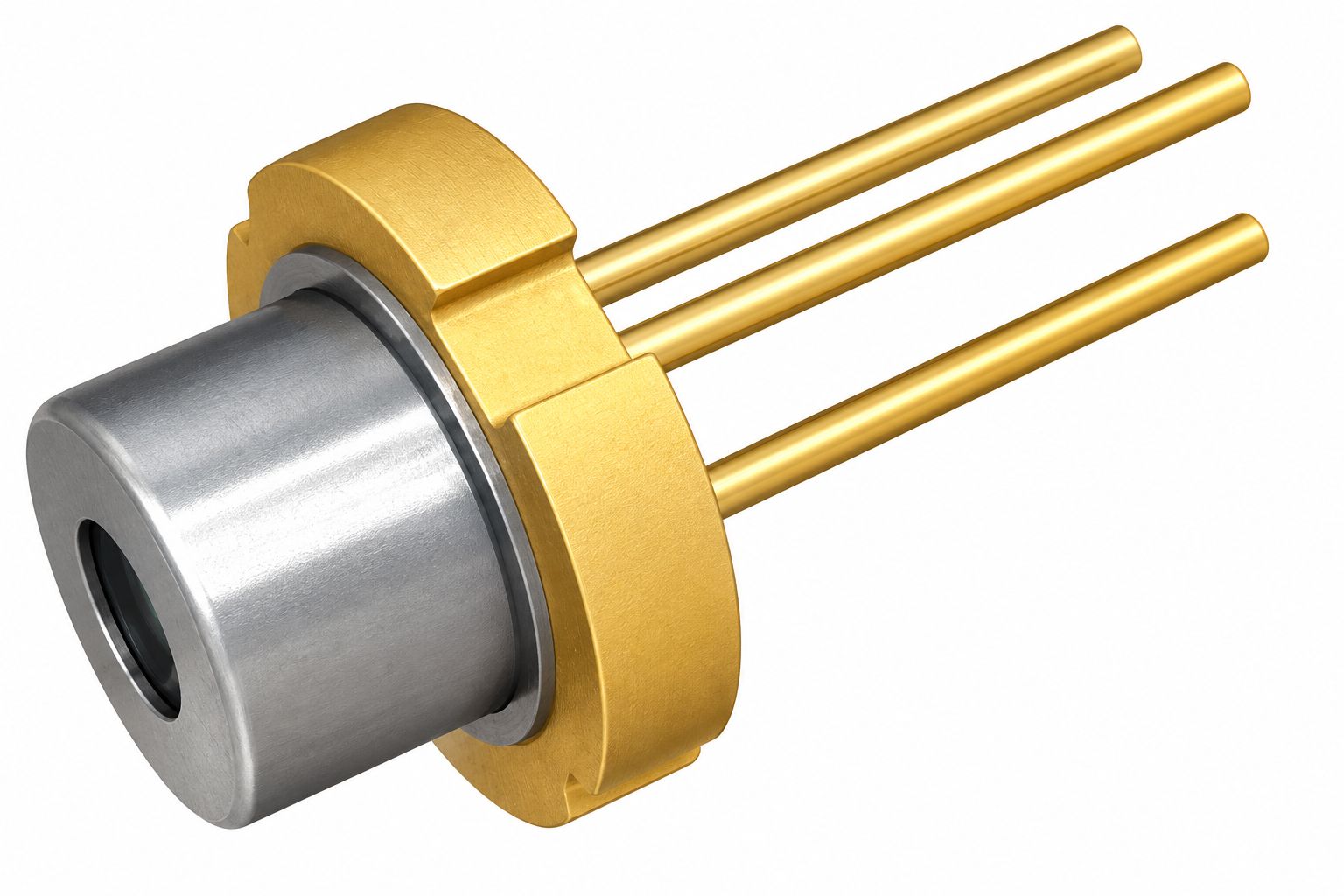
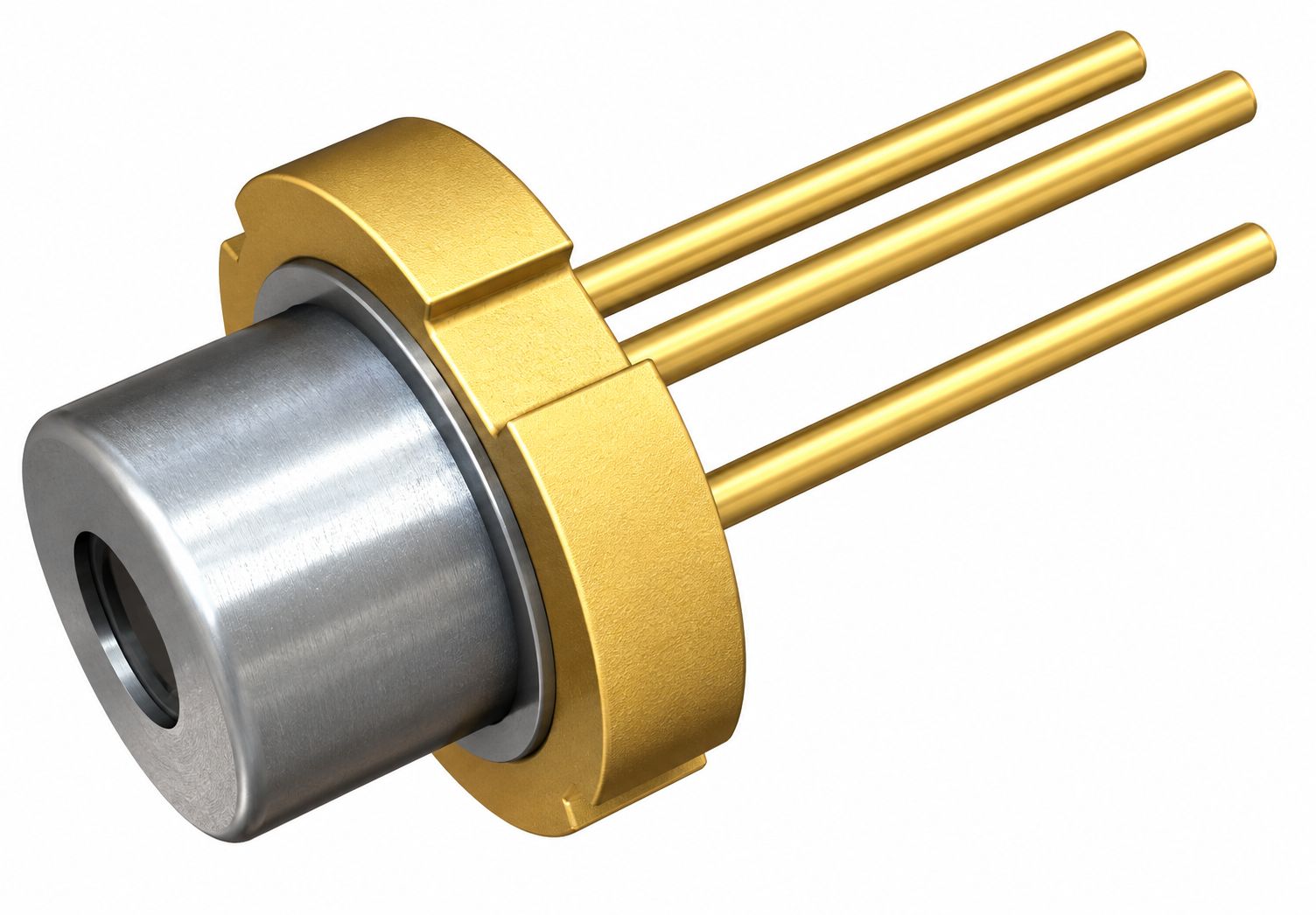
Representative official product photographs. For QCW package drawings, use the mechanical diagram associated with each specific model.
Representative TO-Can Laser Diode Options
The table highlights existing Lumi product families. Values are representative model specifications and are not interchangeable across package versions or test conditions. Use the individual product page for the full technical specification.
| Product / Wavelength | Architecture | Optical Output | Operating Mode | Typical Application |
|---|---|---|---|---|
| 808nm TO-5.6 | FP | 50mW | CW | NIR instrumentation / sensing |
| 940nm TO-18 with monitor PD | FP | 50mW | CW | Near-infrared optical systems |
| 1310nm-class TO | FP | 515mW typ. peak | QCW, 10µs / 1% duty | Specialized pulsed optical systems |
| 1550nm-class TO | FP | 320mW typ. peak | QCW, 10µs / 1% duty | Ranging / optical measurement |
| 1625nm TO | FP | 300mW typ. peak | QCW, 10µs / 1% duty | OTDR / fiber diagnostics |
| 1550nm narrow-linewidth TO | DFB | 90mW typ. | Model-specific CW conditions | Precision photonic measurement |
| 1650.9nm heating-controlled TO56 | DFB | 6mW typ. | Temperature-tuned | Methane spectroscopy |
| 1653.7nm TEC-cooled TO | DFB | 6mW typ. | TEC-stabilized | Methane TDLAS |
DFB TO-Can Lasers for TDLAS & Precision Measurement
TO packaging allows wavelength-selective DFB lasers to be integrated into compact spectroscopy and photonic instruments. Lumi offers a 1550nm narrow-linewidth DFB family, plus methane-oriented devices near 1650.9nm and 1653.7nm with different thermal-control architectures.
1650.9nm / Heating-Controlled TO56
Designed around integrated heating for wavelength positioning in compact methane-sensing systems. Heating control differs electrically and thermally from an integrated TEC module.
View 1650.9nm DFB product →1653.7nm / TEC-Cooled TO
Provides integrated thermoelectric control for methane absorption measurements that require regulated laser operating temperature. Confirm wavelength scan coverage against the specific CH₄ absorption line.
View 1653.7nm DFB product →1550nm / Narrow-Linewidth DFB TO
Used in precision optical systems where a specified optical spectrum, SMSR and linewidth are more important than simply selecting a nominal wavelength.
View 1550nm TO DFB product →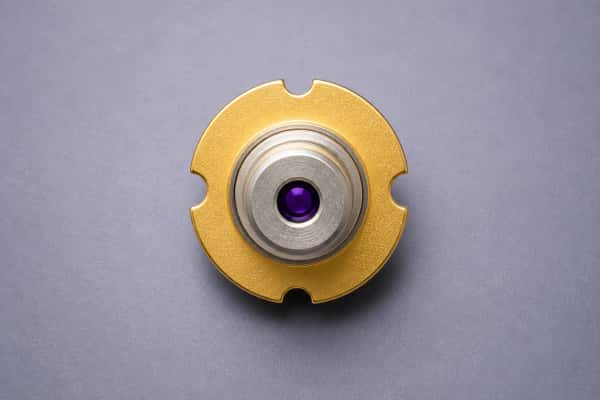
Uncooled, Heating-Controlled and TEC-Cooled TO Packages
TO package designation alone does not determine temperature stability. Different laser systems require different thermal budgets, laser drivers and feedback arrangements.
Uncooled TO
A straightforward metal-header package that relies on external heat sinking and laser-driver design. Useful where the system can tolerate the resulting wavelength and power drift.
Heater-Controlled TO
An integrated heater adjusts the laser temperature to position its wavelength. Control circuitry must account for ambient conditions, heater power and feedback behavior.
TEC-Cooled TO
A thermoelectric device can heat or cool the laser around a controlled setpoint. This improves regulation but needs additional electrical connections and TEC controller design.
Free-Space Output or Fiber-Pigtailed TO-Can?
Free-Space TO-Can
Compact TO lasers with an optical window or aperture leave collimation, focusing and optical alignment to the OEM designer. This is useful where a custom lens system, short free-space path or tight system envelope is required.
Fiber-Pigtailed TO-Can
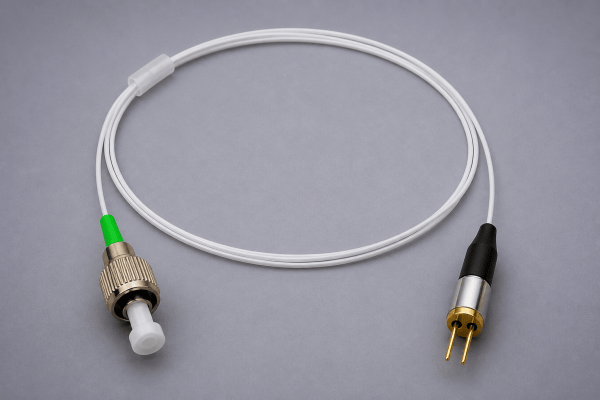
Fiber-pigtailed TO devices incorporate factory-aligned laser-to-fiber coupling. Lumi's cooled DFB TO families cover selected wavelengths around 1273–1653nm and 1290–1653nm for gas detection, optical test, communication and fiber-based instruments.
- Specify SM / PM / MM fiber as supported by the chosen product.
- Confirm fiber length, connector, return loss and isolation requirements.
- State required optical power at the actual fiber output interface.
- Check the relationship between TEC control, fiber routing and package dimensions.
TO-Can vs Butterfly Laser Diode: When to Choose Each
These are package choices—not competing laser-cavity architectures. The best format depends on size, power dissipation, thermal functions, optical interface and how much system integration is expected from the package supplier.
| Engineering Consideration | TO-Can | Butterfly |
|---|---|---|
| Physical form | Compact metal-can device | Larger multi-lead precision package |
| Laser architecture | DFB / FP / selected VCSEL | Multiple architectures; Lumi currently focuses on DFB |
| Temperature control | Passive, heater or TEC on selected models | TEC and thermistor commonly integrated |
| Optical interface | Free-space or pigtailed variants | Frequently supplied with factory fiber output |
| Monitor / feedback | Model-specific monitor PD and thermistor options | Commonly supports precision monitoring functions |
| OEM integration | More external optics or thermal management may remain | More integration handled within the package |
TO-Can Laser Diode Application Areas
Different applications call for different architectures and thermal controls. A package can be attractive for compact OEM integration without implying that every TO laser is suitable for every optical system.
TDLAS Gas Sensing
Wavelength-matched DFB TO lasers with heater or TEC control for absorption spectroscopy, including selected CH₄ systems.
OTDR & Fiber Diagnostics
1310/1550/1625nm-class FP pulsed or DFB fiber-pigtailed options for optical fiber monitoring and measurement.
Optical Ranging
QCW FP lasers where the pulse width, peak output, duty cycle and overall system architecture are compatible.
Precision Laser Measurement
Narrow-linewidth DFB sources for optical characterization and measurement systems requiring controlled spectral properties.
Near-Infrared Sensing
808/940nm compact CW emitters for active sensing, industrial instrumentation and related near-infrared optical paths.
OEM Fiber Modules
Pigtailed TO sources that reduce the need for laser-to-fiber alignment within the customer's compact module.
How to Specify a TO-Can Laser Diode
A reliable quotation starts with measurable optical and integration requirements. Package diameter should not be the first or only selection criterion.
Application & Target
Specify gas line, fiber window, detector, ranging scheme or required system measurement.
Wavelength & Linewidth
State nominal and toleranced wavelength, spectral width, SMSR and tuning range where relevant.
CW / QCW / Pulsed
Define optical power, pulse width, duty cycle, repetition rate and test temperature.
Passive / Heater / TEC
Account for ambient range, wavelength drift, driver limits and thermal-controller interfaces.
Free Space / Fiber
Confirm beam divergence, optical alignment, fiber type, connector and power at the output.
Outline, Pins & Quantity
Provide package drawing requirements, pin functions, sample volume and expected production quantity.
TO-Can Laser Diode Integration Support
Lumi supports project discussions covering laser architecture, wavelength, thermal regulation, metal-can package, fiber output and electrical monitoring. Package options vary by product and should be assessed against the chosen diode's optical and thermal limits.
- DFB / FP / selected VCSEL configuration
- TO-18-class, TO-46, TO-56 and TO-60 project formats
- TEC, heater, thermistor and monitor PD options
- Free-space and factory-aligned fiber-pigtailed configurations
- Mechanical dimensions, lead arrangement and pinout confirmation
- Optical and electrical test conditions for sample qualification
What to Share With Lumi
- Application and target wavelength (nm)
- DFB / FP / VCSEL architecture, if known
- CW power or QCW peak power and pulse conditions
- Linewidth, SMSR or wavelength-tuning requirements
- Operating and storage temperature ranges
- Passive, heater or TEC control preference
- Package size, pin configuration and optical interface
- Sample quantity and estimated annual requirement
Frequently Asked Questions About TO-Can Laser Diodes
What does “TO” mean in a TO-can laser diode?
TO stands for Transistor Outline, a family of metal-package formats used in optoelectronics. It describes packaging and mechanical integration, not a particular laser cavity.
Is a TO-can laser the same as a DFB or FP laser?
No. DFB and FP describe the semiconductor laser architecture. TO-can describes the metal package that holds the device. TO packages can contain DFB, FP or selected VCSEL devices.
Can a TO-can laser include a TEC?
Yes, selected multi-pin TO packages integrate a TEC and thermistor. The exact pinout, electrical requirements and thermal limits must be checked for each specific model.
What is the difference between heating-controlled and TEC-controlled TO lasers?
Heater-controlled devices add heat to shift or regulate temperature. TEC-based designs can actively heat or cool the laser around a setpoint. Their driver requirements and achievable thermal behavior differ.
Can TO-can lasers have a fiber pigtail?
Yes. Pigtailed TO lasers incorporate factory-aligned fiber coupling, reducing the alignment work required in the OEM module. Fiber and connector options depend on the selected product.
Which Lumi TO-can wavelengths are available?
Existing Lumi product families include 808nm and 940nm CW FP, 1310nm/1550nm/1625nm-class QCW FP, 1550nm narrow-linewidth DFB and methane-oriented DFB products near 1650.9nm and 1653.7nm. Additional pigtailed wavelengths depend on product family.
Does QCW peak power equal continuous output power?
No. QCW peak power is specified for a defined pulse width and duty cycle. Continuous-wave ratings must be evaluated separately, together with the thermal design.
How do I choose TO-18, TO-46, TO-56 or TO-60?
Compare the mechanical drawings, lead count, available internal volume, thermal components and optical-output requirements for the exact product. Package names alone are not sufficient to design a PCB footprint.
When should I choose a butterfly package instead?
Butterfly packages are attractive when an OEM prefers a more integrated fiber and thermal-control platform. TO packages are often suitable when compact size and flexible downstream optical design are priorities.
What information should I provide for an OEM TO-can laser inquiry?
Provide the application, wavelength, optical power and operating mode, linewidth or SMSR if relevant, thermal-control requirement, mechanical and pinout constraints, optical interface and forecast quantity.
Related Laser Diode Product Families
DFB Lasers
Wavelength-selective sources for TDLAS, communication and precise optical measurement.
Explore DFB →FP Lasers
Fabry–Perot CW and QCW sources across sensing, measurement and optical test.
Explore FP →Butterfly Lasers
Precision packages with integrated fiber, temperature control and monitoring functions.
Explore Butterfly →Fiber-Coupled Lasers
Laser diodes optimized for direct fiber delivery and optical module integration.
Explore Fiber-Coupled →Discuss Your TO-Can Laser Requirements
Tell us your wavelength, architecture, output power, thermal-control strategy, optical interface and mechanical envelope. Lumi can help evaluate a suitable configuration for your OEM project.