
For most outdoor and consumer-facing 3D sensing systems, 940 nm is a common starting point because the solar spectrum has a useful irradiance dip around the 920–960 nm region and 940 nm illumination produces much less visible red glow than 850 nm. However, 850 nm has an important receiver-side advantage: silicon photodetectors and ToF sensors are generally more sensitive at 850 nm than at 940 nm.
This means there is no universal answer to “850 nm or 940 nm?”
The wavelength decision is a system-level trade-off between:
- Silicon detector quantum efficiency or photon detection efficiency
- Ambient sunlight
- VCSEL optical power
- Target reflectivity
- Measurement range
- Field of view
- Optical filter bandwidth
- Receiver architecture
- Visible glow requirements
- Eye-safety design
- Package and thermal design
- Production ecosystem
A useful first rule is:
Choose 850 nm when silicon receiver sensitivity is one of the dominant limits. Choose 940 nm when outdoor ambient-light performance, invisible illumination and the mature 3D-sensing ecosystem are more important.
That is why 850 nm remains extremely important in optical communication and selected sensing applications, while 940 nm has become highly prevalent in consumer 3D sensing, ToF, face authentication, robotics and active infrared illumination.
For the VCSEL structure itself, see What Is a VCSEL? Working Principle, Types & Applications.
850 nm vs 940 nm VCSEL at a Glance
| Factor | 850 nm VCSEL | 940 nm VCSEL |
|---|---|---|
| Silicon detector sensitivity | Generally higher | Generally lower |
| Solar background | Higher | Lower around the 920–960 nm atmospheric dip |
| Visible red glow | Can become faintly visible at sufficient optical intensity | Much less visible / effectively invisible in typical use |
| Indoor ToF | Strong | Strong |
| Outdoor ToF | Possible | Often preferred |
| Consumer 3D sensing | Used | Very common |
| Face authentication | Possible | Strong ecosystem |
| Robot navigation | Strong | Strong |
| Outdoor robotic sensing | Possible | Strong starting point |
| MMF datacom | Major ecosystem | Much less common |
| Silicon receiver photon budget | Advantage | Disadvantage |
| Ambient-light photon budget | Disadvantage | Advantage |
| Eye-safety engineering | Required | Required |
These are system tendencies, not absolute wavelength limits.
The final performance depends on the complete transmit–scene–receive chain.
What Are 850 nm and 940 nm VCSELs?
850 nm and 940 nm VCSELs use the same fundamental laser architecture:
Vertical-Cavity Surface-Emitting Laser
The difference is primarily the emission wavelength.
That means:
- VCSEL = laser architecture
- 850 nm / 940 nm = optical wavelength
- SMD / TO / array / module = package or integration form
- ToF / structured light / proximity sensing = application or sensing method
An 850 nm VCSEL is not inherently a “datacom package,” and a 940 nm VCSEL is not inherently a “ToF package.”
Either wavelength can be designed into different optical systems if the emitter, detector and optics support it.
However, industry ecosystems have developed differently around these wavelengths.
850 nm VCSEL Ecosystem
850 nm is strongly associated with:
- Short-reach optical communication
- Multimode fiber
- Data-center links
- High-speed optical transmitters
- Selected machine-vision and sensing systems
940 nm VCSEL Ecosystem
940 nm is strongly associated with:
- Time-of-flight sensing
- 3D cameras
- Structured-light illumination
- Proximity sensing
- Face authentication
- Robot navigation
- Automotive in-cabin sensing
- Active infrared illumination
Coherent notes that VCSEL arrays, typically operating at 940 nm, have become a major light-source architecture for modern 3D sensing.
Why Silicon Detectors Are More Sensitive at 850 nm
One of the strongest arguments for 850 nm is on the receiver side.
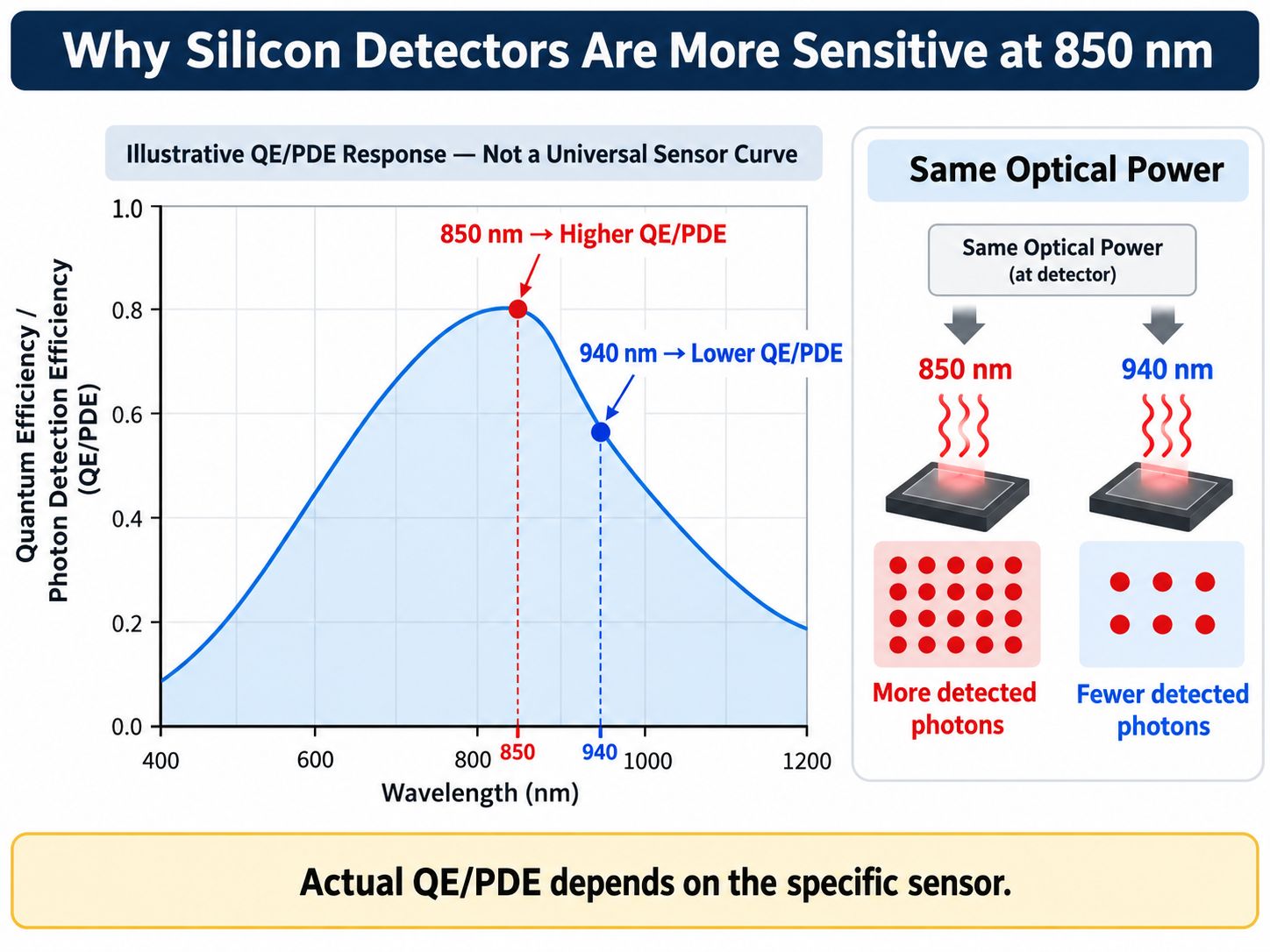
Silicon detectors do not have the same quantum efficiency across the entire near-infrared spectrum.
As wavelength moves farther into the near infrared and approaches the long-wavelength response limit of silicon, photon conversion efficiency generally falls.
For a ToF system, this means an 850 nm photon has a higher probability of contributing to a useful detected signal than a 940 nm photon in many silicon sensors.
Analog Devices gives a useful real-world example from its continuous-wave ToF sensor family:
- 850 nm: 44% QE
- 940 nm: 27% QE
ADI also notes that silicon-based ToF sensor QE can commonly be around twice as high at 850 nm as at 940 nm, depending on the sensor.
These values are an example from a specific receiver platform, not a universal silicon-detector curve.
The correct OEM rule is:
Always check the QE or PDE curve of the actual SPAD, CMOS ToF sensor or photodiode you plan to use.
What Higher Detector Sensitivity Means for the System
Assume two systems deliver the same optical power back to the receiver.
If the detector has higher QE/PDE at 850 nm, the receiver may generate more useful photoelectrons from the returned signal.
That can improve:
- Signal-to-noise ratio
- Low-reflectivity target performance
- Long-range return detection
- Low-power operation
- Receiver margin
This advantage becomes especially important when very little light returns from the target.
Examples include:
- Dark objects
- Long distance
- Wide field of view
- Low transmitted power
- Small receiver aperture
- Highly diffuse targets
So why not simply use 850 nm everywhere?
Because the receiver does not only see photons from the VCSEL.
It also sees ambient photons.
That is where 940 nm becomes extremely important.
Why 940 nm Performs Better in Bright Sunlight
Outdoor ToF performance is strongly affected by ambient light.
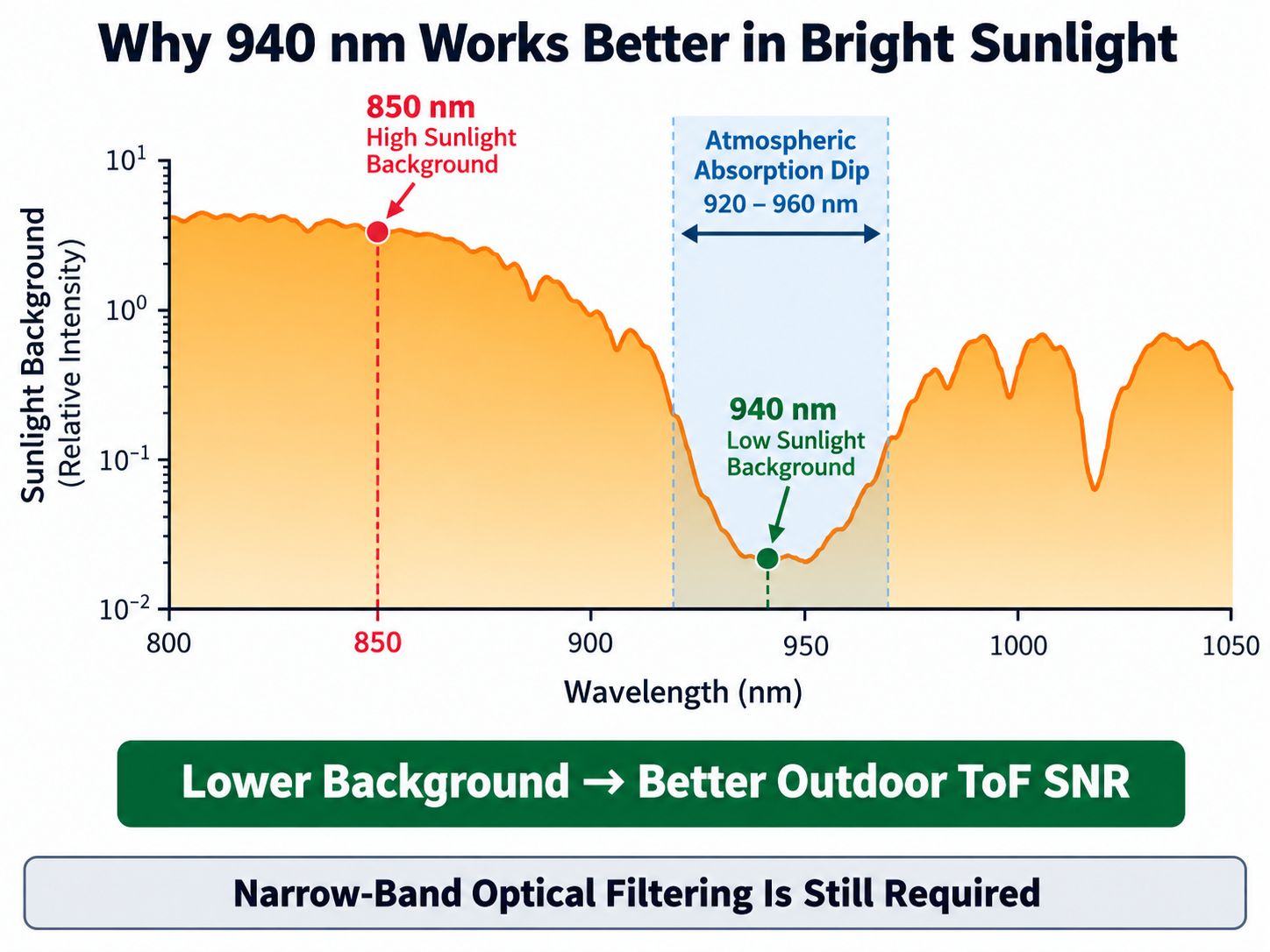
Sunlight contains substantial near-infrared energy.
When a ToF receiver is operating outdoors, incoming solar photons create background signal that can:
- Increase depth noise
- Reduce effective range
- Increase receiver saturation risk
- Reduce signal-to-background ratio
- Increase filtering requirements
The solar spectrum reaching the ground is not smooth.
Atmospheric absorption creates a useful reduction in irradiance around approximately 920–960 nm.
940 nm lies inside this region.
Analog Devices reports that solar irradiance around 940 nm can be less than half the irradiance around the 850 nm region in its ToF system comparison.
This creates an important system trade-off:
850 nm
→ higher silicon sensitivity
but also
→ higher solar background
940 nm
→ lower silicon sensitivity
but also
→ lower solar background
For outdoor depth sensing, the second advantage can outweigh the first.
That is why 940 nm is frequently selected for:
- Outdoor ToF cameras
- Robot navigation
- Robotic lawn mowers
- Industrial mobile robots
- Smart access systems exposed to daylight
- Automotive sensing
940 nm Is Not Immune to Sunlight
A common mistake is to interpret the 940 nm solar dip as:
“940 nm eliminates sunlight interference.”
It does not.
Outdoor systems still require careful control of ambient light.
Typical design measures include:
- Narrow-band optical filters
- Receiver gating
- SPAD timing
- High peak optical power
- Modulation
- Background subtraction
- Optimized optics
The correct statement is:
940 nm reduces the solar-background disadvantage compared with 850 nm; it does not remove ambient light from the system.
Why 940 nm Reduces Visible Red Glow
Although 850 nm is technically in the near-infrared region, the human eye can retain a small amount of sensitivity near the edge of the visible spectrum.
A sufficiently intense 850 nm emitter may therefore appear as a faint red glow.
This may be undesirable in:
- Face recognition
- Smartphones
- Smart locks
- Payment terminals
- Driver monitoring
- Night sensing
- Consumer electronics
At 940 nm, human visual sensitivity is much lower.
For most practical consumer illumination systems, 940 nm output is effectively invisible to users.
ams OSRAM explicitly positions 940 nm VCSEL illumination as a way to avoid the disturbing red-glow effect found closer to 850 nm.
This gives 940 nm another advantage that has nothing to do with ToF distance calculation:
user experience.
If 850 nm Has Higher QE, Why Is 940 nm So Common in 3D Sensing?
Three system-level reasons explain much of the market preference.
1. Better Outdoor Ambient-Light Conditions
The solar spectral dip near 940 nm improves the signal-to-background environment.
2. Less Visible Illumination
Consumer-facing systems benefit from illumination that users do not perceive.
3. Mature 940 nm VCSEL Ecosystem
Modern 3D-sensing supply chains include:
- 940 nm single emitters
- High-power VCSEL arrays
- Multi-junction VCSELs
- Flood illuminators
- Dot projectors
- Drivers
- Narrow-band filters
- SPAD receivers
- Optical modules
Coherent currently supplies 940 nm arrays for:
- 3D cameras
- Mobile devices
- Robotics
- Automotive in-cabin sensing
- Short-range LiDAR
This ecosystem matters because an OEM does not design wavelength in isolation.
The wavelength has to work with the full component chain.
The ToF Photon Budget: Why Wavelength Alone Cannot Decide
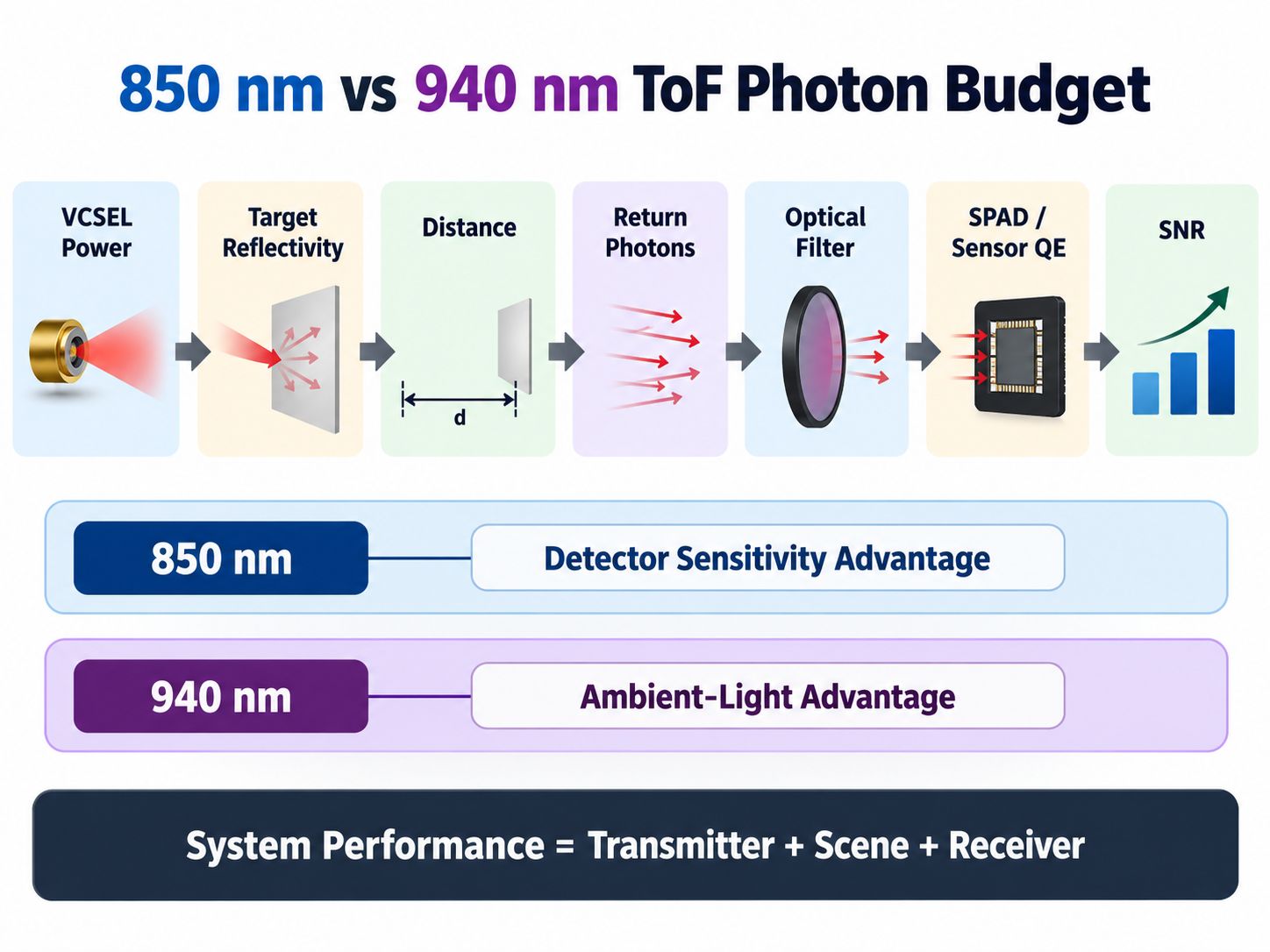
ToF performance can be understood as a photon-budget problem.
A simplified path is:
VCSEL Power → Scene Illumination → Target Reflectivity → Distance Loss → Returned Photons → Optical Filter → Receiver QE/PDE → Signal Processing → SNR
Every stage changes the result.
VCSEL Optical Power
The source must generate enough useful illumination.
But source power alone does not determine receiver signal.
The beam may be spread across:
- Wide field of view
- Dot pattern
- Flood illumination region
Target Reflectivity
A white wall can return much more light than:
- Black plastic
- Dark fabric
- Black automotive trim
- Wet surfaces
- Low-reflectivity industrial objects
Distance
Returned optical power decreases strongly with distance and geometry.
A system that works well at 0.5 m may behave very differently at 5 m.
Optical Filter
A narrow-band filter blocks out-of-band ambient light.
Its:
- Center wavelength
- bandwidth
- angle sensitivity
- temperature shift
must be matched to the VCSEL.
Receiver QE / PDE
850 nm often has the silicon-detector advantage here.
Ambient Background
940 nm often has the outdoor advantage here.
So the real comparison is:
850 nm = receiver-sensitivity advantage
940 nm = ambient-light advantage
The better wavelength is the one that creates the stronger system SNR under the actual operating environment.
Does 940 nm Need More Optical Power?
Sometimes, but not as a universal rule.
Because many silicon detectors have lower sensitivity at 940 nm, an otherwise identical system may need to compensate using:
- More transmitter power
- Larger receiver aperture
- Better VCSEL efficiency
- Better optical filter
- Higher detector PDE
- Narrower field of view
- More averaging
But actual power requirements depend on the complete design.
There is no valid general statement such as:
“940 nm always requires 50% more power than 850 nm.”
The correct transmitter power depends on:
- VCSEL architecture
- Receiver
- target reflectivity
- distance
- pulse width
- duty cycle
- optical losses
- ambient light
- safety classification
High-Power 940 nm VCSEL Arrays
Modern 3D sensing often uses VCSEL arrays rather than one small single emitter.
Coherent currently offers 940 nm multi-mode VCSEL arrays with multi-junction architectures for high-power sensing and fast pulse operation.
Applications include:
- Direct ToF
- 3D cameras
- Robotics
- Short-range LiDAR
- Automotive in-cabin sensing
Some of these industry devices operate at multi-watt optical power levels.
That is a different product class from Lumi’s current compact single-channel 1206 SMD VCSELs.
This distinction is important.
Industry capability of a 5 W or 10 W VCSEL array should never be interpreted as the specification of a small single-emitter SMD VCSEL.
850 nm vs 940 nm Application Matrix
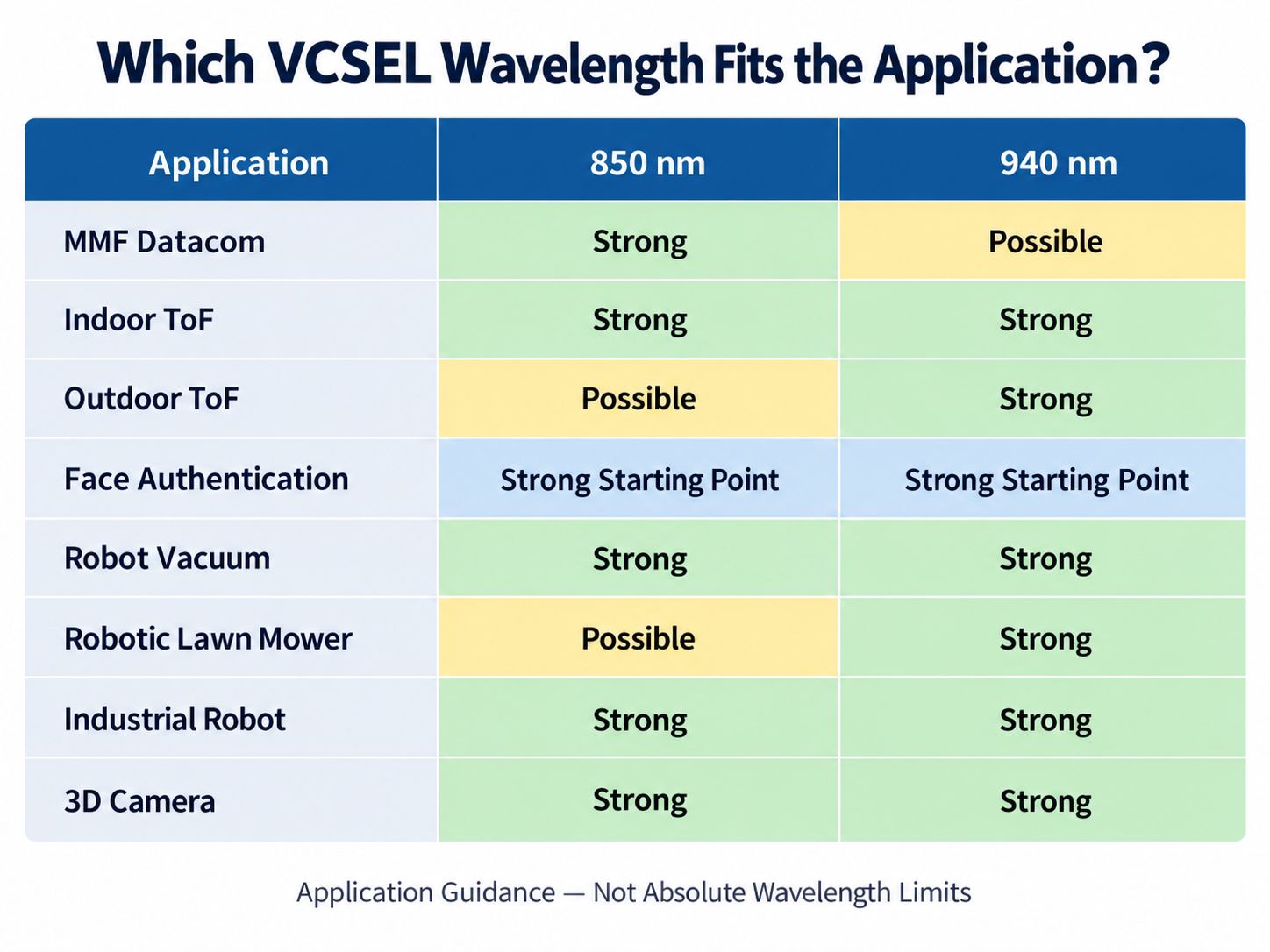
| OEM Application | 850 nm | 940 nm |
|---|---|---|
| MMF datacom | Strong | Limited ecosystem |
| Indoor ToF | Strong | Strong |
| Outdoor ToF | Possible | Strong starting point |
| Face authentication | Possible | Strong starting point |
| Robot vacuum | Strong | Strong |
| Robotic lawn mower | Possible | Strong starting point |
| Industrial robot / AGV | Strong | Strong |
| 3D camera | Possible | Strong |
| Low-return target with controlled ambient | Strong | Possible |
| Invisible consumer illumination | Possible | Strong |
These are application guidelines, not hard wavelength limits.
850 nm vs 940 nm for Face Recognition
For modern consumer face recognition, 940 nm is usually the stronger starting point.
Why?
Invisible Illumination
Users should not see a red flash or glow during authentication.
3D-Sensing Ecosystem
940 nm has a mature supply chain for:
- Flood illumination
- Dot projection
- ToF
- Structured-light systems
Daylight Operation
Lower solar background around 940 nm can improve daytime operation.
ams OSRAM uses 940 nm VCSEL modules for applications including:
- 3D gesture recognition
- Face authentication
- Industrial robotics
- Smart access systems
This does not mean 850 nm cannot be used for biometric sensing.
It means the system-level advantages of 940 nm often align better with consumer authentication requirements.
Why 940 nm Is Common in Modern 3D Sensing
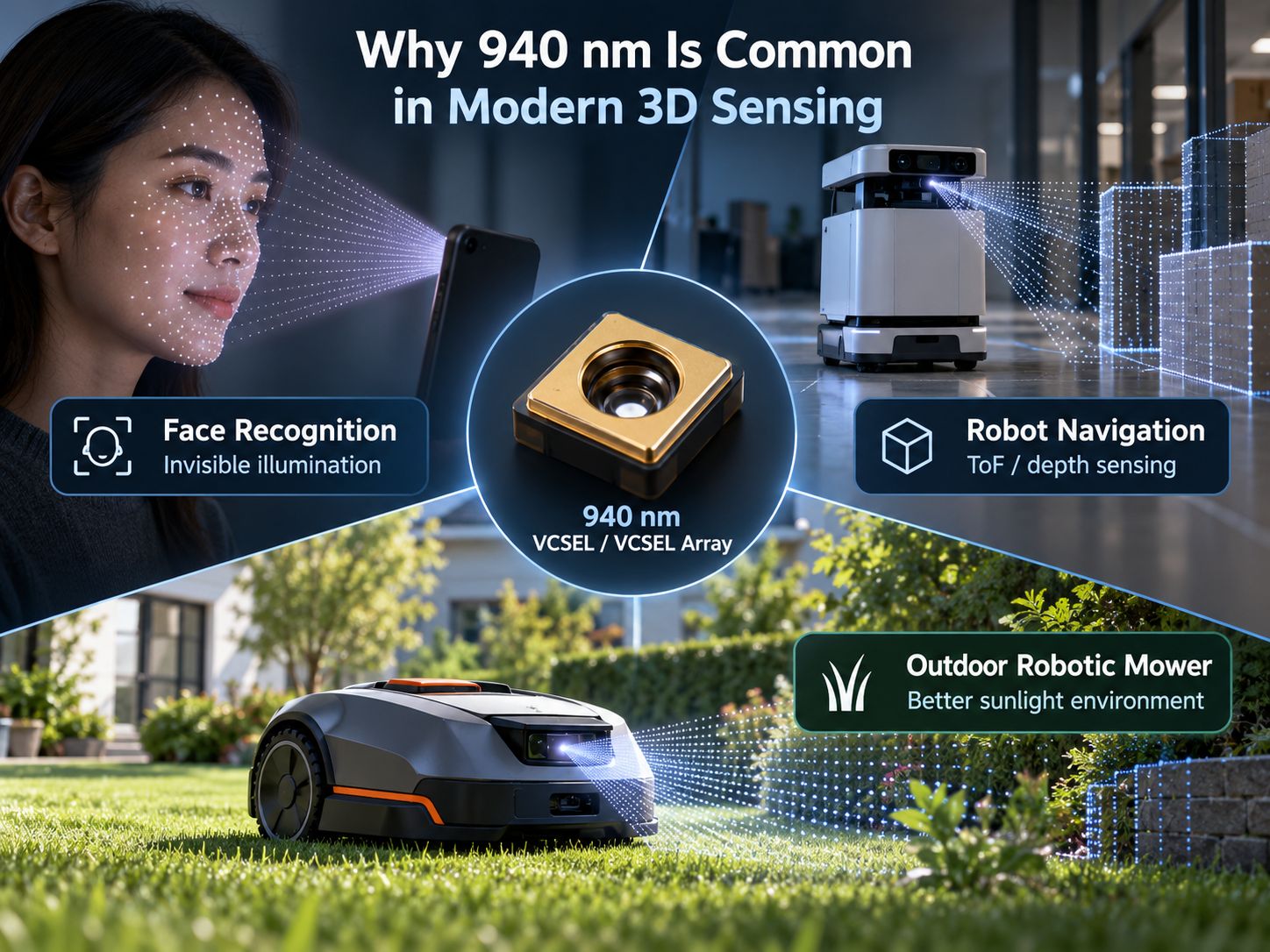
940 nm is now seen across several active-sensing categories.
Face Recognition
A VCSEL can provide:
- Flood illumination
- Structured-light pattern
- ToF illumination
The system then uses an imaging sensor to reconstruct:
- Depth
- facial geometry
- biometric features
Robot Navigation
A ToF or 3D camera can help a robot estimate:
- Obstacle distance
- wall position
- free space
- docking geometry
940 nm is especially attractive when robots encounter mixed indoor and daylight conditions.
Outdoor Robotic Mowers
Outdoor robots operate in one of the hardest environments for active optical sensing:
- Full sunlight
- Dark vegetation
- Bright surfaces
- Shadows
- Changing weather
- Large temperature variation
The 940 nm ambient-light advantage therefore becomes much more important.
850 nm vs 940 nm for Robot Vacuums
For an indoor robot vacuum, both wavelengths can be reasonable.
Why 850 nm Can Be Attractive
- Strong silicon sensitivity
- Good photon budget
- Controlled indoor lighting
- Mature optical components
Why 940 nm Can Be Attractive
- Invisible illumination
- Strong ToF ecosystem
- Better tolerance when strong sunlight enters through windows
- Strong availability of sensing modules
The actual choice should consider:
- Required range
- Receiver PDE
- black-object performance
- floor reflectivity
- field of view
- window sunlight
- size
- BOM cost
So the recommendation is not:
robot vacuum = 940 nm
It is:
For an indoor robot vacuum, compare the actual receiver sensitivity and worst-case sunlight environment.
850 nm vs 940 nm for Robotic Lawn Mowers
For an outdoor robotic lawn mower, 940 nm is generally the stronger starting point.
Outdoor daylight makes ambient-light immunity a major system requirement.
Typical sensing challenges include:
- Direct sunlight
- Grass reflectivity
- Dark obstacles
- Trees and shadow transitions
- reflective garden objects
- wet surfaces
A 940 nm VCSEL combined with:
- narrow-band filter
- suitable SPAD / ToF receiver
- sufficient optical power
- robust signal processing
can provide a strong platform for obstacle detection and depth sensing.
However, wavelength remains only one part of the design.
850 nm vs 940 nm for Industrial Robots and AGVs
Industrial systems are more application-dependent.
Controlled Indoor Warehouse
850 nm and 940 nm can both work well.
If the system is receiver-sensitivity limited, 850 nm may be attractive.
Mixed Indoor / Outdoor Operation
940 nm becomes more attractive as sunlight exposure increases.
Factory Machine Vision
Other factors can dominate:
- Surface reflectivity
- background lighting
- required range
- safety
- industrial temperature range
- optical contamination
For this reason, the full operating environment should be tested rather than selecting solely from wavelength trends.
Where 850 nm Still Has a Major Advantage
The rise of 940 nm in 3D sensing does not mean 850 nm is obsolete.
Multimode-Fiber Datacom
850 nm remains one of the most important VCSEL wavelengths for:
- Short-reach optical links
- Multimode fiber
- Data-center interconnects
- Optical transceivers
This ecosystem is one of the strongest applications of VCSEL technology.
High Detector Sensitivity
When ambient lighting is controlled and the return signal is weak, higher silicon receiver sensitivity can make 850 nm extremely attractive.
Precision Sensing
850 nm VCSELs are also available in:
- Single-mode
- polarization-locked
- specialized sensing architectures
So the correct conclusion is:
850 nm is not an older version of 940 nm.
They optimize different system constraints.
Does Wavelength Change the Basic ToF Distance Equation?
No.
The basic ToF principle is based on the propagation time of light.
For direct ToF:
Distance ≈ c × Round-Trip Time / 2
For indirect ToF, distance is derived from phase shift.
Changing from 850 nm to 940 nm does not fundamentally change that ranging principle.
Analog Devices specifically notes that wavelength itself should not directly change the fundamental ToF accuracy because the method depends on the speed of light.
What changes is the system performance around the measurement:
- Signal level
- detector QE
- ambient background
- filtering
- range
- SNR
A useful way to phrase it is:
Wavelength affects the photon budget and environmental robustness more than the fundamental ToF ranging equation.
dToF vs iToF: Is One Wavelength Required?
No.
Do not classify the technologies as:
850 nm = iToF
and:
940 nm = dToF
That would be incorrect.
Direct ToF
dToF commonly uses:
- Short optical pulses
- SPAD receivers
- timing histograms
- high peak power
940 nm high-power VCSEL arrays are very mature for this architecture.
Indirect ToF
iToF commonly uses:
- Modulated illumination
- phase measurement
- CMOS ToF pixels
Both 850 nm and 940 nm can be used.
The wavelength selection remains a trade-off among:
- detector sensitivity
- ambient light
- transmitter efficiency
- optical filter
- power
- range
3D Sensing, ToF and Structured Light Are Not the Same Thing
These terms are often mixed together.
3D Sensing
An umbrella term for technologies that obtain depth or three-dimensional shape.
Time of Flight
Measures distance from:
- light propagation time
- phase delay
Structured Light
Projects a known:
- dot pattern
- grid
- coded pattern
and reconstructs depth from its deformation in the captured image.
Active Stereo
Uses active illumination to improve feature matching between cameras.
VCSELs can be used in several of these architectures.
A 940 nm VCSEL may therefore appear as:
- ToF flood source
- dot projector
- proximity illuminator
- active stereo illuminator
The wavelength does not define the ranging architecture.
Eye Safety: 850 nm vs 940 nm
Neither wavelength should be described as inherently “eye-safe.”
Both are near-infrared laser wavelengths.
Because they are mostly invisible, users do not receive the same visual warning they would from visible light.
Laser safety depends on the full accessible emission condition, including:
- Optical power
- Pulse width
- Repetition rate
- beam divergence
- emitter area
- diffuser / DOE
- optical failure mode
- aperture
- exposure geometry
Consumer systems may include:
- monitor photodiode
- fault detection
- driver shutdown
- diffuser integrity monitoring
ams OSRAM’s 940 nm VCSEL modules, for example, use integrated photodiode monitoring as part of an eye-safety protection architecture.
The correct OEM process is:
Design and verify the complete optical module against the applicable laser-safety requirements.
Do not choose 940 nm simply because it is invisible and assume it is safer.
Optical Filtering: A Critical Part of Both Systems
Both 850 nm and 940 nm ToF systems benefit from narrow-band filtering.
A receiver filter should:
- Pass the VCSEL wavelength
- Reject broadband ambient light
- maintain performance over incidence angle
- maintain performance over temperature
The filter bandwidth has to accommodate:
- VCSEL wavelength tolerance
- wavelength shift with temperature
- wavelength shift with drive
- angle-dependent filter shift
This means a narrower filter is not automatically better.
An extremely narrow filter can begin clipping the source spectrum under temperature or angle variation.
Can You Replace an 850 nm VCSEL with a 940 nm VCSEL Directly?
Usually not.
Even if the package dimensions are similar, changing wavelength can require changes to:
Receiver
The sensor may have different QE/PDE at 940 nm.
Optical Filter
The bandpass center wavelength must change.
Transmitter Power
A different photon budget may be required.
Driver
The laser may have different:
- forward voltage
- current
- pulse requirements
Optics
Coatings, DOE behavior and lens transmission should be checked.
Calibration
ToF and reflectivity calibration may change because system SNR changes.
Thermal Design
Different devices can have different PCE and thermal load.
Eye Safety
Accessible emission must be re-evaluated.
Therefore:
850 nm and 940 nm VCSELs should not be treated as drop-in wavelength substitutions without system requalification.
850 nm or 940 nm? OEM Selection Checklist
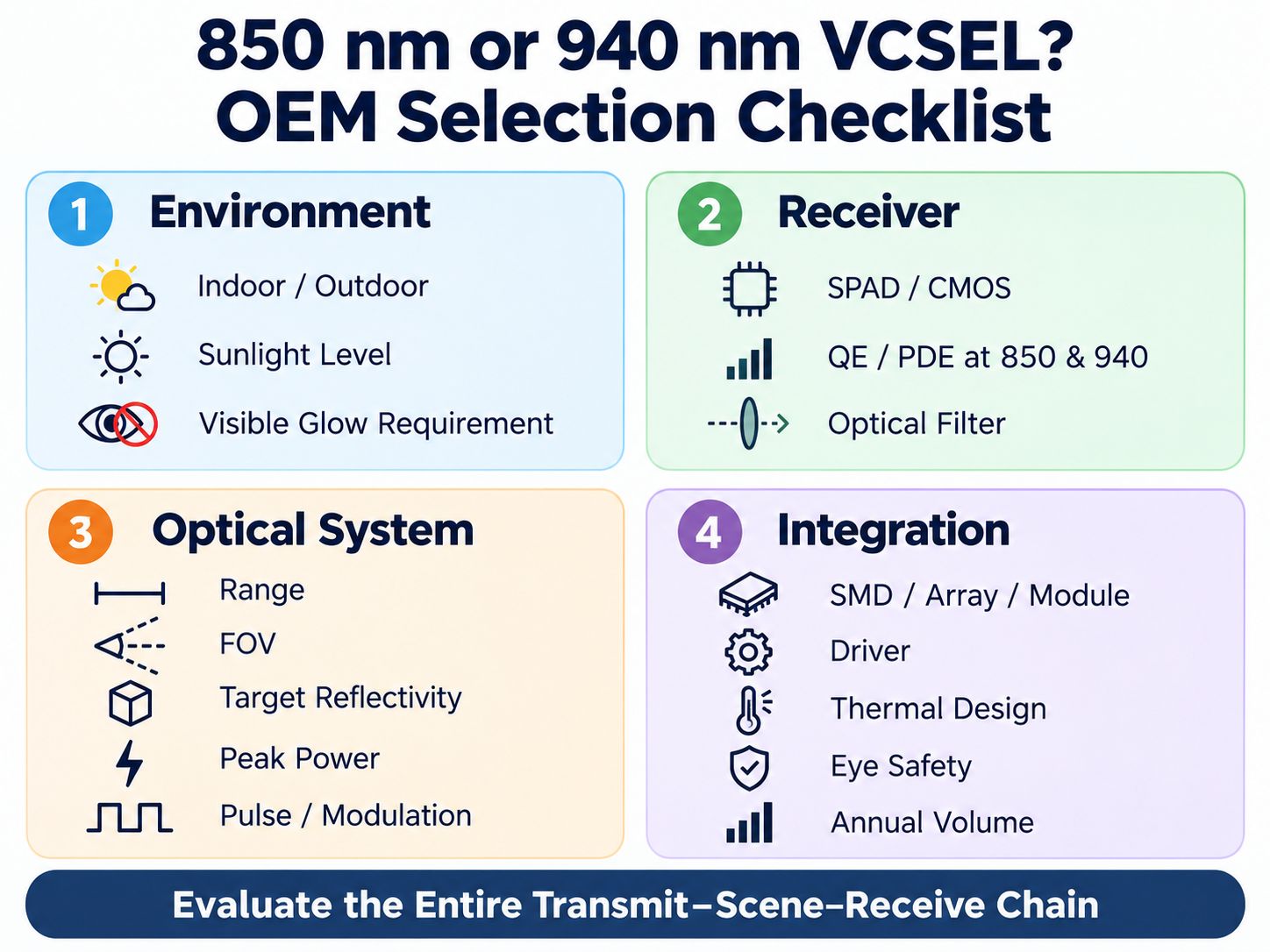
Before choosing the wavelength, define four groups of requirements.
Environment
- Indoor or outdoor?
- Direct sunlight?
- Sunlight through windows?
- Night-only operation?
- Must illumination avoid visible red glow?
Receiver
- SPAD, CMOS ToF or photodiode?
- What is QE/PDE at 850 nm?
- What is QE/PDE at 940 nm?
- What optical filter is available?
- What is the receiver saturation behavior?
Optical System
- Measurement range
- Field of view
- Target reflectivity
- Required depth precision
- Peak optical power
- Pulse width or modulation frequency
- Receiver aperture
- optical efficiency
Integration
- Single emitter, array or module?
- SMD package?
- Driver current?
- Thermal design?
- Laser safety?
- Prototype quantity?
- Annual volume?
The important principle is:
Evaluate the complete transmit–scene–receive chain.
A Practical 850 nm vs 940 nm Decision Tree
Is the main application MMF optical communication?
If yes:
850 nm is the natural starting point.
Will the sensor operate outdoors in bright sunlight?
If yes:
940 nm is usually the stronger starting point.
Must the illumination be unobtrusive to users?
If yes:
940 nm is usually preferred.
Is silicon receiver sensitivity the dominant limitation?
If yes:
Evaluate 850 nm carefully.
Is the product a face-authentication or consumer 3D-sensing system?
940 nm has a very mature ecosystem.
Is the product an indoor robot vacuum?
Evaluate both 850 nm and 940 nm using the actual receiver and sunlight requirement.
Is the product an outdoor robotic mower?
Start by evaluating 940 nm.
Then verify:
VCSEL power → receiver PDE/QE → optical filter → target reflectivity → range → FOV → thermal design → laser safety
Lumi 850 nm and 940 nm VCSEL Examples
Lumi currently offers compact SMD VCSEL products in both wavelength families.
These products illustrate different product directions and should not be interpreted as a controlled wavelength-only A/B comparison.
Their:
- Optical power
- chip design
- package
- beam behavior
- electrical drive
also differ.
Lumi 850 nm 1206 SMD VCSEL — 1206ULM850-L
The 850nm 1206 SMD VCSEL – 1206ULM850-L combines compact surface-mount integration with high-speed optical performance.
Current published values include:
| Parameter | Value |
|---|---|
| Typical wavelength | 850 nm |
| Wavelength range | 830–860 nm |
| Typical optical output | 2 mW @ 6 mA |
| Specified peak power | 30 mW |
| 3 dB bandwidth | ≥3 GHz @ 6 mA |
| Typical viewing angle | 12° |
| Package | 1206 SMD |
This product is particularly relevant to:
- High-speed compact optoelectronics
- Short-reach optical links
- PCB-level optical integration
- Selected sensing systems
Lumi 940 nm 1206 SMD VCSEL — 1206VCA940R8
The 940nm 1206 SMD VCSEL – 1206VCA940R8 is a compact single-channel 940 nm VCSEL for active sensing and space-constrained surface-mount systems.
Current Lumi portfolio information includes:
| Parameter | Value |
|---|---|
| Typical wavelength | 940 nm |
| Optical output | 7.2 mW typ. |
| Operating current | 10 mA typ. |
| Forward voltage | 1.8 V typ. |
| PCE | 40% typ. |
| Package | 1206 SMD |
This illustrates the 940 nm active-sensing direction in a compact PCB-mountable form.
Lumi 940 nm 1616 VCSEL + Photodiode
The 940nm 1616 SMD VCSEL & Photodiode – 1616VCA940R8-PD0224-Z integrates a 940 nm VCSEL emitter and photosensitive diode in one 1616 SMD package.
Current published values include:
- 940 nm VCSEL
- 7.2 mW typical VCSEL optical power
- 10 mA typical operating current
- 1.8 V typical forward voltage
- 40% typical PCE
- Integrated photodiode
- 1616 SMD package
The device is an example of:
940 nm emitter + detector integration + compact PCB package
rather than a high-power multi-watt 3D-sensing array.
For the current family overview, see the Lumi VCSEL Laser Diode portfolio.
Frequently Asked Questions
Is 940 nm better than 850 nm for ToF?
Not universally. 940 nm is often stronger for outdoor ToF because solar background is lower around 940 nm and the illumination is less visible. 850 nm often provides higher silicon-detector sensitivity. The better wavelength depends on the full photon budget.
Why is 940 nm commonly used in 3D sensing?
940 nm combines lower outdoor solar background, minimal visible red glow and a mature ecosystem of VCSEL arrays, flood illuminators, dot projectors, optical filters and ToF receivers.
Is a silicon SPAD more sensitive at 850 nm or 940 nm?
Many silicon detectors have higher QE/PDE at 850 nm than at 940 nm. The exact difference depends on the specific SPAD or sensor, so the manufacturer’s response curve should be used.
Why does 940 nm work better in sunlight?
Atmospheric absorption creates a reduction in solar irradiance around the 920–960 nm region. This can give a 940 nm ToF system a lower ambient background than an 850 nm system.
Can humans see 850 nm VCSEL light?
850 nm is near-infrared, but sufficiently intense emission can produce a faint red glow. 940 nm is much less visible to the human eye.
Is 940 nm eye-safe?
Not inherently. Eye safety depends on optical power, pulse conditions, divergence, optics and accessible emission. A 940 nm laser system still requires a proper laser-safety design and evaluation.
Which wavelength is better for face recognition?
940 nm is commonly the stronger starting point because it provides unobtrusive illumination and has a mature ecosystem for structured light and ToF face authentication.
Which wavelength is better for a robot vacuum?
Both can work. 850 nm offers stronger silicon receiver sensitivity, while 940 nm provides better sunlight conditions and invisible illumination. The correct choice depends on the receiver, range and worst-case lighting environment.
Which wavelength is better for an outdoor robotic lawn mower?
940 nm is usually the stronger starting point because outdoor sunlight is a major design constraint. The complete ToF photon budget and narrow-band filtering still need to be evaluated.
Does 850 nm vs 940 nm change ToF distance accuracy?
Not at the fundamental ranging-equation level. The wavelength mainly affects system factors such as detector sensitivity, ambient-light background, optical filtering and SNR.
Can I replace an 850 nm VCSEL with a 940 nm VCSEL directly?
Usually no. The detector response, optical filter, power budget, driver, optics, calibration, thermal design and eye-safety evaluation should all be reviewed.
Choose the Wavelength from the Complete System
The simplest summary is:
850 nm
→ stronger silicon detector sensitivity
→ major datacom ecosystem
→ strong option for controlled-light sensing
940 nm
→ lower solar background
→ less visible illumination
→ very mature 3D sensing / ToF ecosystem
For an OEM sensing project, the best sequence is:
Application → Environment → Receiver QE/PDE → Optical Filter → Range / FOV → VCSEL Power → Thermal Design → Eye Safety → Package
not:
Choose 850 or 940 first and design everything else around it.
Lumi currently supports compact 850 nm and 940 nm SMD VCSEL platforms for OEM optoelectronic integration.
For a ToF, robotic sensing, proximity, 3D camera or active infrared project, provide the intended environment, receiver type, target range, optical architecture, required power and expected production volume so the VCSEL wavelength and package can be evaluated as part of the complete sensing system.
