
Butterfly Laser Diodes for Precision Photonic Systems
Lumi supplies butterfly-packaged DFB laser diodes for wavelength-sensitive sensing, optical communication, fiber-optic instrumentation and OEM integration. Available directions include 1310 nm and 1550 nm sources, polarization-maintaining output, narrow-linewidth devices, gas-sensing wavelengths and tunable O/C/L-band lasers.
What Is a Butterfly Laser Diode?
A butterfly laser diode combines a semiconductor optical source with mechanical packaging, electrical connections and—depending on the model—fiber coupling, a thermoelectric cooler (TEC), thermistor, monitor photodiode and optical isolator.
Butterfly is the package format, not the optical architecture. A DFB laser can be provided in a butterfly package; the same DFB architecture may also be offered in a TO-can configuration.
Its 14-pin format can simplify integration of multiple active and sensing components, but pin assignments and internal features differ by model.
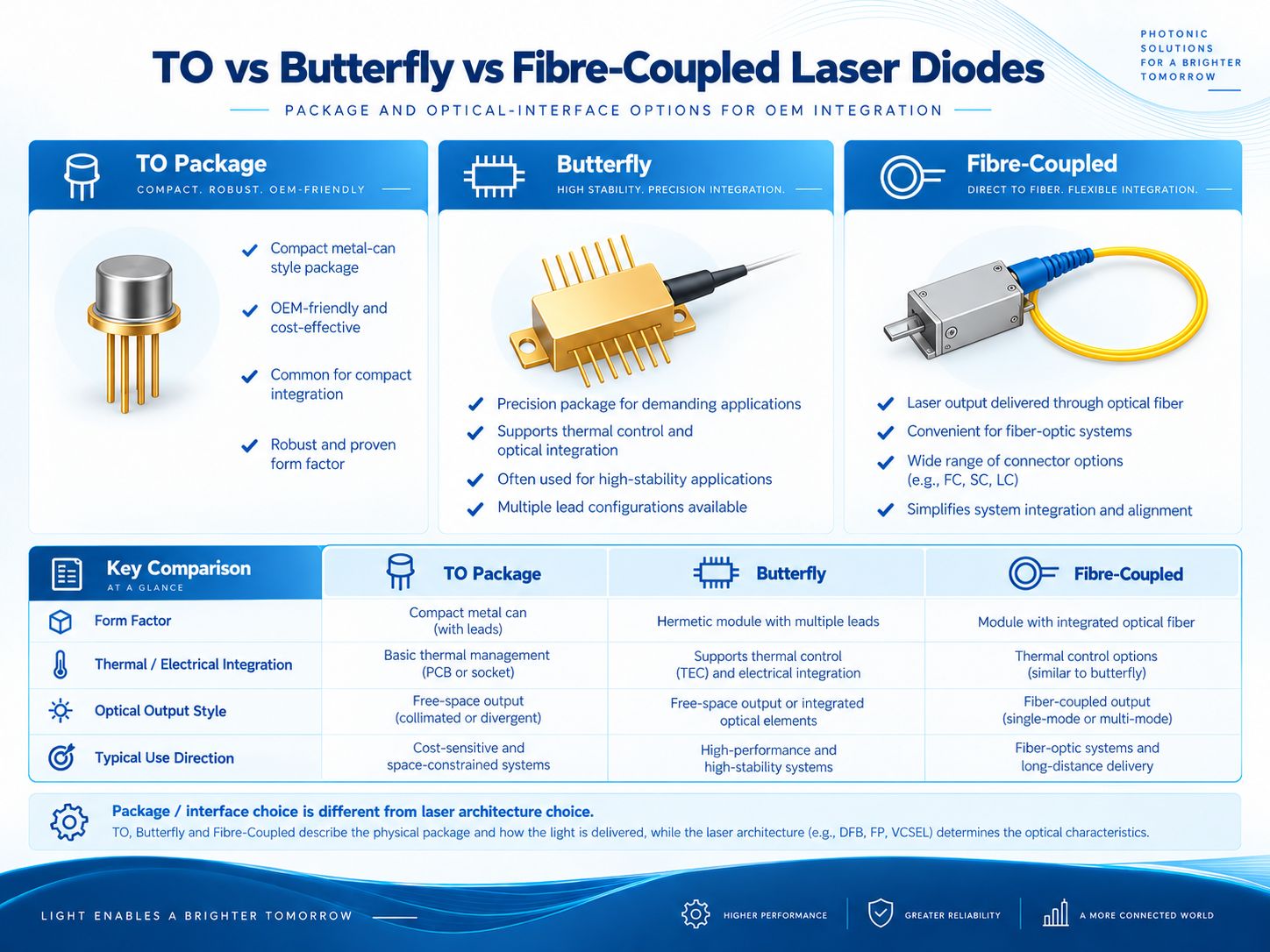
What a Butterfly Laser Package Can Integrate
DFB Laser Chip
Provides the wavelength-selective optical source for sensing or communication.
TEC & Thermistor
The external controller regulates laser temperature using the integrated sensor and cooler.
Monitor Photodiode
Provides feedback to monitor optical output when included in the selected model.
Fiber Output
Factory-aligned SM or PM fiber provides a defined optical interface.
Optical Isolation
Certain devices include an isolator to help limit unwanted feedback.
Pin-Level Connectivity
Electrical connections support the LD, thermistor, TEC and other functions according to the model.
Explore Lumi Butterfly Laser Diodes
Browse real butterfly laser diode models without maintaining a second manual list of product cards.

The product list is generated directly from WooCommerce. Select a product to view the full specifications, drawings and available configuration.
1310 nm, 1550 nm and Gas-Sensing Butterfly Lasers
Choose the product family according to wavelength, fiber-delivered power, linewidth, fiber type and optical-control requirements.
| Product direction | Reported product capability | Typical engineering use |
|---|---|---|
| 1273 / 1392 / 1653 nm DFB | Fiber-pigtailed gas-sensing butterfly, about 10 mW typical in published configuration | TDLAS optical gas analysis |
| 1310 nm DFB, SM fiber | 10 mW typical, TEC / thermistor / monitor photodiode | Optical test and 1310 nm systems |
| 1550 nm DFB, SM fiber | 10 mW-class output with integrated thermal control | Telecom, optical measurement and sensing |
| 1550 nm, narrow linewidth | 100 mW-class; published linewidth about 80–150 kHz for selected device | Precision measurement and coherent optical systems |
| 1550 nm, PM fiber | 20 mW-class; published PER ≥20 dB for selected model | Polarization-sensitive instrumentation |
| 1550 nm, SM / PM fiber | 50 mW-class in published configuration | Higher-output fiber-delivered systems |
| O / C / L-band tunable DFB | 35 nm typical tuning span on published platform | Wavelength-scanning and characterization |
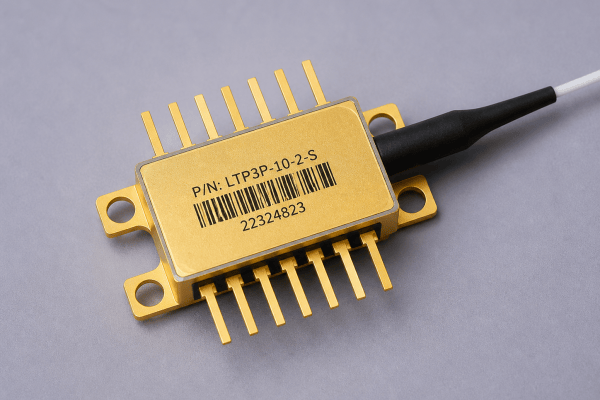
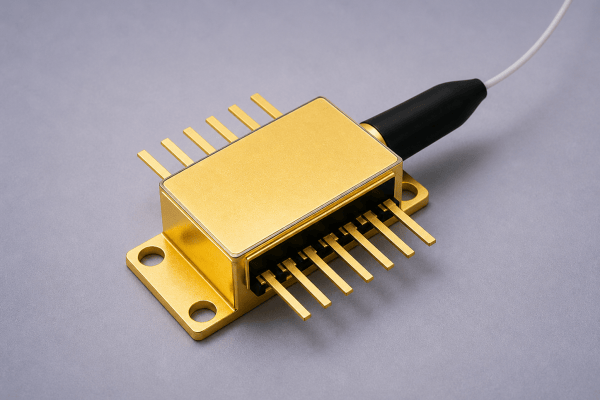
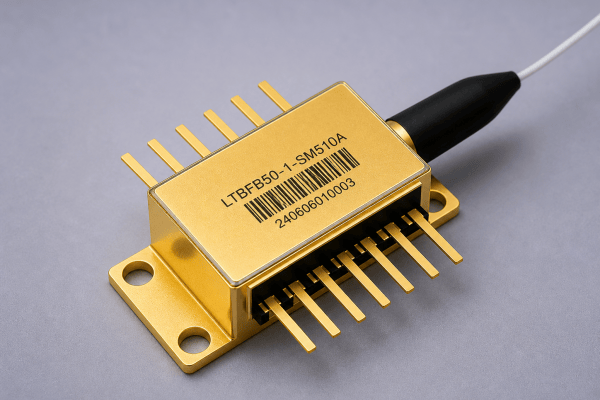
Representative Butterfly Laser Packages
SM Fiber vs PM Fiber in Butterfly Packages
Single-Mode (SM) Fiber
A conventional single-mode output suitable for many sensing, communication and test systems. Specify fiber type, working wavelength, length and connector.
Polarization-Maintaining (PM) Fiber
Selected where downstream interferometry, polarization-sensitive optics or measurement needs a controlled polarization relationship. Confirm PER and fiber-axis alignment for the specific product.
Butterfly vs TO-Can Laser Diode Packages
| Selection factor | Butterfly | TO-Can |
|---|---|---|
| Package size | Larger platform with room for multiple functions | More compact metal can |
| Temperature control | TEC and thermistor commonly available | Heating or TEC on selected configurations |
| Fiber coupling | Often factory-pigtailed SM/PM | Free-space or pigtailed according to model |
| Monitoring | Monitor photodiode on many precision configurations | Available on selected TO products |
| Integration trade-off | More integrated optical source | Compact device; host-system integration may be greater |
TEC Control, Monitor Diode and Pin Assignments
Laser Current Driver
A controlled, low-noise laser driver must remain within the device current and thermal limits.
TEC Driver & Sensor Readout
The external TEC controller reads thermistor feedback and controls the internal cooler.
Monitor Photodiode Feedback
Where provided, the monitor diode can be used for diagnostics and optical-power feedback.
- Do not assume all 14-pin butterflies use the same pin assignment.
- Confirm case connections, TEC polarity, thermistor characteristics and LD polarity.
- Consider ESD handling and driver power-up / shutdown sequencing.
- Choose optical connectors and isolation according to acceptable back-reflection levels.
Where Butterfly DFB Lasers Are Used
TDLAS Gas Analysis
Wavelength-specific DFB sources with controlled temperature and fiber delivery can support industrial spectroscopy.
Optical Communication
1310/1550 nm fiber-delivered sources for communication-related equipment and transmitter evaluation.
Precision & Coherent Sensing
Selected narrow-linewidth 1550 nm products for optical measurement where linewidth and source stability matter.
Polarization-Sensitive Systems
PM-fiber versions for interferometry and systems requiring defined polarization delivery.
Optical Test Instruments
Tunable O/C/L-band sources for component characterization and wavelength-selective testing.
OEM Photonic Modules
Integrations requiring specified wavelength, package pinout, fiber and thermal control.
How to Specify a Butterfly Laser Diode
A useful RFQ begins with the optical function and ends with package-level details.
Optical Requirements
- Nominal wavelength and allowable tuning range
- Fiber-output optical power
- Linewidth, SMSR and stability
- Optical isolation or feedback tolerance
Integration Requirements
- SM or PM fiber and required PER
- Fiber length and FC/APC or other connector
- TEC / thermistor / monitor photodiode
- 14-pin wiring, operating temperature and volume
Butterfly Laser Diode Questions
Is a butterfly laser always a DFB laser?
No. Butterfly describes the package. Current published Lumi butterfly products are DFB-based, but the format can contain other laser architectures.
Does a 14-pin butterfly always include a TEC?
Not automatically. TEC, thermistor, MPD, isolator and pin assignment must be checked on the selected model.
Can I order a polarization-maintaining 1550 nm butterfly?
Lumi has published 1550 nm PM-fiber butterfly configurations; optical power and polarization specifications vary by model.
What is the difference between a tunable DFB and a fixed-wavelength source?
A tunable device is specified for a broader controlled wavelength range. A fixed-wavelength source may allow only limited current- or temperature-driven adjustments.
What does a narrow linewidth specification describe?
It describes spectral width under defined measurement conditions; it should be evaluated alongside phase noise, wavelength stability and system requirements.
Are FC/APC and SC/APC interchangeable?
They are different mechanical connector families; connector type and polish must both match the mating optical interface.
Can a butterfly laser be used for TDLAS?
Yes, when the DFB emission and tuning range match the molecular absorption line and the complete gas-sensing optical system.
What should I send for an OEM quotation?
Share wavelength, delivered fiber power, linewidth, fiber type, connector, TEC/MPD requirements, mechanical constraints, quantities and intended application.
Need a Butterfly Laser for Your Optical System?
Tell us the wavelength, optical output, fiber configuration, spectral requirements and target application. We can evaluate an appropriate butterfly laser configuration.