

Choosing a laser diode manufacturer is not simply a matter of comparing wavelength and output power on several datasheets. The right supplier must be able to match the semiconductor structure, package, thermal design, optical interface and testing method to the final system.
This is especially important for OEM projects involving TDLAS gas sensing, optical communication, medical equipment, spectroscopy and industrial laser integration. A laser diode that appears suitable at component level may still create integration problems if its wavelength tolerance, fiber configuration, temperature control, pin definition or batch consistency does not match the system design.
A practical supplier evaluation should therefore answer three questions:
- Can the supplier provide the required laser chip or packaged diode?
- Can the product be customized for the application and mechanical interface?
- Can the supplier maintain repeatable performance from engineering samples to production quantities?
This guide explains how to evaluate a laser diode manufacturer or OEM supplier, compare packaging options and prepare a more complete request for quotation.
Quick selection principle: Start with the target wavelength and optical performance, then select the package, thermal-control method and fiber interface. Do not choose the package first and force the optical design to fit it later.
What Does a Laser Diode Manufacturer Actually Supply?
The term “laser diode manufacturer” can describe several different types of companies. Some focus on semiconductor wafer and chip fabrication. Others specialize in packaging, fiber coupling, module integration or project-based supply.
Before comparing suppliers, determine which product level your project requires.
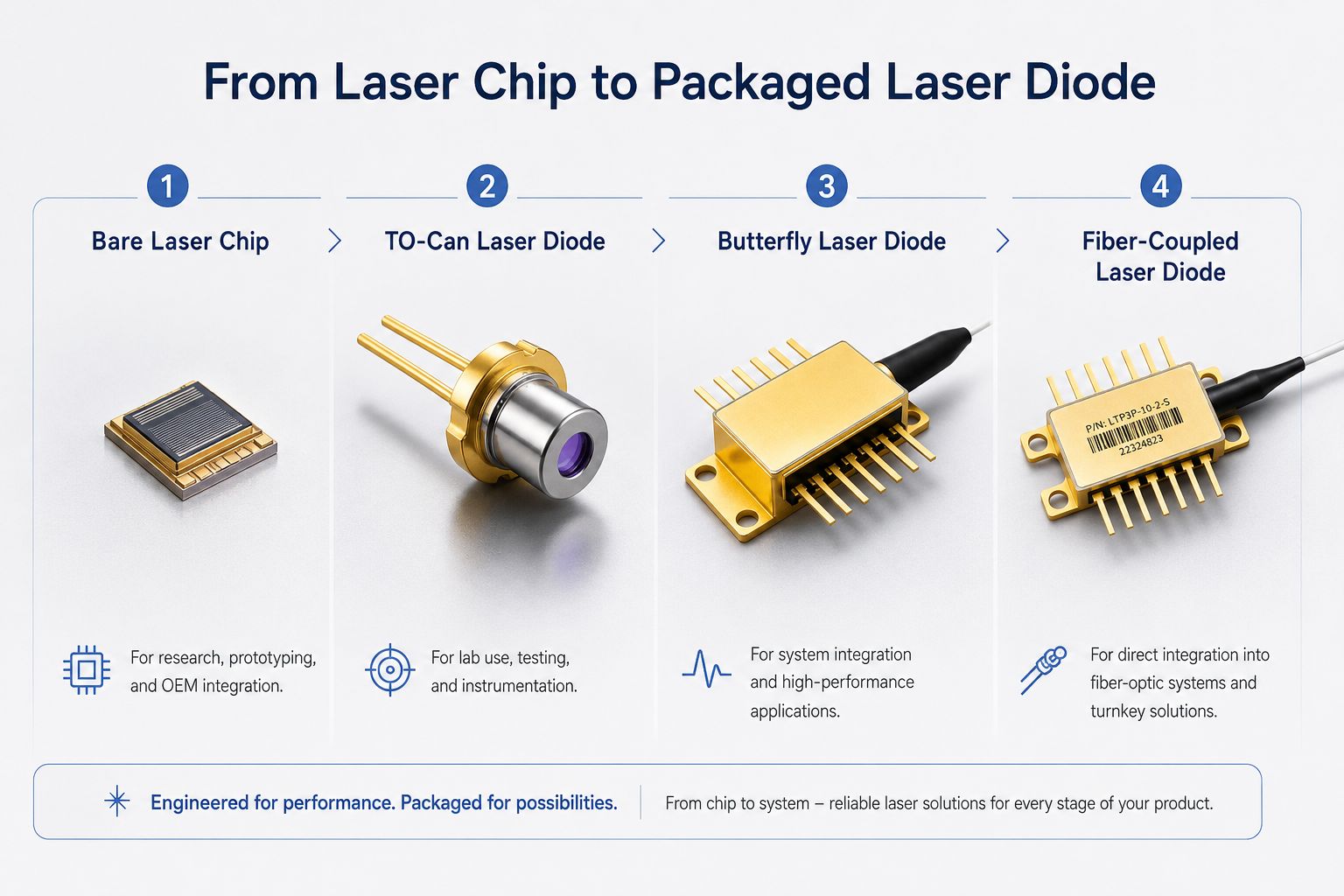
Bare Laser Diode Chips
A bare laser chip is the upstream semiconductor light-emitting component before final packaging. It provides the greatest freedom for customers that have their own photonic packaging, optical alignment or module-production capability.
Bare chips are commonly considered when the customer needs:
- A proprietary optical or mechanical structure
- In-house die bonding and wire bonding
- Integration into a compact photonic module
- Custom heat spreading or submount design
- Greater control over packaging cost at production scale
- Project-based wavelength or chip development
Bare-chip sourcing requires more engineering capability from the buyer. The customer must manage ESD protection, die handling, mounting, thermal transfer, optical alignment and hermetic or non-hermetic packaging.
Lumi supports project-based laser chip OEM cooperation as well as packaged laser diode supply. Buyers that need an upstream component rather than a finished package can begin by reviewing the Lumi laser diode product range and submitting the chip-level requirements for evaluation.
Packaged Laser Diodes
Packaging turns the semiconductor chip into a component that can be electrically connected, thermally managed and integrated into equipment. Common forms include:
- TO-can laser diodes
- Butterfly laser diodes
- Fiber-pigtailed laser diodes
- Fiber-coupled laser diode assemblies
- Application-specific custom packages
The package may incorporate a monitor photodiode, thermistor, thermoelectric cooler, heater, optical window, lens, isolator or fiber pigtail. The exact configuration determines how easily the laser can be driven and stabilized in the final instrument.
Laser Diode Packages vs Complete Laser Modules
A packaged laser diode is not always a complete laser module.
A complete module may also include:
- Laser driver electronics
- TEC controller
- Optical collimation
- Mechanical housing
- Communication interface
- Power regulation
- Safety control
- Firmware or monitoring functions
This distinction matters during sourcing. A buyer asking for a “laser module” may receive quotations for very different product levels. The RFQ should clearly state whether the requirement is for a bare chip, packaged diode, fiber-pigtailed component or fully driven module.
Key Capabilities to Evaluate in a Laser Diode Manufacturer
A reliable evaluation should combine optical, electrical, mechanical and supply-chain criteria.
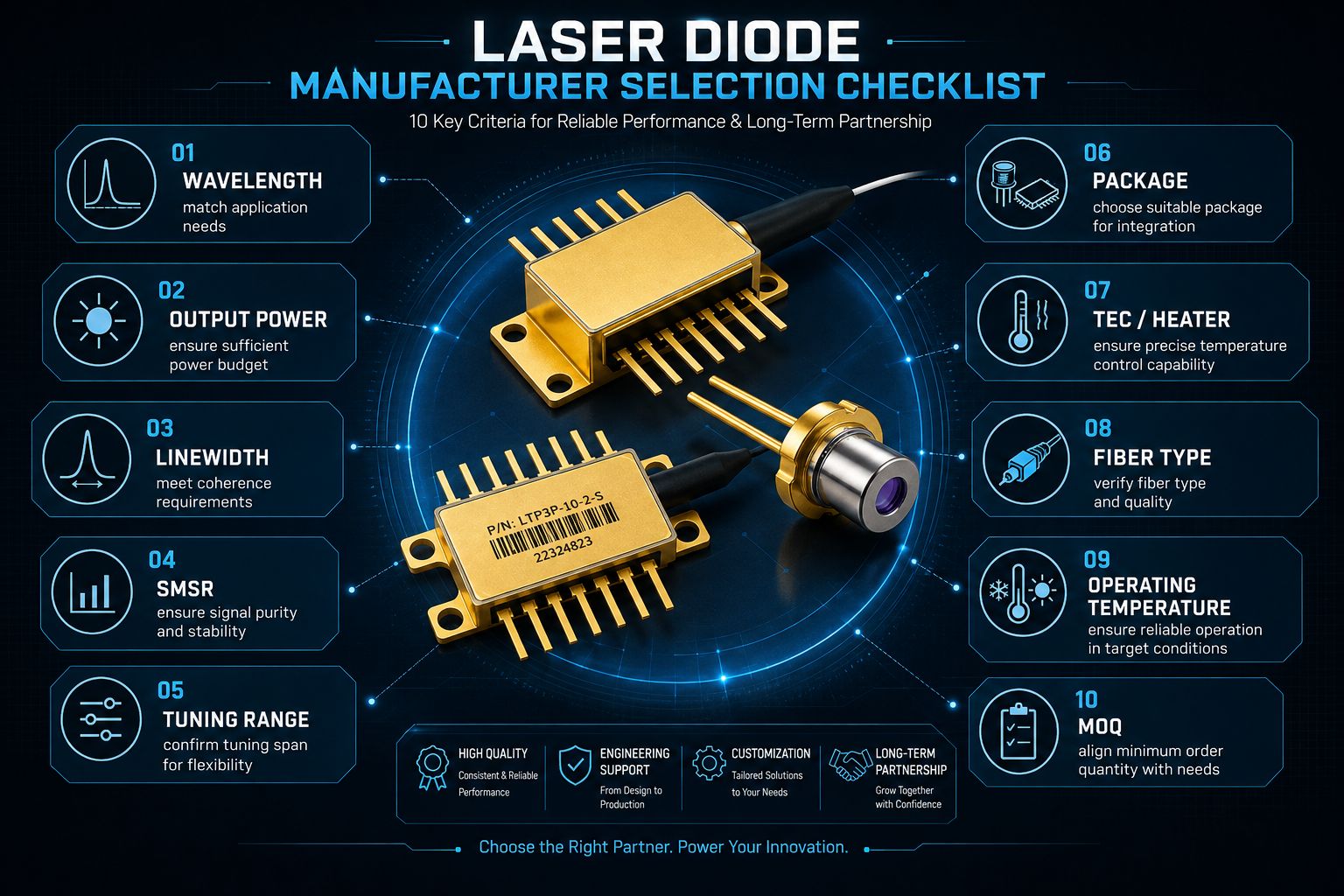
1. Wavelength Capability and Laser Architecture
The first question is not simply “Do you have a 1550 nm laser diode?” It is whether the supplier can provide the correct center wavelength, tolerance and tuning behavior under the intended operating conditions.
Important points include:
- Target center wavelength
- Allowed wavelength tolerance
- Temperature tuning coefficient
- Current tuning coefficient
- Required tuning range
- Operating temperature
- Mode-hop behavior
- Longitudinal-mode requirements
The laser structure also matters. Common options include Fabry–Pérot, DFB and other wavelength-selective designs.
A DFB laser diode is frequently selected when the application needs narrow spectral output, stable wavelength behavior or a defined single-mode operating region. For general technical background, the RP Photonics explanation of distributed feedback lasers provides a useful overview of the operating principle.
For TDLAS projects, the target wavelength must correspond to an appropriate molecular absorption feature. Databases such as HITRANonline can support absorption-line research, but the final laser specification must also consider pressure, temperature, interfering gases, tuning range and detector response.
2. Optical Output and Spectral Performance
Nominal optical power alone does not define whether a laser diode is suitable.
Depending on the application, evaluate:
- Continuous-wave or pulsed output
- Threshold current
- Operating current
- Slope efficiency
- Spectral linewidth
- Side-mode suppression ratio
- Beam divergence
- Polarization
- Relative intensity noise
- Power stability
- Wavelength stability
For spectroscopy and gas sensing, linewidth, SMSR and tuning characteristics may be more important than maximum output power. For pumping or industrial applications, power, electrical efficiency, duty cycle and thermal resistance may dominate the design.
Ask the supplier to identify the test conditions behind each value. A parameter measured at 25°C under a specific drive current should not automatically be treated as valid across the entire operating range.
3. Packaging Capability
The package affects size, heat transfer, electrical access, optical alignment and long-term reliability.
A supplier should be able to explain:
- Which standard packages are available
- Which dimensions and pin configurations can be customized
- Whether the package is hermetic
- Whether an optical window or lens is included
- Whether TEC, thermistor or monitor photodiode can be integrated
- Whether fiber coupling is completed at the factory
- Which mounting and heat-sinking requirements apply
Lumi currently offers several relevant categories, including TO package laser diodes, butterfly laser diodes and fibre-coupled laser diodes.
4. Thermal-Control Design
Laser-diode wavelength and output can change with junction temperature. Thermal control is therefore a functional part of the optical design rather than an optional mechanical detail.
The evaluation should cover:
- Maximum junction and case temperature
- Required heat sink
- TEC capacity
- Thermistor type
- Heater option
- Temperature-control accuracy
- Start-up stabilization time
- Power consumption
- Heat flow from chip to package and system
A compact TO package may be suitable for an instrument with limited space, while a butterfly package with integrated TEC may be preferable when wavelength stability and fiber output are priorities.
The supplier should also clarify whether a stated operating-temperature range refers to the package, ambient environment or a controlled internal temperature.
5. Fiber-Coupling Capability
Fiber coupling can simplify downstream optical alignment, but it introduces additional variables that must be specified.
These include:
- Single-mode, polarization-maintaining or multimode fiber
- Fiber core and cladding dimensions
- Numerical aperture
- Coupling efficiency
- Polarization extinction ratio
- Fiber length
- Buffer or jacket
- Connector type
- Output-end treatment
- Minimum bend radius
- Fiber proof testing
- Optical isolator requirements
Do not treat “fiber-coupled” as a complete specification. A device with SM fiber and an FC/APC connector may be entirely different from one with PM fiber, a specified slow-axis orientation and a bare fiber end.
6. Testing and Traceability
A qualified manufacturer or packaging supplier should define what is tested on each device, what is tested by sampling and what can be included in a project-specific report.
Relevant verification may include:
- LIV characteristics
- Center wavelength
- Optical spectrum
- SMSR
- Fiber-coupled output
- Thermistor resistance
- TEC current and voltage
- Pin continuity
- Visual inspection
- Burn-in or aging
- Temperature cycling
- ESD controls
- Serial-number traceability
The exact test plan depends on product type and project risk. Buyers should request the test method, environmental conditions, acceptance limits and report format before approving a production order.
7. OEM and Customization Support
Many sourcing problems begin when “customizable” is not clearly defined.
Possible customization items include:
- Center wavelength
- Output power
- Chip structure
- Package type
- Pin assignment
- TEC or heater
- Thermistor
- Monitor photodiode
- Fiber type
- Fiber length
- Connector
- Housing or mounting interface
- Test criteria
- Product label and traceability
A capable OEM supplier should identify which changes are standard configuration options, which require engineering development and which are not feasible.
8. Sample, MOQ and Production Support
A technically suitable product can still fail as a sourcing solution when the sample process, MOQ or lead time does not match the project.
Confirm:
- Engineering-sample quantity
- Sample lead time
- Non-recurring engineering cost
- Production MOQ
- Pilot-batch availability
- Volume lead time
- Forecast requirements
- Change-notification process
- Batch-consistency controls
- Long-term availability
For early-stage development, low-volume sample support can be more valuable than a low unit price tied to an impractical MOQ.
TO-Can vs Butterfly vs Fiber-Coupled Laser Diodes
The following comparison provides a practical starting point. The correct choice still depends on the optical and system requirements.
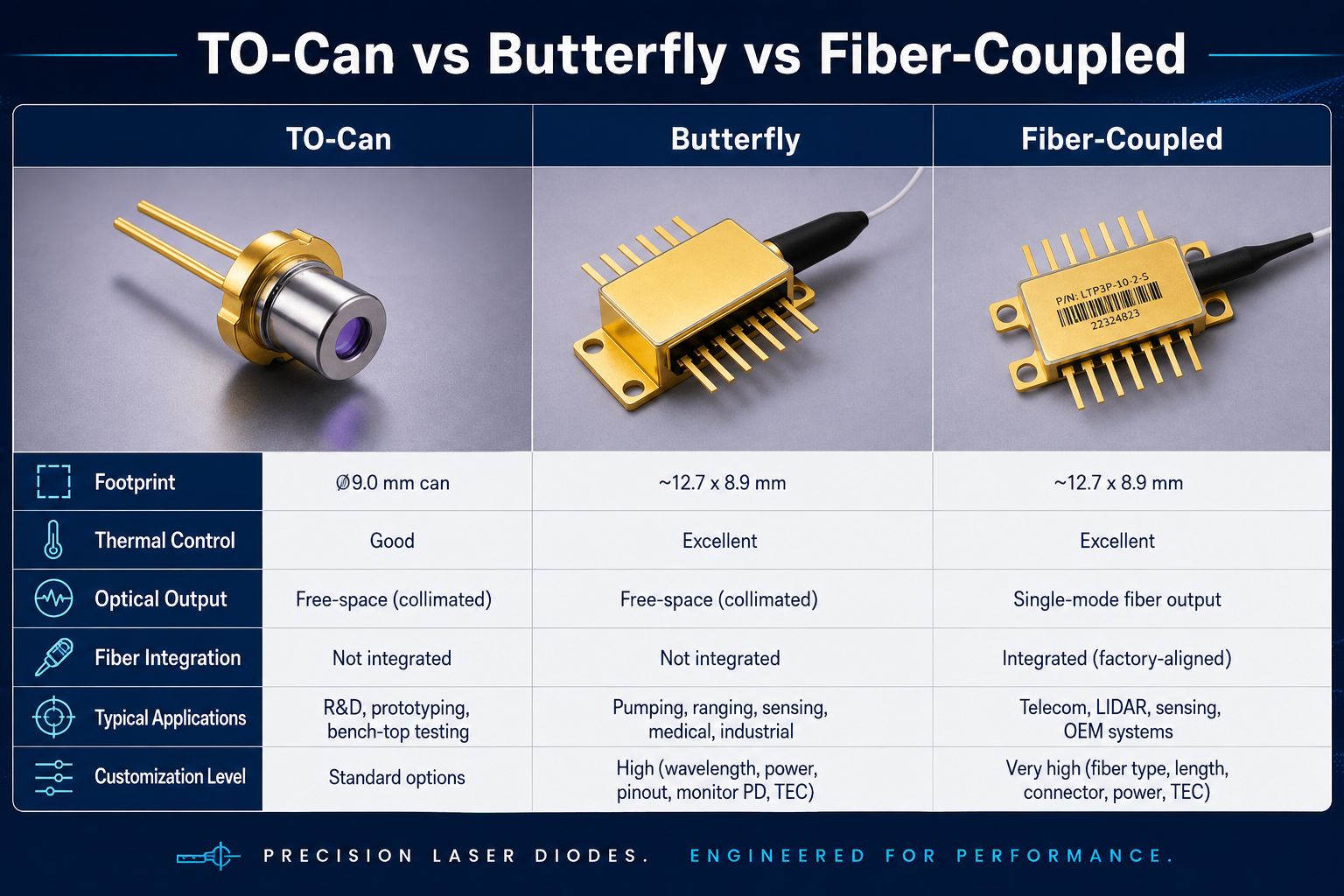
| Product Form | Main Advantages | Main Considerations | Typical Fit |
|---|---|---|---|
| Bare laser chip | Maximum integration flexibility and control over the final package | Requires die handling, bonding, heat management and optical packaging capability | Proprietary modules, high-volume OEM integration and photonic development |
| TO-can laser diode | Compact, cost-effective and suitable for space-constrained instruments | Limited internal volume; thermal and optical configuration must be checked carefully | Gas sensing, compact instruments, laboratory systems and OEM devices |
| Butterfly laser diode | Can integrate TEC, thermistor, monitor photodiode and fiber pigtail in a stable package | Larger footprint and usually higher system cost | TDLAS, optical communication, spectroscopy and precision photonics |
| Fiber-coupled laser diode | Simplifies beam delivery and downstream optical integration | Fiber type, connector, coupling stability and polarization must be specified | Sensing systems, communication, medical equipment and industrial integration |
When to Choose a TO-Can Package
A TO-can package is often suitable when the project needs:
- Compact dimensions
- Direct electrical connection
- Free-space output or a compact fiber-pigtailed design
- Cost-effective OEM integration
- Optional TEC or heater control
- A standard mechanical form
For methane sensing, Lumi offers a cooled 1653.7 nm DFB laser diode in a TEC-integrated TO package. A heating-type 1650.9 nm DFB laser diode for methane gas sensing is also available for projects using a different thermal-control approach.
When to Choose a Butterfly Package
A butterfly package is a strong candidate when the system requires:
- Integrated temperature control
- Stable fiber output
- Monitor photodiode feedback
- Narrow-linewidth or wavelength-sensitive operation
- Mechanical robustness for system integration
- Multiple internal functions in one package
Lumi’s 1273–1653 nm DFB pigtailed butterfly laser diode is positioned for gas-detection and TDLAS-related projects. For communication and precision photonics, the 1550 nm high-power narrow-linewidth DFB butterfly laser diode provides another example of an application-oriented butterfly configuration.
When to Choose a Fiber-Pigtailed or Fiber-Coupled Device
Fiber output is useful when the laser must connect directly to:
- A gas cell
- A splitter or coupler
- A photonic circuit
- A communication module
- A remote optical head
- A medical handpiece
- A spectroscopy system
For projects that need a compact package with fiber delivery, the 1290–1653 nm cooled TO-CAN laser diode with fiber pigtail illustrates how TO packaging and fiber output can be combined.
Choosing a Laser Diode Manufacturer by Application
Application requirements should determine the order in which specifications are prioritized.
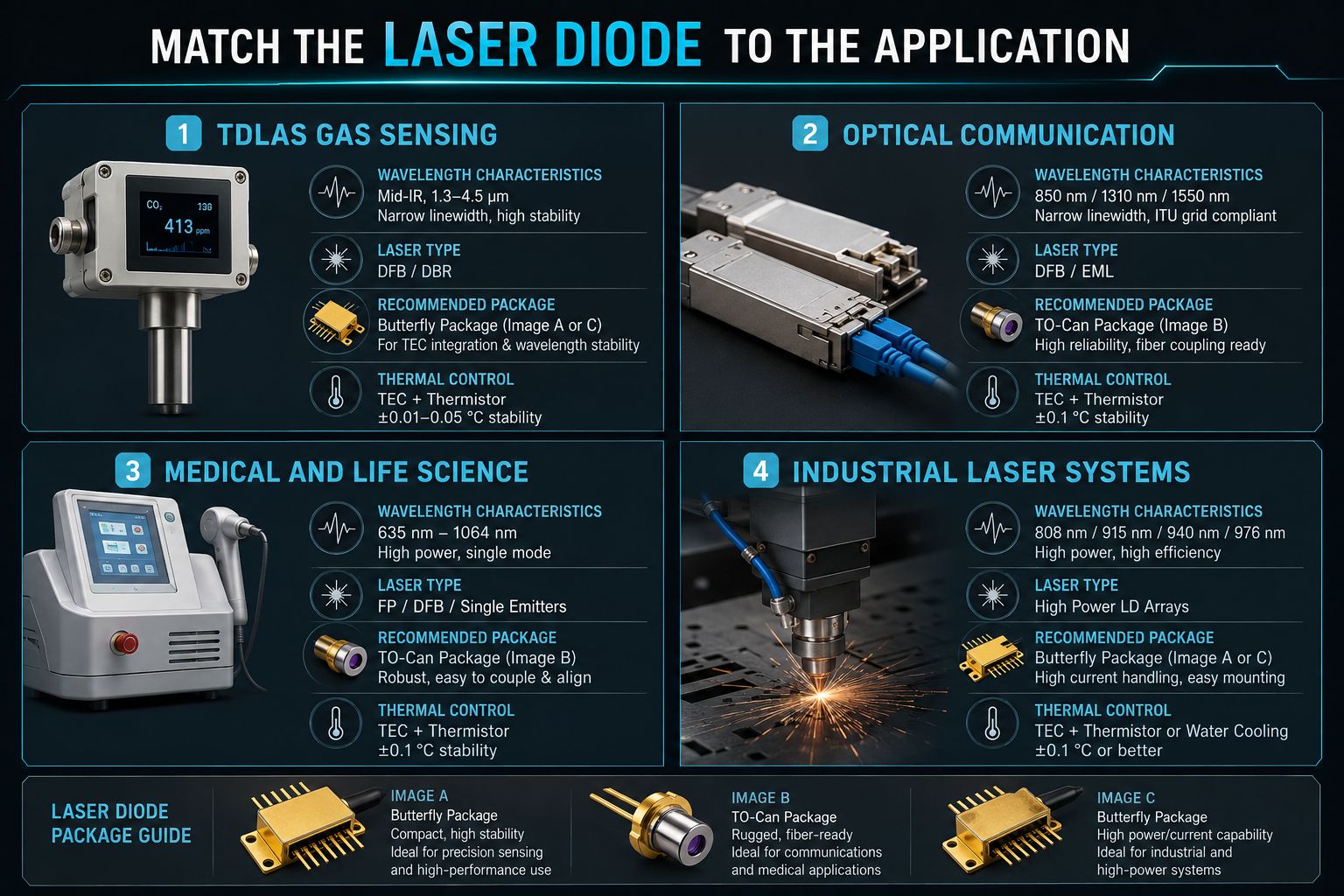
The application matrix above is a selection framework. Exact wavelength, laser structure, package and thermal-control requirements must be verified for each system.
TDLAS and Gas Sensing
TDLAS systems use a tunable laser to scan across a selected gas-absorption feature. The laser must therefore deliver controlled wavelength tuning and sufficient spectral purity for the target measurement.
Important sourcing criteria include:
- Target gas and absorption line
- Center wavelength
- Temperature and current tuning range
- Linewidth
- SMSR
- Mode-hop-free operating region
- Optical power at the detector
- Fiber or free-space output
- TEC or heater strategy
- Long-term wavelength repeatability
For methane detection, wavelengths around 1653 nm are commonly considered in near-infrared TDLAS designs. However, the correct device should be selected using the complete measurement environment rather than wavelength alone.
Lumi’s gas-sensing product directions include TO-can, fiber-pigtailed TO-can and butterfly-packaged DFB laser diodes. This allows an OEM customer to compare compact packaging, integrated temperature control and fiber-delivery options within the same project.
Optical Communication and Photonic Systems
Communication and photonic-integration projects may prioritize:
- 1310 nm or 1550 nm operation
- DFB single-mode output
- Narrow linewidth
- Fiber coupling
- Polarization behavior
- Optical power
- Modulation requirements
- Connector and pigtail configuration
- Long-term wavelength and power stability
The final selection depends on whether the diode is used as a transmitter, seed source, test source, sensing element or part of a larger optical subassembly.
For a broader overview of semiconductor laser types and operating principles, see the RP Photonics laser diode reference.
Medical and Life-Science Equipment
Medical, analytical and life-science systems may require specific wavelengths based on tissue interaction, fluorescence excitation, absorption or instrument architecture.
The supplier evaluation should address:
- Wavelength tolerance
- Optical power and beam delivery
- Continuous or pulsed operation
- Fiber compatibility
- Thermal management
- Package size
- Duty cycle
- Product lifetime
- System-level safety requirements
The laser diode is only one component of the final medical or aesthetic device. Regulatory compliance, laser classification and patient safety must be managed at the finished-equipment level.
Industrial Laser Integration
Industrial projects may place greater emphasis on:
- Output power
- Conversion efficiency
- Heat dissipation
- Duty cycle
- Mechanical mounting
- Fiber delivery
- Environmental resistance
- Production consistency
- Service lifetime
Applications can range from sensing and alignment to pumping, material processing and laser welding subsystems. The selected manufacturer should understand whether the laser is acting as a precision optical source or a power-delivery component, because the package and test priorities are very different.
A Typical Custom Laser Diode OEM Process
Custom laser diode projects work best when technical requirements are agreed before sample production.
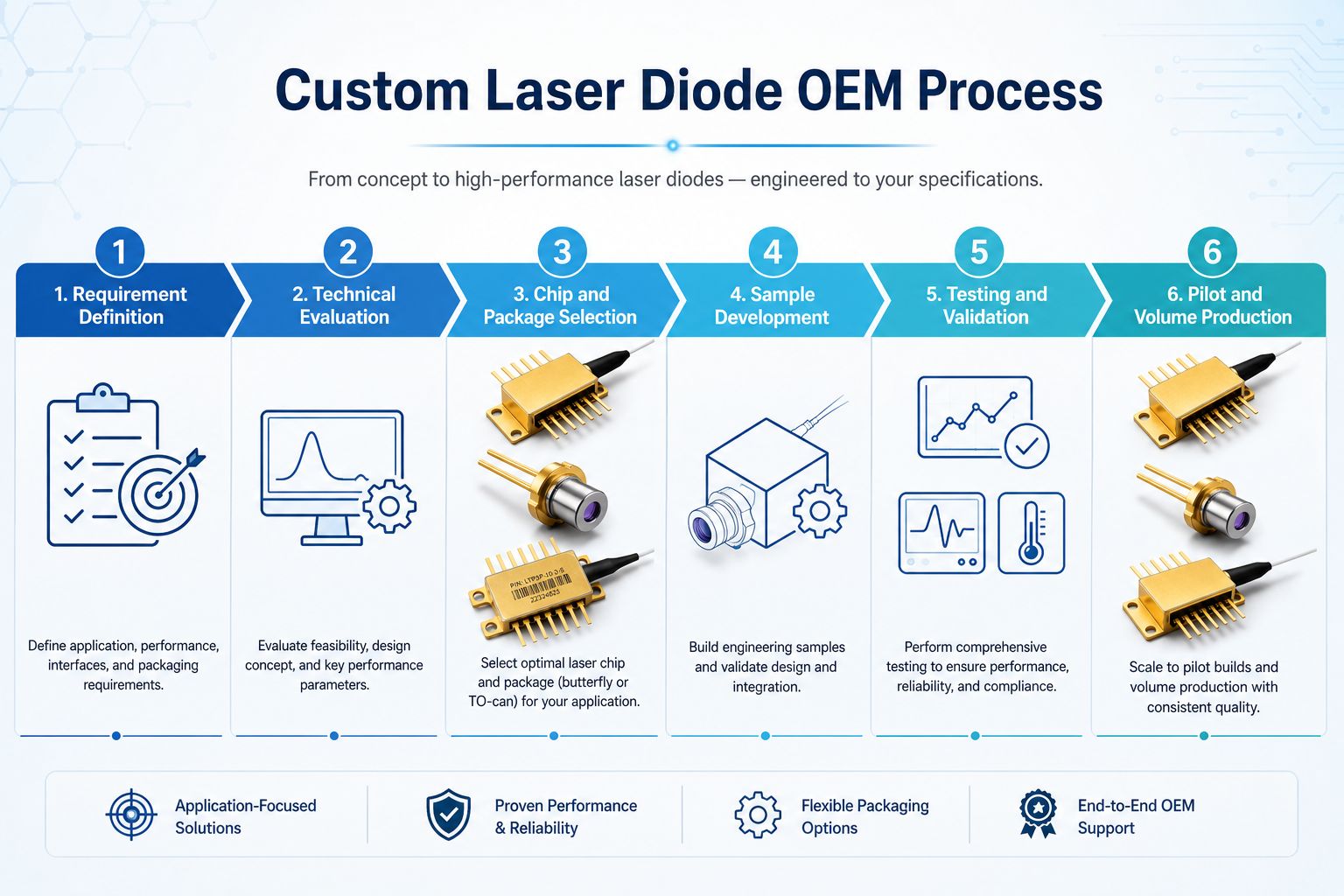
Step 1: Requirement Definition
The buyer should provide:
- Application
- Target wavelength
- Required optical power
- Laser structure, if known
- Package preference
- Fiber type and connector
- Operating temperature
- Available heat sink
- Electrical-drive conditions
- Sample quantity
- Estimated annual quantity
A complete requirement reduces the risk of receiving a quotation for a product that matches only the wavelength.
Step 2: Technical Evaluation
The supplier reviews whether the optical, electrical and mechanical requirements can be achieved together.
This stage should identify:
- Available chip platform
- Wavelength feasibility
- Expected optical output
- Package constraints
- Thermal-control strategy
- Fiber-coupling requirements
- Test method
- Development risk
Step 3: Chip and Package Selection
The project then moves from general requirements to a defined component architecture.
The decision may involve:
- Bare chip or packaged diode
- FP or DFB structure
- TO-can or butterfly package
- Free-space or fiber output
- TEC, heater or passive thermal control
- Monitor photodiode
- Thermistor
- Pin configuration
- Connector and pigtail
Step 4: Sample Development
Engineering samples allow both supplier and customer to verify the design.
The sample stage may include:
- Prototype packaging
- Initial optical testing
- Fiber alignment
- Mechanical inspection
- Pin and electrical verification
- Preliminary test report
- Customer-system evaluation
Step 5: Testing and Validation
Sample approval should be based on agreed acceptance criteria rather than visual inspection alone.
The customer should confirm:
- Center wavelength under operating conditions
- Output power
- Spectral performance
- Temperature behavior
- Electrical characteristics
- Fiber performance
- Mechanical compatibility
- Repeatability between samples
Step 6: Pilot and Volume Production
Before full production, a pilot batch can help verify:
- Batch consistency
- Assembly yield
- Test limits
- Packaging and labeling
- Traceability
- Shipping protection
- Customer-system performance
Once the pilot is approved, the final specification and change-control process should be documented.
Quality and Reliability Questions to Ask
Quality claims are more useful when they are connected to a defined test method.
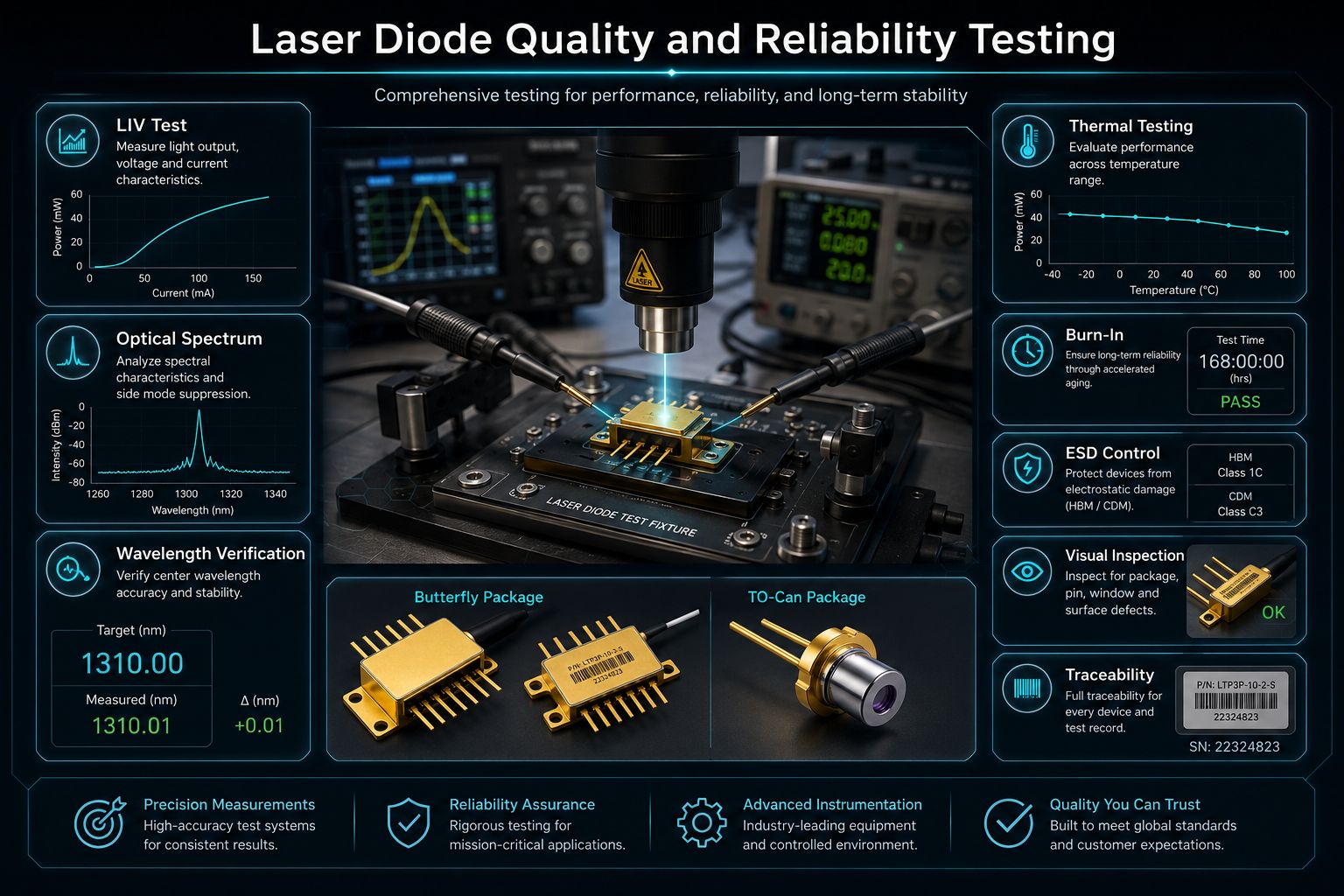
Ask the supplier:
- Which parameters are tested on every device?
- At what temperature and drive current are they tested?
- Is the center wavelength measured before or after fiber coupling?
- Is optical power measured at the chip, package window or fiber end?
- Is SMSR included in the test report?
- Are TEC and thermistor functions checked?
- Is burn-in available or standard?
- What ESD controls are used during handling and packaging?
- Is each unit linked to a serial number or batch record?
- Can project-specific acceptance limits be included in the order specification?
For custom projects, the testing scope should be agreed during quotation. Lumi supports power and wavelength verification and can discuss additional project-specific requirements according to the product form and application.
Common Warning Signs When Evaluating a Supplier
A low quotation should not compensate for incomplete technical information.
Be cautious when:
- The datasheet does not state test conditions
- The wavelength is listed without tolerance
- Fiber type is not identified
- TEC, thermistor and monitor-photodiode pins are unclear
- Mechanical drawings are missing
- Sample and production specifications are different
- The supplier cannot explain what is tested
- “Custom” options are not defined
- MOQ and lead time change after sample approval
- Product changes are made without notification
A reliable manufacturer or OEM supplier should be able to explain limitations as clearly as capabilities.
Questions to Include in a Laser Diode RFQ
A good RFQ can significantly shorten the technical-evaluation cycle.
Use the following checklist:
| RFQ Item | Information to Provide |
|---|---|
| Application | TDLAS, communication, medical, industrial, spectroscopy or other |
| Target wavelength | Nominal wavelength and acceptable tolerance |
| Optical output | Required minimum, typical or range |
| Laser structure | DFB, FP or open to recommendation |
| Spectral requirements | Linewidth, SMSR, tuning behavior |
| Package | Bare chip, TO-can, butterfly or fiber-coupled |
| Thermal control | TEC, heater, thermistor or passive |
| Optical interface | Free-space, SM fiber, PM fiber or MM fiber |
| Fiber configuration | Length, coating, connector and end-face |
| Electrical requirements | Current, voltage, pin definition and driver constraints |
| Environment | Operating and storage temperature |
| Quantity | Samples, pilot batch and estimated annual demand |
| Testing | Required report and acceptance limits |
| Compliance | Project or market-specific requirements |
Why Work with Lumi for Laser Diode OEM Projects?
Lumi focuses on upstream laser chips and packaged laser diode solutions for global B2B projects.
Current product and cooperation directions include:
- Laser diode chip OEM support
- Standard and custom TO-can packaging
- Butterfly laser diode supply
- Fiber-coupled and fiber-pigtailed configurations
- DFB laser diodes for gas sensing and communication
- TEC- and heater-related package options
- Project-based wavelength and configuration matching
- Sample and engineering communication for OEM buyers
The objective is not to force every project into one standard product. It is to identify whether the customer needs a bare chip, compact TO package, thermally controlled butterfly package or fiber-delivered component.
Explore the complete laser diode product range or contact Lumi with the target wavelength, package, optical power, fiber requirement and expected quantity.
