

A DFB laser diode around 1684 nm is widely used as a near-infrared light source for ethane (C₂H₆) detection because ethane has a useful absorption band in the 1.68 µm region, including a strong sensing feature reported near approximately 5937.2–5937.3 cm⁻¹, corresponding to about 1684.3 nm.
For tunable diode laser absorption spectroscopy (TDLAS), the value of this wavelength is not simply that “ethane absorbs at 1684 nm.” The real engineering advantage is that a narrow-linewidth DFB laser can be temperature- and current-tuned across a selected C₂H₆ absorption feature while using compact near-infrared optics, InGaAs detection and established fiber components.
There is an important qualification, however:
“1684 nm” should be treated as a practical ethane sensing region, not as one universal, perfectly isolated ethane line that every system should target at exactly 1684.000 nm.
Ethane shows an unresolved vibration-rotation absorption structure in this spectral region, and nearby methane absorption must also be considered. A published CH₄/C₂H₆ fiber sensor, for example, used a DFB laser around 1684 nm to access a methane structure near 5938.12 cm⁻¹ and a stronger ethane feature near 5937.3 cm⁻¹. More recent work continues to address spectral overlap between methane and ethane in the approximately 1680 nm region.
For an OEM project, the correct purchasing requirement is therefore not simply:
“Need a 1684 nm laser.”
It is closer to:
“Need a single-mode DFB laser whose verified temperature/current tuning range covers the selected ethane absorption feature under the intended gas pressure, temperature and interference conditions.”
That distinction can prevent a nominally correct laser from missing the absorption region required by the actual detection algorithm.
For the broader laser-architecture background, see DFB vs FP vs VCSEL: Laser Diode Types Compared.
Why Measure Ethane?
Ethane is more than another hydrocarbon concentration measurement.
In natural-gas monitoring, measuring C₂H₆ together with CH₄ can help distinguish different methane sources.
Natural gas and other thermogenic hydrocarbon sources commonly contain both methane and heavier hydrocarbons such as ethane. In contrast, methane generated by many biogenic processes can contain little or no ethane.
This makes ethane useful in applications such as:
- Natural-gas leak identification
- Methane source attribution
- Pipeline leak surveying
- Oil and gas emissions monitoring
- C₂H₆ / CH₄ ratio analysis
- Portable and mobile gas analyzers
- UAV-based environmental monitoring
The engineering value of an ethane channel is therefore often not limited to measuring “how much ethane is present.”
It may also help answer:
Is this methane plume likely associated with natural gas, or with another methane source?
A compact optical sensor that measures both CH₄ and C₂H₆ can therefore provide more diagnostic information than a methane-only sensor.
Where Does Ethane Absorb in the Near Infrared?
Ethane has near-infrared absorption structure around the 1.68 µm region.
Unlike an idealized diagram showing one perfectly isolated narrow line, published work often describes the near-IR ethane feature as an unresolved or unresolvable vibration-rotation absorption band.
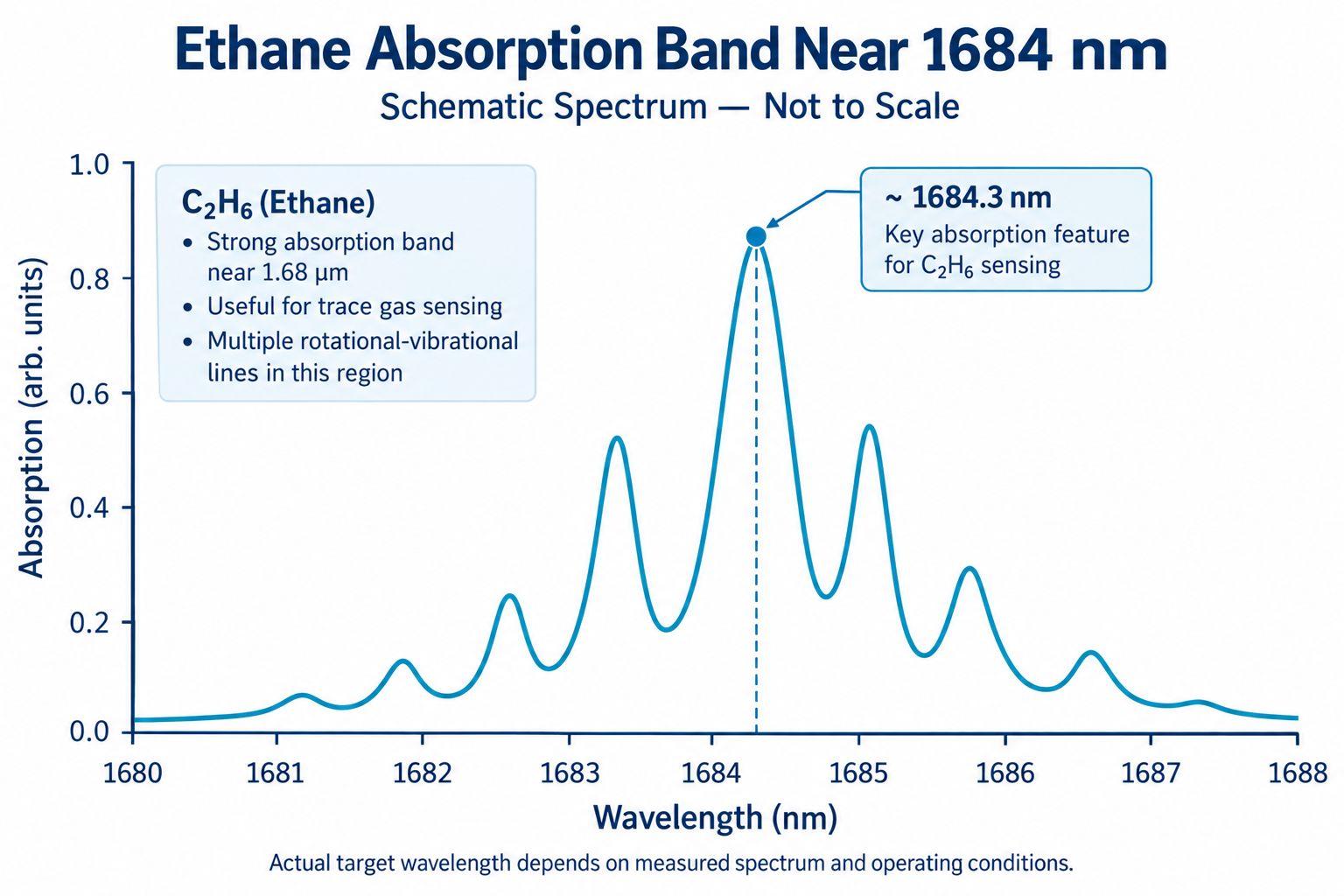
Experimental studies have identified strong ethane absorption in the region around:
5937.2–5937.3 cm⁻¹
which corresponds to approximately:
1684.3 nm
The exact useful operating point depends on:
- The specific laser tuning range
- Gas pressure
- Gas temperature
- Ethane concentration
- Optical path length
- Other absorbing gases
- Spectral-fitting method
- Whether the system uses DAS, WMS, PAS or QEPAS
This is why a schematic absorption plot should be treated as a conceptual guide rather than as a substitute for measured or validated spectral data.
For actual instrument development, the selected DFB laser should be scanned across the real target spectrum under representative operating conditions.
Why Is 1684 nm Used for Ethane TDLAS?
Several system-level factors make the 1.684 µm region practical for near-infrared ethane sensing.
Useful C₂H₆ Absorption
Ethane has measurable absorption in this region, and experimental work has successfully used DFB diode lasers around 1684 nm for ethane detection.
A published photoacoustic sensor, for example, used a DFB source at 5937.25 cm⁻¹ and wavelength modulation with second-harmonic detection for C₂H₆ measurement.
Other work has used pigtailed DFB lasers around 1684–1684.5 nm in fiber-based sensing systems.
Mature DFB Semiconductor Laser Technology
Near-infrared InP-based semiconductor laser technology supports narrow, electrically tunable DFB sources in the wavelength range used by many gas-sensing instruments.
Compared with more complex laser systems, a DFB diode can provide:
- Compact size
- Low electrical power
- Direct current modulation
- Temperature tuning
- Fiber-compatible output
- OEM-friendly packaging
InGaAs Detector Compatibility
The 1.68 µm region can be detected with established InGaAs photodetector technology.
This helps keep the receive side compact and practical for OEM analyzers.
Fiber Delivery
Single-mode fiber delivery can be used to separate the laser source from:
- Multipass cell
- QEPAS module
- Probe head
- Remote measurement point
This can simplify mechanical design in portable and modular analyzers.
Current and Temperature Tuning
A DFB source can normally be tuned by adjusting:
- Laser temperature
- Injection current
That makes it possible to position the emission near the desired spectral region and then scan across the target feature.
The actual tuning coefficients must always come from the specific laser datasheet or measurement.
Is the Correct Wavelength 1684.0 nm, 1684.3 nm or 1684.5 nm?
All three numbers can appear in technical discussions, but they do not necessarily contradict one another.
1684 nm is commonly used as a nominal product or sensing-region label.
Experimental systems may use a laser specified near 1684 nm or 1684.5 nm and then tune the emission to the actual C₂H₆ absorption structure.
Published absorption measurements have reported strong ethane response around 5937.2–5937.3 cm⁻¹, corresponding to roughly 1684.3 nm.
The correct engineering interpretation is:
The nominal laser wavelength identifies the product region; the actual target feature and required tuning range determine whether the laser is suitable for the sensor.
An OEM should therefore define:
- Target absorption region
- Minimum and maximum tuning wavelength
- Operating temperature
- Expected current scan
- Gas pressure
- Required margin around the target feature
rather than relying only on a center-wavelength label.
Methane Interference Near the Ethane Band
One of the most important points in 1684 nm ethane sensing is that methane also has spectral structure nearby.
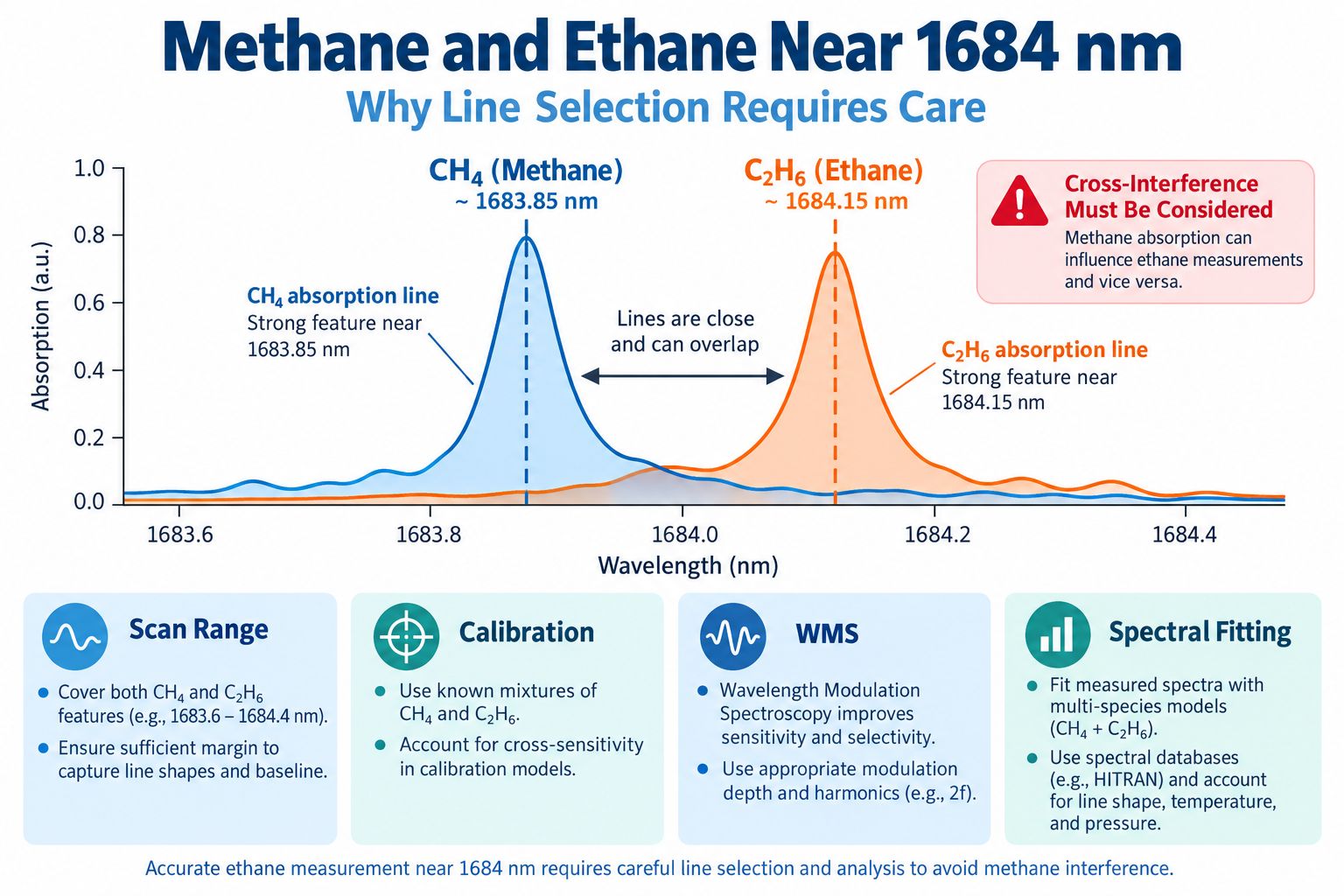
Published work using a DFB laser around 1684 nm identified:
- A methane structure near 5938.12 cm⁻¹
- Strong ethane absorption near 5937.3 cm⁻¹
The two species can therefore influence measurements in the same general wavelength region.
This matters because real natural-gas samples may contain methane at concentrations far higher than ethane.
A small amount of spectral overlap can become significant when the interfering gas concentration is much larger.
How OEM Systems Handle CH₄ / C₂H₆ Cross-Interference
Possible strategies include:
- Choosing an appropriate scan window
- Calibrating with realistic CH₄ / C₂H₆ mixtures
- Using wavelength modulation spectroscopy
- Performing multi-species spectral fitting
- Using independent methane and ethane channels
- Applying interference-compensation algorithms
Recent research has also demonstrated single-laser CH₄/C₂H₆ detection around this spectral region using spectral-decoupling algorithms specifically because the absorption structures overlap.
The important product-selection lesson is:
A 1684 nm ethane laser should be selected as part of a spectral measurement strategy, not as an isolated component.
Why Use a DFB Laser Instead of an FP or VCSEL?
For many near-infrared TDLAS systems, DFB architecture is a strong starting point because the sensing method depends on controlled wavelength scanning across a molecular absorption feature.
Useful DFB characteristics include:
Single-Mode Operation
The system needs a dominant optical mode that can be positioned and scanned predictably.
Multiple uncontrolled longitudinal modes can complicate absorption measurements.
High SMSR
A high side-mode suppression ratio helps concentrate the optical power in the desired longitudinal mode.
Narrow Spectral Output
The laser spectrum should be narrow relative to the spectral feature being interrogated.
Current Tuning
Injection current enables fast wavelength scanning and modulation.
Temperature Tuning
Temperature adjustment shifts the DFB operating region and can be used to place the laser near the desired C₂H₆ feature.
Stable Packaging
For precision gas sensing, the package may integrate:
- TEC
- Thermistor
- Monitor photodiode
- Fiber pigtail
The goal is not simply to achieve “1684 nm,” but to hold and scan the laser predictably around the selected spectral region.
For a broader architecture comparison, see DFB vs FP vs VCSEL.
How Temperature and Injection Current Tune a 1684 nm DFB Laser
DFB wavelength control is usually performed with both temperature and injection current.
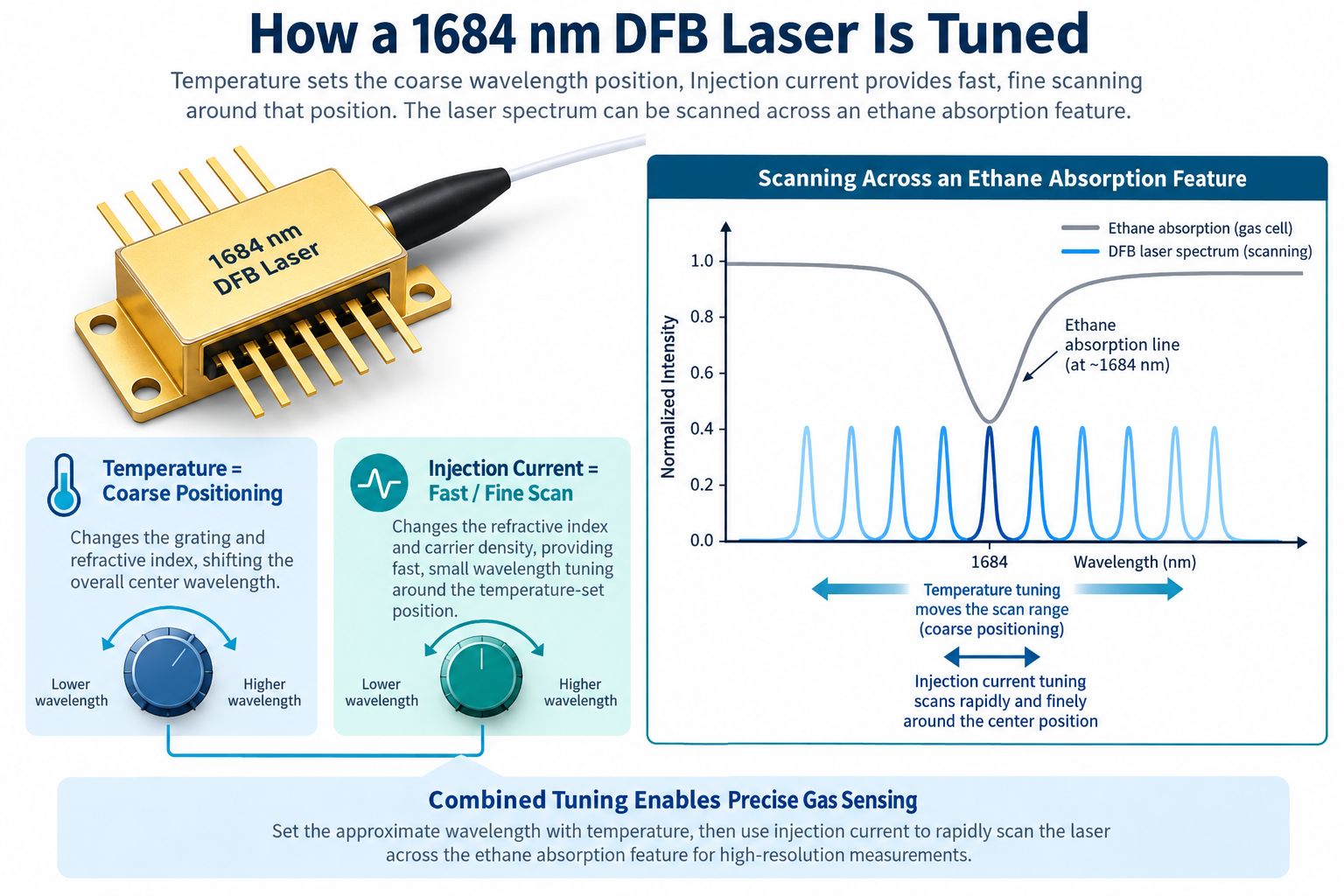
A useful simplified model is:
Temperature = coarse wavelength positioning
Injection current = fast / fine scanning
Temperature Tuning
Changing the chip temperature changes the semiconductor refractive index and the effective grating period.
This shifts the laser’s emission wavelength.
Temperature control is relatively slow but provides a stable way to move the overall operating region.
A TEC-controlled package is especially useful when:
- Ambient temperature varies
- Wavelength repeatability matters
- Long-term calibration must be maintained
- A specific absorption feature must stay inside the current tuning window
Current Tuning
Changing injection current affects:
- Carrier density
- Junction temperature
- Effective refractive index
This produces a faster wavelength shift than changing the package temperature.
Current modulation can therefore be used for:
- Spectral scanning
- WMS modulation
- Rapid measurement cycles
Do Not Reuse a Published Current or Temperature Setting
A research paper may report that a particular ethane DFB reached its target feature at a certain current and temperature.
Those values apply to that specific laser and system.
They should not be copied as universal operating settings for another 1684 nm DFB.
The OEM needs the actual device-specific:
- Temperature tuning coefficient
- Current tuning coefficient
- Wavelength-current curve
- Wavelength-temperature curve
- Mode-hop behavior
DAS vs WMS for Ethane Detection
Two common TDLAS approaches are direct absorption spectroscopy and wavelength modulation spectroscopy.
Direct Absorption Spectroscopy
DAS measures how transmitted optical intensity changes as the laser scans across the gas absorption feature.
Advantages include:
- Straightforward physical interpretation
- Direct absorbance measurement
- Useful for spectral characterization
However, weak absorption can be difficult to distinguish from baseline drift and intensity noise.
Wavelength Modulation Spectroscopy
WMS applies a higher-frequency modulation to the laser wavelength and detects a harmonic component of the signal, often the second harmonic or 2f component.
This can improve sensitivity to weak absorption signals and suppress some forms of low-frequency noise.
Published ethane sensors around 1.684 µm have used wavelength modulation and harmonic detection.
WMS is not automatically better for every application. The OEM must still optimize:
- Modulation depth
- Modulation frequency
- Scan range
- Detector bandwidth
- Lock-in or digital demodulation
- Calibration model
A Typical 1684 nm Ethane TDLAS System
A practical ethane analyzer includes much more than the laser.
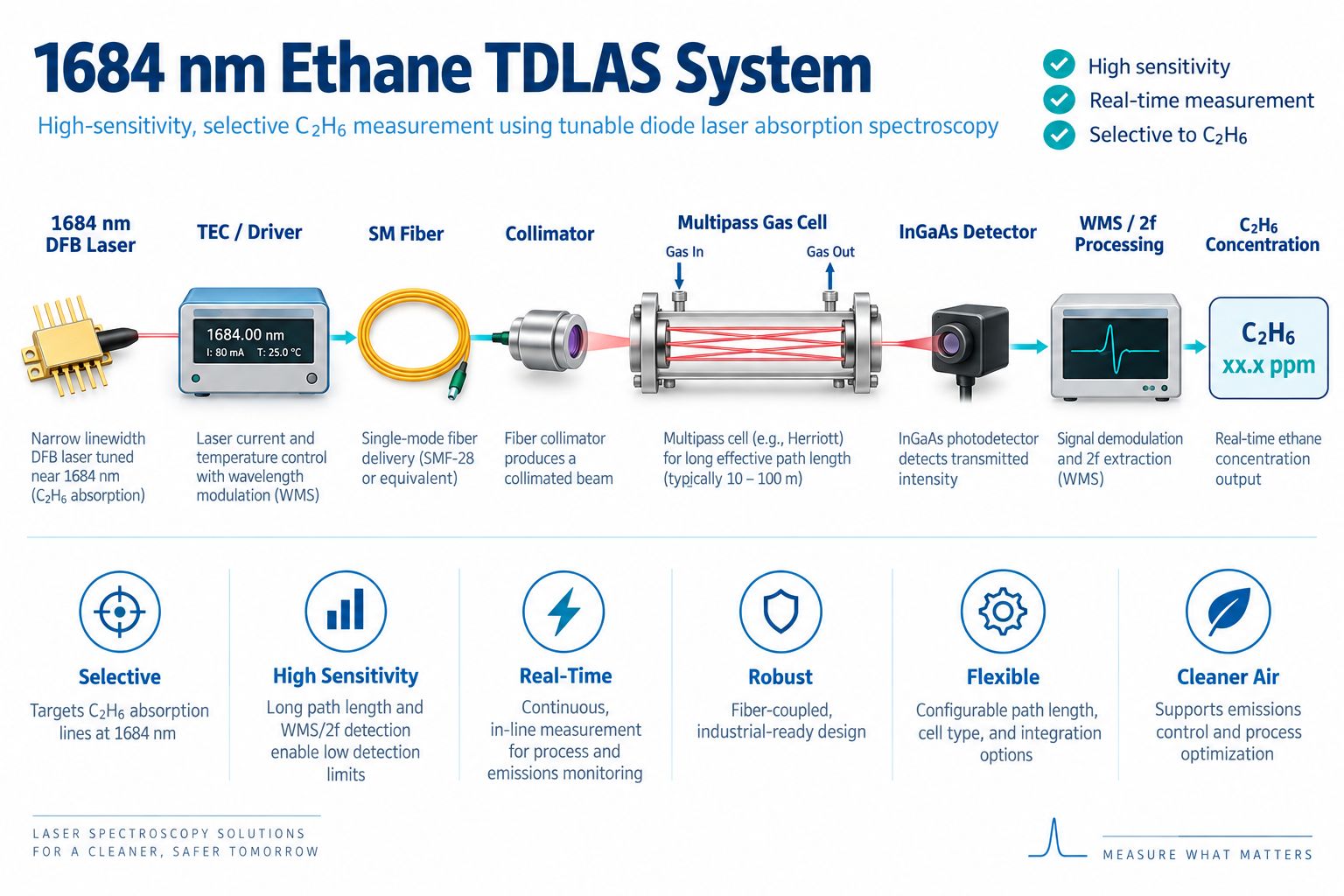
A representative signal chain is:
1684 nm DFB → TEC / Driver → Fiber or Free-Space Optics → Gas Cell → InGaAs Detector → WMS / Signal Processing → C₂H₆ Concentration
DFB Laser
Provides narrow, tunable near-infrared output.
Laser Driver and Temperature Controller
Stabilizes injection current and package temperature and applies the scan / modulation waveform.
Fiber or Free-Space Delivery
Depending on the instrument, the laser can be:
- Free-space
- Fiber-pigtailed
- Collimated after SM fiber
Gas Cell
The optical path can be increased with a multipass cell when the absorption is weak.
Longer optical path length increases the total absorbance for a given gas concentration.
InGaAs Detector
Measures the transmitted near-infrared signal.
Signal Processing
The analyzer may use:
- DAS fitting
- WMS / 2f
- Digital lock-in
- Multi-species fitting
- Interference compensation
The final gas detection limit is therefore a system-level result, not a laser-only specification.
Near-IR 1684 nm vs Mid-IR Ethane Detection
Near-infrared 1684 nm is not selected because ethane absorption is universally strongest there.
Mid-infrared fundamental molecular absorption can be substantially stronger.
The near-IR route remains attractive because of the wider semiconductor and fiber ecosystem.
| Around 1684 nm Near-IR | Mid-IR Ethane Detection |
|---|---|
| Compact DFB diode lasers | Often stronger fundamental absorption |
| Mature InGaAs detectors | Source / detector technology can be more specialized |
| SM fiber delivery practical | Fiber delivery can be more difficult depending on wavelength |
| Direct electrical modulation | Source architecture may be more complex |
| Compact, low-power OEM instruments | Strong option when maximum spectroscopic sensitivity is the priority |
| Established telecom-style packaging | Often higher optical-system complexity |
For a portable industrial analyzer, the easier laser, fiber and detector ecosystem can make the 1684 nm region attractive even though another spectral region may offer stronger molecular absorption.
The correct choice depends on the required detection limit, path length, power budget, instrument size, environmental conditions, cost and response time.
Fiber-Pigtailed or Free-Space 1684 nm DFB?
Both interfaces can be suitable.
Free-Space Output
Free-space output can be attractive when:
- The laser sits close to the gas cell
- The OEM controls all optical alignment
- Direct beam access is required
- Minimum internal coupling loss is important
- The instrument uses a compact optical bench
Fiber-Pigtailed Output
Fiber output is useful when:
- The laser is remote from the cell
- The analyzer is modular
- A QEPAS head is separated from the electronics
- The system uses fiber couplers
- The optical head needs to be compact
Published ethane QEPAS work has used a pigtailed DFB source around 1684.5 nm with a fiber collimator.
For a deeper comparison of SM, PM, MM fiber and pigtailed vs free-space output, see Fiber-Coupled Laser Diode: Pigtailed vs Free-Space Guide.
TO-Can or Butterfly for Ethane TDLAS?
Package selection should follow the instrument architecture.
| Requirement | TO-Can | Butterfly |
|---|---|---|
| Compact free-space analyzer | Strong fit | Possible |
| Integrated TEC | Possible | Very common |
| Thermistor | Possible | Very common |
| Monitor PD | Possible | Common |
| SM fiber pigtail | Possible | Strong fit |
| Stable fiber-fed analyzer | Possible | Strong fit |
| Small package footprint | Strong fit | Larger |
| More integrated internal functions | Limited by package size | Strong fit |
TO-Can
A TO package can be attractive when the OEM wants:
- Compact source
- Free-space output
- External optics
- Smaller mechanical package
- Dedicated system-level mount
Butterfly
A butterfly package can be attractive when the OEM wants:
- Integrated TEC
- Thermistor
- Monitor photodiode
- Factory-aligned SM fiber
- Optical isolator options
- More stable fiber-delivered source
For the package-selection framework, see Butterfly vs TO-CAN Package for Gas Sensing Laser Diodes.
Why Fiber Connector and Back Reflection Matter
A narrow-linewidth DFB source can be sensitive to light reflected back into the laser cavity.
In fiber systems, reflections can come from fiber connectors, flat optical surfaces, collimators, gas-cell windows and other fiber components.
Possible mitigation strategies include:
- FC/APC connectors
- Optical isolation
- Angled windows
- Controlled optical layout
The correct configuration depends on the required linewidth, stability and package design.
Do not assume that adding an APC connector automatically solves all optical-feedback problems.
The complete optical system should be evaluated.
Detection Path Length, Optical Power and Sensitivity
Ethane detection sensitivity is not determined by laser wavelength alone.
At a basic level, the absorption signal depends on:
- Gas concentration
- Absorption strength
- Optical path length
- Optical power
- Detector noise
- Pressure
- Temperature
- Signal-processing method
This is why many trace-gas systems use multipass cells, photoacoustic detection, QEPAS, WMS or longer integration times.
A stronger laser can improve the optical signal budget, but it does not allow a responsible supplier to promise a specific ppm detection limit without knowing the complete system.
OEM specifications should therefore separate:
Laser requirement
from:
Analyzer detection-limit requirement
Dual-Gas Methane and Ethane Detection
Methane and ethane are often more useful when measured together.
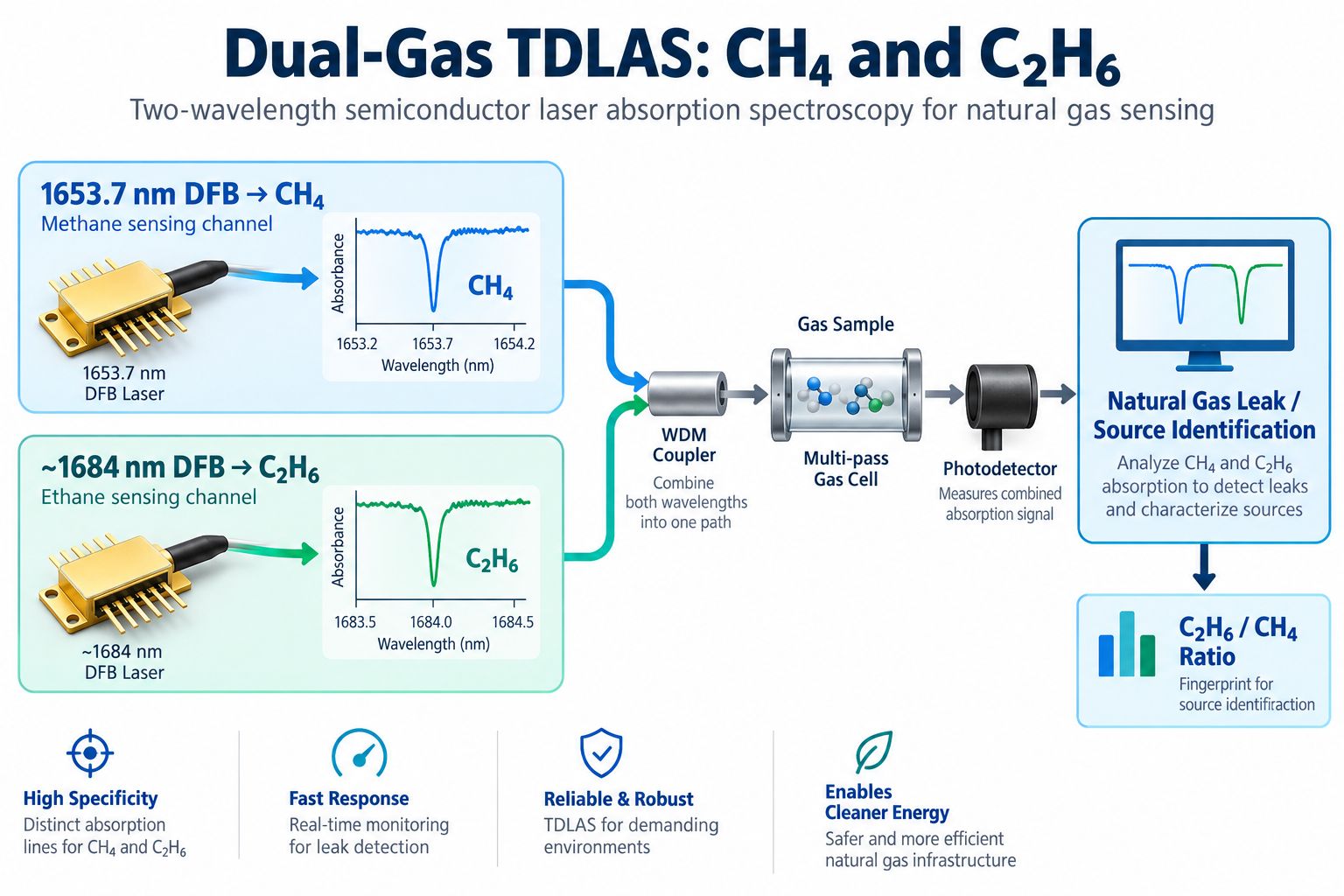
A common two-channel architecture is:
1653.7 nm DFB → CH₄
and:
~1684 nm DFB → C₂H₆
The two signals can then be combined at system level to provide:
- Methane concentration
- Ethane concentration
- C₂H₆ / CH₄ ratio
- Source-identification information
A published fiber-coupled QEPAS sensor used exactly this general wavelength strategy: approximately 1653.7 nm for methane and 1684 nm for ethane.
Lumi already offers a 1653.7nm DFB Laser Diode for Methane Gas Sensing with integrated TEC in a TO package.
For ethane, the laser should be selected or customized according to the required 1684 nm-region target feature and tuning span.
Can One 1684 nm Laser Detect Both CH₄ and C₂H₆?
Potentially, yes, depending on the tuning range and signal-processing method.
Recent work has demonstrated single-laser approaches that analyze overlapping CH₄ and C₂H₆ features in this spectral region.
However, this approach places greater demands on:
- Spectral model
- Calibration
- Scan range
- Modulation strategy
- Cross-interference compensation
For many OEM instruments, separate methane and ethane channels remain easier to understand and validate.
Main Applications for a 1684 nm Ethane DFB Laser
Natural-Gas Leak Identification
C₂H₆ measurement can add source information to a methane leak survey.
Methane Source Attribution
The presence and ratio of ethane can help distinguish thermogenic natural-gas emissions from methane sources with little ethane.
Oil and Gas Environmental Monitoring
Portable or fixed analyzers can measure C₂H₆ alongside CH₄ around pipelines, processing sites, storage infrastructure and production facilities.
Mobile and UAV Gas Sensing
Compact near-infrared DFB sources and fiber-based optical layouts are attractive for weight- and power-sensitive measurement platforms.
Process Gas Analysis
Ethane concentration may be relevant to hydrocarbon process monitoring and composition measurement.
How to Specify a 1684 nm Ethane DFB Laser
For an OEM request, “1684 nm DFB” is not enough information.
The laser supplier needs to understand the spectral and integration requirements.
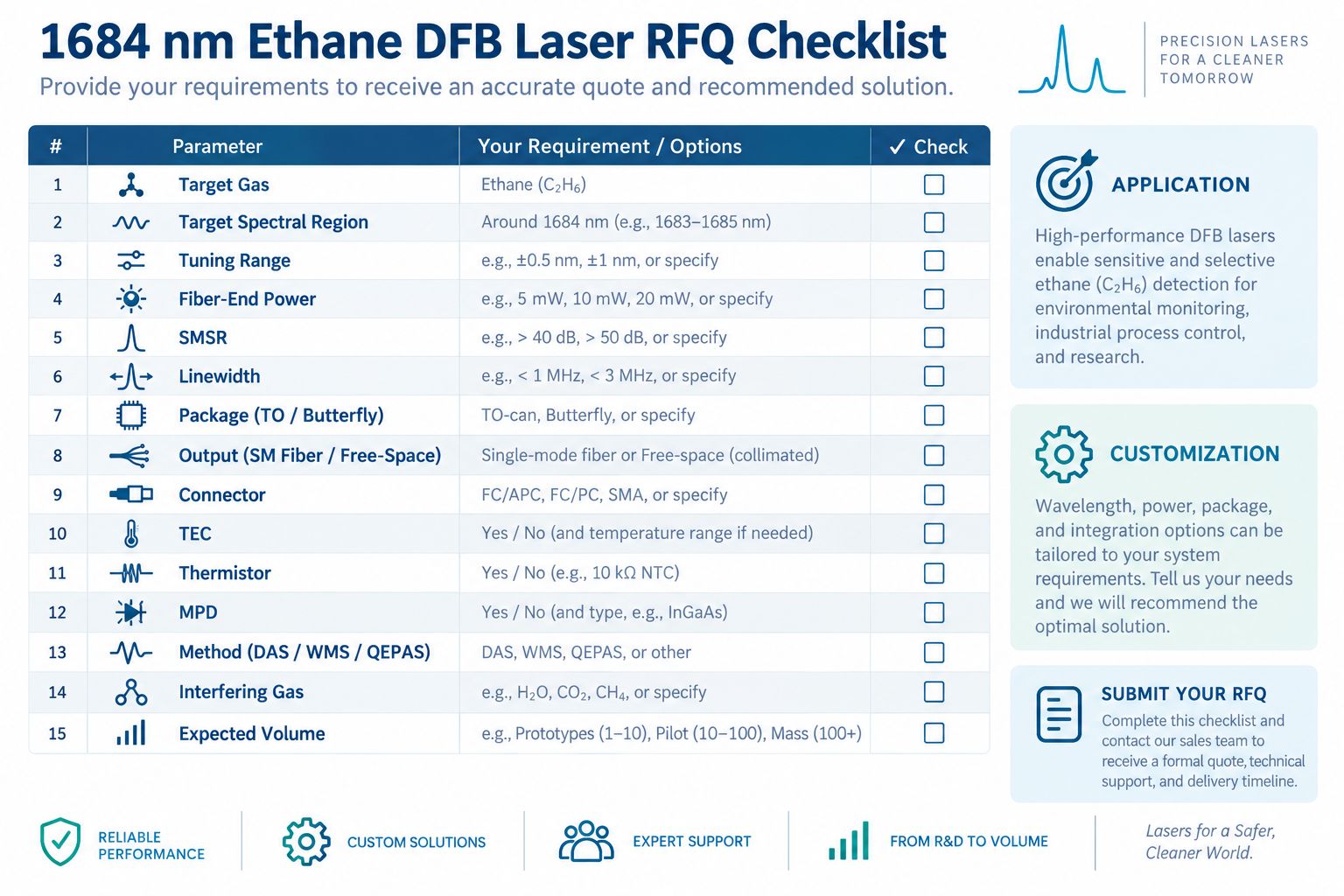
| Requirement | What to Specify |
|---|---|
| Target gas | C₂H₆ |
| Spectral region | Around 1684 nm |
| Target feature | Selected C₂H₆ absorption region |
| Tuning range | Must cover the intended feature and scan margin |
| Laser architecture | DFB |
| Optical power | Specify free-space or fiber-end measurement point |
| SMSR | Project requirement |
| Linewidth | Project requirement |
| Current tuning | Required scan range / modulation method |
| Temperature tuning | Required wavelength positioning range |
| Package | TO / Butterfly / custom |
| Optical output | Free-space / SM fiber |
| Connector | FC/APC / bare fiber / other if required |
| TEC | Yes / No |
| Thermistor | Yes / No |
| Monitor PD | Yes / No |
| Detection method | DAS / WMS / PAS / QEPAS |
| Interfering gases | CH₄ and other expected species |
| Operating pressure | Gas-cell condition |
| Quantity | Samples + pilot + annual demand |
A useful first RFQ sentence is:
We need a DFB laser in the 1684 nm region for C₂H₆ detection, with a tuning range verified to cover our selected ethane absorption feature under the specified temperature/current conditions.
That statement is much more useful than requesting only a nominal wavelength.
Common Mistakes in 1684 nm Ethane Laser Selection
Mistake 1: Treating 1684 nm as One Universal Ethane Line
The near-IR ethane spectrum in this region contains unresolved absorption structure.
The actual system should target a validated spectral feature.
Mistake 2: Ignoring Methane Absorption
CH₄ can have nearby absorption features, especially important when methane concentration is much larger than ethane concentration.
Mistake 3: Specifying Only Center Wavelength
A nominal 1684 nm label does not guarantee that the laser can scan across the required C₂H₆ feature.
Ask for tuning range and operating conditions.
Mistake 4: Copying Current and Temperature from a Research Paper
Those settings apply to the particular laser used in that experiment.
They are not universal.
Mistake 5: Comparing Chip Power with Fiber-End Power
Fiber coupling introduces loss.
Always clarify the optical-power measurement point.
Mistake 6: Asking the Laser Supplier to Guarantee the Analyzer Detection Limit
Detection limit depends on the complete optical, gas-cell, detector and signal-processing system.
The laser supplier can specify laser performance; the final ppm or ppb limit is a system-level result.
Lumi DFB Options for TDLAS Projects
Lumi’s current published DFB portfolio includes wavelength-specific sources for TDLAS and gas sensing in TO, butterfly and fiber-coupled formats.
The Lumi DFB Laser Diode range includes:
- TEC-cooled TO-can configurations
- Heating-controlled gas-sensing sources
- Butterfly DFB lasers
- SM / PM fiber options
- Wavelength-specific OEM solutions
Current gas-sensing products include a 1653.7nm methane DFB laser diode and 1273–1653nm DFB pigtailed butterfly configurations.
For an ethane project around 1684 nm, Lumi can evaluate the required wavelength region, tuning range, output interface and package based on the customer’s selected absorption feature and TDLAS architecture.
A published 1684 nm ethane-specific Lumi product should not be assumed unless its wavelength, power and package specifications have been formally defined for the project.
Frequently Asked Questions
Why is 1684 nm used for ethane sensing?
Ethane has a useful near-infrared absorption band around 1.68 µm, with strong experimentally used features near approximately 1684.3 nm. A DFB laser in this region can be tuned across the feature using temperature and injection current.
Is 1684 nm the exact ethane absorption wavelength?
Not as one universal fixed number. “1684 nm” is a practical nominal region. The actual target feature can be around 1684.3 nm, and the required operating wavelength depends on the measured spectrum and system conditions.
Why use a DFB laser for C₂H₆ TDLAS?
A DFB laser provides controlled single-mode output, narrow spectral behavior and predictable current/temperature tuning, all useful for scanning molecular absorption features.
Does methane interfere with ethane near 1684 nm?
It can. Methane has absorption structure close to the ethane band in this region. The analyzer may need appropriate scan-window selection, calibration, WMS or multi-species fitting.
Can 1653.7 nm be used for ethane?
1653.7 nm is strongly associated with methane TDLAS rather than the commonly used 1.684 µm ethane band. A dual-gas system may use 1653.7 nm for CH₄ and approximately 1684 nm for C₂H₆.
Can one DFB laser measure methane and ethane?
Potentially, if its tuning range covers useful features for both species and the spectral-processing method can separate the overlapping responses. This is more demanding than using dedicated CH₄ and C₂H₆ channels.
Is fiber-coupled output better for ethane TDLAS?
Not always. Fiber coupling is useful for modular or remote optical layouts. Free-space output may be simpler in a compact optical bench. The right choice depends on instrument architecture.
Should I choose a TO-can or butterfly 1684 nm laser?
TO-can is attractive for compact free-space systems. Butterfly is attractive when the analyzer benefits from integrated temperature control, monitoring and factory-aligned fiber output. Both can be suitable.
What detector is used around 1684 nm?
InGaAs photodetectors are commonly used in this near-infrared wavelength region.
What should I include in a 1684 nm ethane laser RFQ?
Specify the target ethane absorption region, required tuning span, optical power measurement point, SMSR, linewidth, package, fiber or free-space output, TEC, thermistor, monitor PD, detection method, interfering gases and expected quantity.
Select the Absorption Feature First, Then the Laser
The most important lesson in a 1684 nm ethane project is that the nominal laser wavelength should not be the starting point.
The correct engineering sequence is:
C₂H₆ target spectrum → Interfering gases → Required scan range → DFB tuning capability → Package / fiber → TDLAS electronics
A laser labeled “1684 nm” may still be unsuitable if its verified tuning range does not cross the absorption structure required by the analyzer.
Conversely, a properly selected DFB source in the 1684 nm region can provide a compact and practical near-infrared platform for ethane monitoring, CH₄ / C₂H₆ dual-gas analysis, natural-gas leak identification, mobile environmental measurement and OEM TDLAS instruments.
For a 1684 nm C₂H₆ project, provide Lumi with the target spectral region, intended gas pressure, tuning requirement, desired package, fiber interface and expected annual quantity so the DFB wavelength and package can be evaluated against the actual system rather than a nominal wavelength label alone.
