
FP Laser Diodes for CW, QCW and OEM Optical Systems
Lumi supplies compact Fabry–Perot laser diodes for optical sensing, instrumentation, fiber test equipment and OEM photonics. Explore our 808nm and 940nm continuous-wave products, along with 1310nm, 1550nm and 1625nm high-peak-power QCW devices.
Choose a device by its operating mode, optical power, wavelength tolerance, transverse and longitudinal mode requirements, and package—not simply by the wavelength in its product name.
What Is a Fabry–Perot Laser Diode?
A Fabry–Perot (FP) laser diode is an edge-emitting semiconductor laser whose resonant cavity is formed primarily by two partially reflective chip facets. Light travels repeatedly through the gain region, and resonant optical modes are amplified.
Unlike a DFB laser diode, a conventional FP structure does not use a distributed wavelength-selective grating along the cavity. Multiple longitudinal modes may therefore occur within the gain spectrum even when spatial beam quality is carefully controlled.
- Mature edge-emitting semiconductor laser architecture
- Suitable for efficient CW or high-peak-power QCW designs
- Applicable where DFB-grade spectral selectivity is unnecessary
- Available in compact TO packaging within the current Lumi portfolio
For an overview of laser-diode fundamentals, see What Is a Laser Diode?.
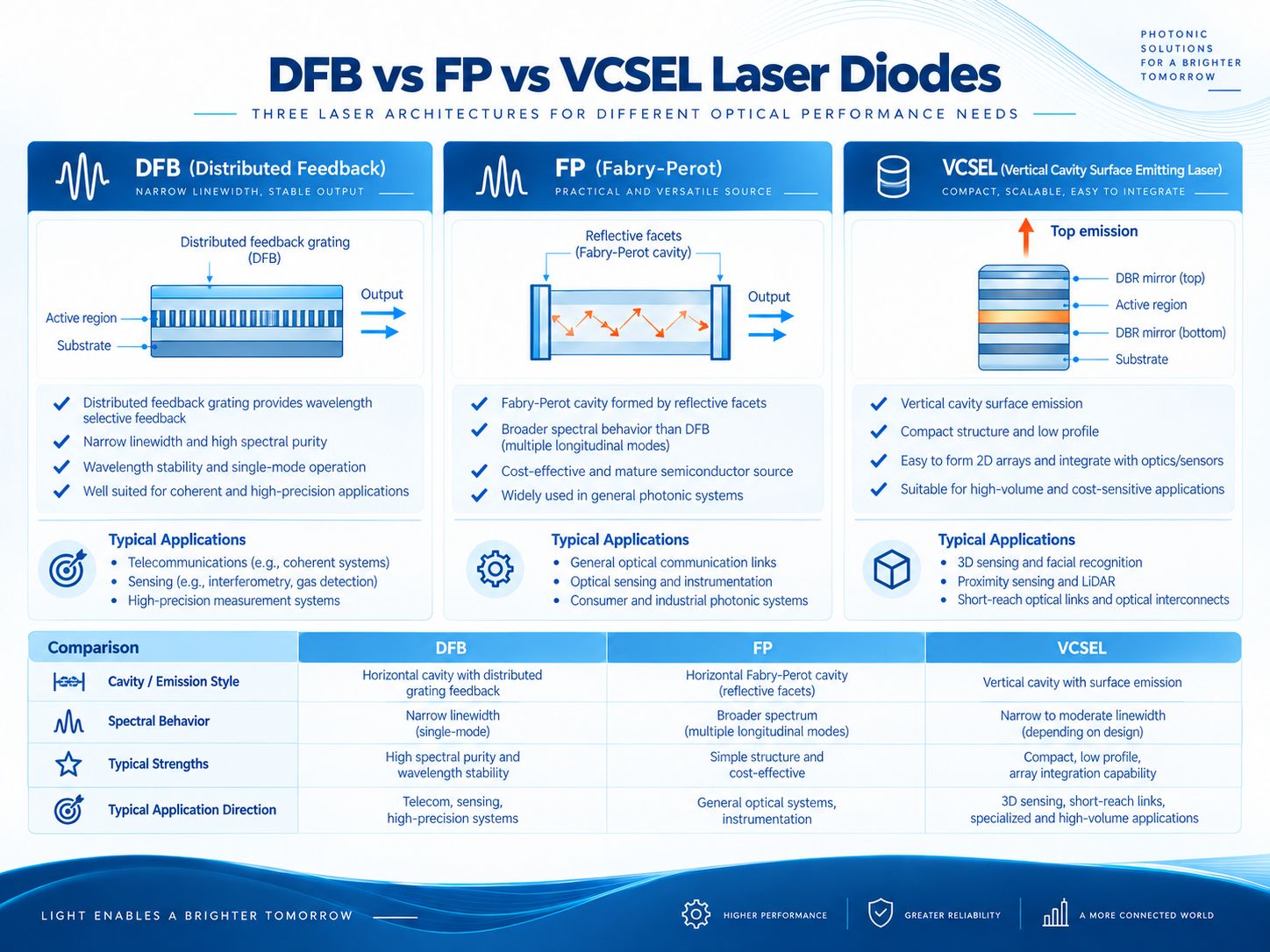
Single-Mode FP Does Not Always Mean Single-Longitudinal-Mode
A common selection mistake is to interpret “single-mode” as a guarantee of a narrow, single-frequency laser spectrum.
Transverse Mode
Describes the spatial intensity profile and field across the emitting aperture. Single-transverse-mode behavior can support well-controlled collimation and coupling.
Longitudinal Mode
Describes the resonant wavelengths within the Fabry–Perot cavity. Multiple longitudinal modes can coexist under the gain envelope.
Selection Implication
For gas-line scanning, narrow linewidth or high side-mode suppression, check the spectral specification. A DFB laser may be more appropriate.
Continuous-Wave (CW) vs Quasi-Continuous-Wave (QCW)
The drive mode is a primary product specification. A QCW peak-power rating is not interchangeable with continuous-wave output power.
CW Laser Diodes
A CW device operates continuously under its specified current and temperature conditions. Lumi's current 808nm and 940nm FP product examples provide 50mW rated CW output.
- Sustained optical output under rated conditions
- Thermal design based on continuous electrical dissipation
- Suitable for steady illumination, sensing and measurement systems
High-Peak-Power QCW Laser Diodes
QCW devices are driven with short pulses and low duty cycles. Lumi's current 1310, 1550 and 1625nm FP device specifications use 10µs pulse width and 1% duty cycle for the quoted high-power figures.
- Peak power only at defined pulse conditions
- Driver and current pulse shape require careful control
- Average optical power depends on duty cycle
Explore Lumi FP Laser Diodes
Browse available FP products using live WooCommerce records. Each listing links directly to the product's electrical, optical and package information.

FP Laser Diode Portfolio at a Glance
Use the table below to narrow your selection before reviewing individual device specifications. Optical power values shown are defined by their respective CW or QCW test conditions.
| Wavelength Class | Rated Optical Output | Operating Mode | Package / Feature | Product Details |
|---|---|---|---|---|
| 808nm | 50mW | CW | TO-5.6 | 808nm FP → |
| 940nm | 50mW | CW | TO-18; monitor PIN PD | 940nm FP → |
| 1310nm class | 515mW typical (peak) | QCW: 10µs / 1% | TO package | 1310nm FP → |
| 1550nm class | 320mW typical (peak) | QCW: 10µs / 1% | TO package | 1550nm FP → |
| 1625nm | 300mW typical (peak) | QCW: 10µs / 1% | TO package | 1625nm FP → |
The 1310nm and 1550nm labels identify wavelength classes; typical measured center wavelengths in the current product information include approximately 1305nm and 1544nm under specified conditions. Always use the detailed specification for optical design.
Choose the FP Wavelength for Your Optical System
Wavelength selection should begin with the fiber, target detector, optical transmission path and intended measurement. The FP architecture is a practical source when exact narrow-line interrogation is not the primary requirement.
808nm
Compact CW optical source for pumping, instruments and near-infrared sensing.
940nm
Compact CW optical emission with integrated monitor photodiode on the current product.
1310nm
QCW high-peak-power direction for fiber-oriented systems and photonics instruments.
1550nm
QCW source for certain ranging, measurement and optical test designs.
1625nm
QCW source relevant to fiber-monitoring and OTDR instrument architectures.
FP vs DFB Laser Diodes
Neither architecture is universally better. What matters is whether the system values practical optical output or precise, wavelength-selective emission.
| Selection Factor | FP Laser Diode | DFB Laser Diode |
|---|---|---|
| Optical Cavity | Facet-defined Fabry–Perot resonator | Distributed wavelength-selective grating |
| Longitudinal Modes | Several modes may occur | Designed for stronger single-mode selection |
| Spectral Behaviour | Usually broader, model dependent | Typically narrower; evaluate linewidth and SMSR |
| Optical Output | Practical CW and QCW high-output configurations | Suitable powers available where spectral control is needed |
| Gas Absorption TDLAS | Generally not first choice for narrow-line scanning | Strong starting point for absorption-line targeting |
| Fiber Test / General Ranging | Useful when spectrum meets system requirements | Useful when additional wavelength selectivity is required |
Explore our DFB Laser Diode range or review the DFB vs FP vs VCSEL guide.
Where FP Laser Diodes Are Used
FP laser diodes are relevant wherever the operating mode, optical power, spectral behaviour and package match the integration requirements.
OTDR & Fiber Monitoring
1625nm and other fiber-system wavelengths support source selection for optical-fiber test and monitoring equipment; detector and system architecture must be matched.
Optical Ranging
1550nm QCW output can suit selected pulsed ranging schemes where peak power and pulse timing matter more than a very narrow emission spectrum.
Near-Infrared Sensing
808nm and 940nm CW devices can provide compact light sources in intensity, reflection, alignment and optical-monitoring designs.
Pump & Seed Integration
FP devices can provide optical input to compatible pump and seed stages, subject to wavelength, beam shape, coupling and spectral requirements.
Test & Measurement
Compact TO laser packages are suited to OEM instruments and photonic benches where drive electronics and thermomechanics are designed around the part.
Custom Photonic Systems
Evaluate target optical power, modulation, spectral stability, thermal path and packaged interface to determine the most appropriate architecture.
How to Specify an FP Laser Diode
The most useful RFQ defines the optical operating point and electrical drive conditions, not only a nominal wavelength.
Wavelength & Tolerance
Specify nominal wavelength, acceptable band and measurement condition.
Drive Mode
Separate CW from QCW; state any pulse requirement explicitly.
Optical Power
Define continuous power or peak power, measurement condition and minimum needed value.
Spectrum & Modes
Check longitudinal modes, linewidth, SMSR if needed and beam characteristics.
Pulse & Driver
For QCW specify pulse width, repetition rate, duty cycle and current limits.
Package & Thermal
Specify TO configuration, case temperature, monitor PD and mechanical constraints.
FP Laser Diode Integration for OEM Projects
The current Lumi FP product family emphasizes compact TO-can packages. We can discuss product selection, drive-condition requirements, thermal interface, monitoring and external optical coupling in the context of your equipment design.
- 808nm / 940nm continuous-wave devices
- 1310nm / 1550nm / 1625nm high-peak-power QCW devices
- TO-can mechanical and electrical integration
- Monitor photodiode on selected models
- Optical divergence, coupling and lens design considerations
- Sample requirements, project volume and evaluation parameters
Recommended Inquiry Details
| Application | OTDR, pump, ranging, sensing, instrumentation |
|---|---|
| Wavelength | Required range and operating condition |
| Optical Output | CW rating or QCW peak rating |
| Pulse Parameters | Pulse width, duty cycle and repetition rate |
| Integration | TO format, beam, driver, thermal, monitor PD |
| Quantity | Samples and estimated annual demand |
Frequently Asked Questions About FP Laser Diodes
What does FP mean in a laser diode?
FP stands for Fabry–Perot. The end facets of the semiconductor chip provide the main optical feedback, forming a resonant cavity.
Can an FP laser diode be single mode?
Yes, in the transverse spatial sense. That does not guarantee single-longitudinal-mode emission; always check the spectral specifications.
What is the main difference between FP and DFB laser diodes?
An FP laser typically uses facet feedback and can support multiple longitudinal modes; a DFB laser uses wavelength-selective distributed feedback and usually provides stronger longitudinal mode control.
Can QCW peak power be used as a continuous-wave rating?
No. Peak QCW output applies only at its specified electrical pulse width, duty cycle, operating temperature and current. Verify every device's ratings before designing the driver.
Why can a 1310nm-class product have a center wavelength near 1305nm?
A rounded product-family name indicates a nominal wavelength band. The detailed optical center wavelength is measured at defined test conditions and may differ from the rounded class name.
Is a 1625nm FP laser suitable for OTDR?
1625nm is a widely used fiber-testing wavelength. Suitability depends on the instrument's test architecture, pulse characteristics, receiver, power budget and other optical requirements.
Does a 1625nm FP laser directly replace a methane TDLAS laser?
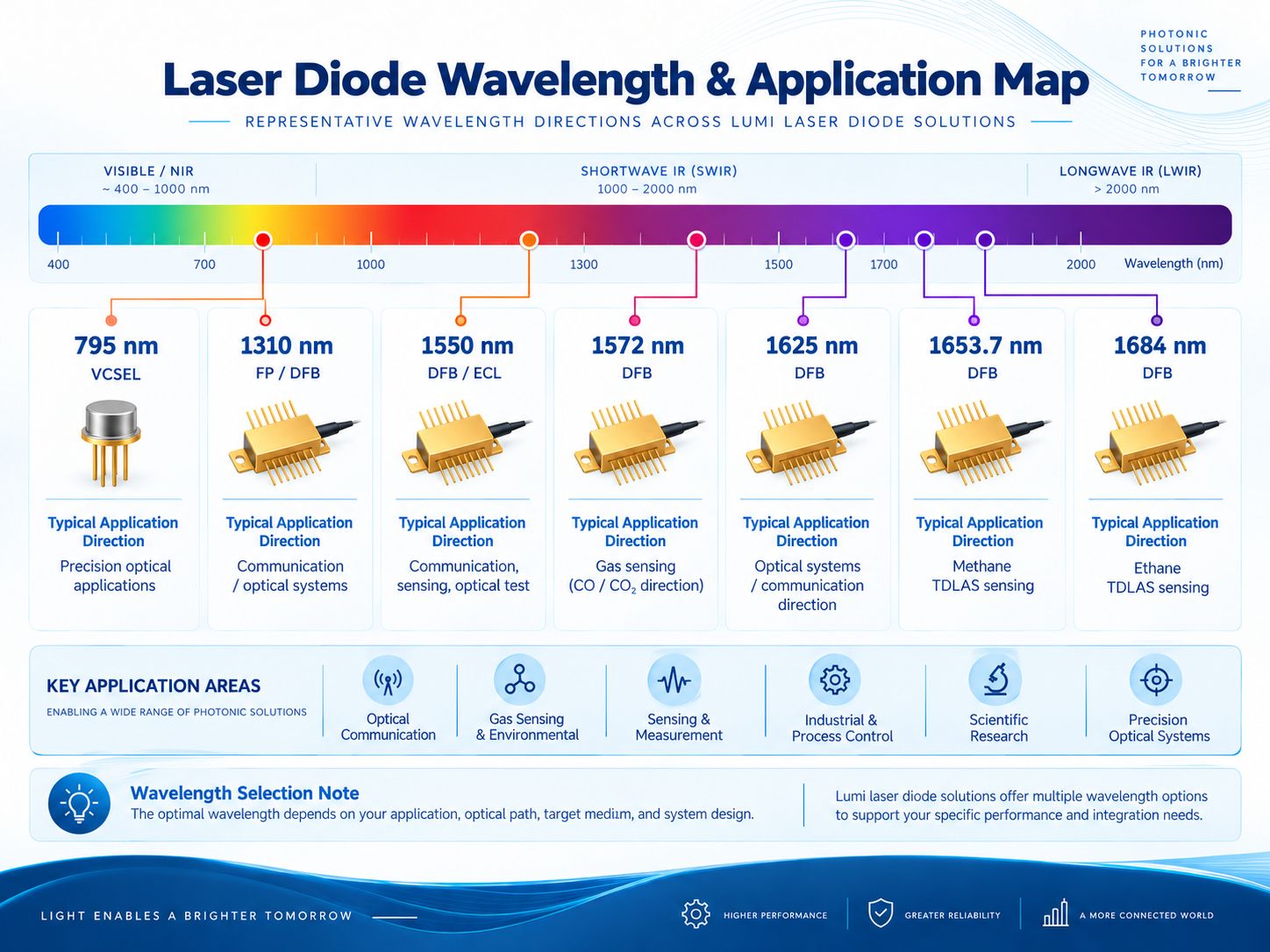
No. Methane absorption measurements must address the selected absorption line, often near 1653.7nm in near-infrared TDLAS. A suitable laser must cover the required absorption feature and tuning range.
What details should I send for an FP laser quotation?
Provide target wavelength, CW/QCW operating mode, required optical output, pulse conditions where applicable, package dimensions, spectral needs, operating temperature and estimated quantity.
Need an FP Laser Diode for Your Optical System?
Send your target wavelength, optical power, continuous or pulsed operating mode, spectral requirement and TO-package constraints. Our team can help identify the applicable FP product family or discuss an alternative laser architecture.