
Laser Diodes for Precision Photonic Systems
Lumi supplies DFB, Fabry–Pérot (FP) and VCSEL laser diodes for optical sensing, fiber-optic systems, measurement instruments and OEM integration. Select a laser by its optical architecture first, then match its wavelength, output performance, package and optical interface to your system.
Architecture, Package and Output Are Different Choices
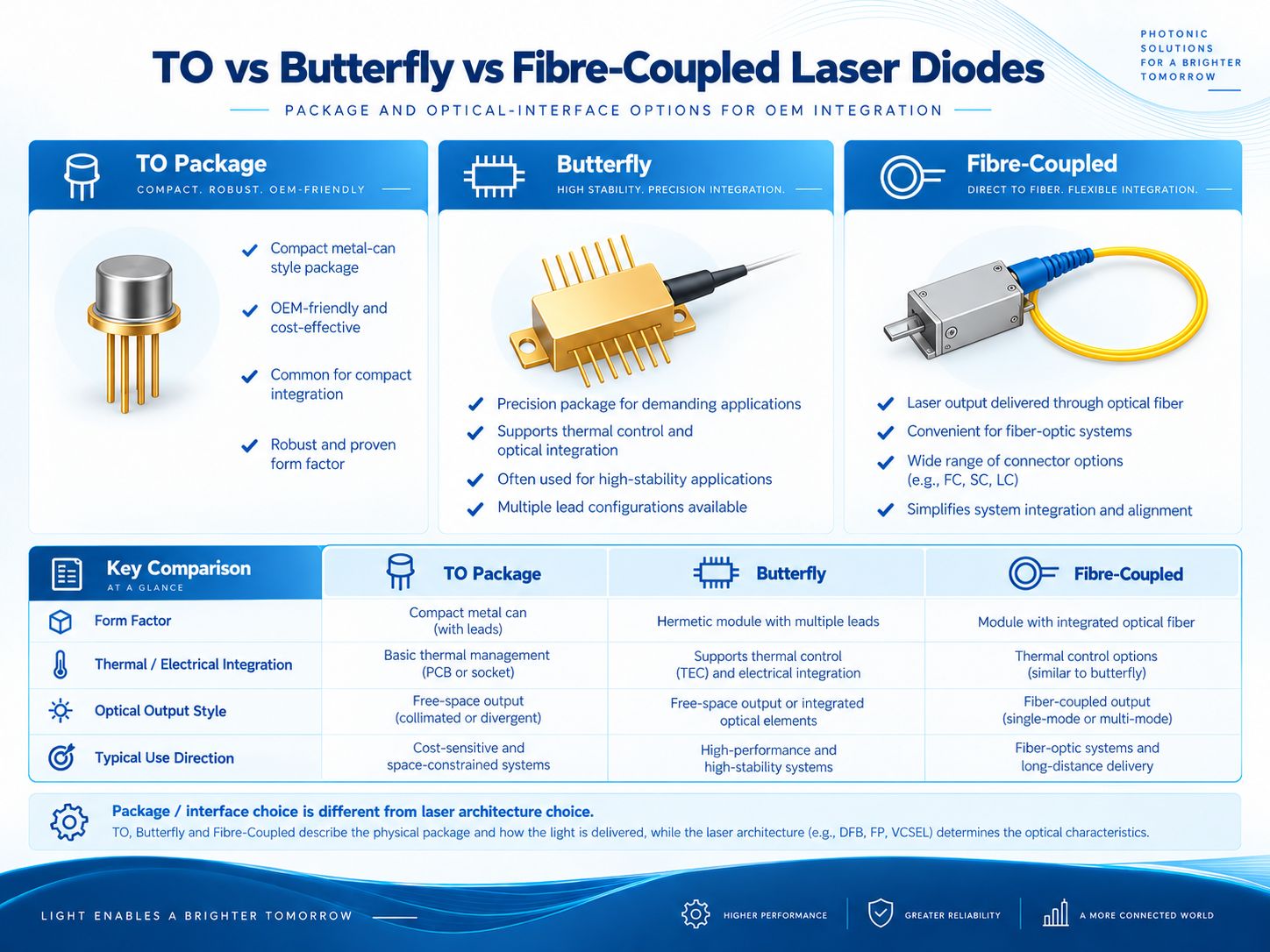
Laser diode selection involves several independent design decisions. The architecture (DFB, FP or VCSEL) determines important emission characteristics. The package addresses mechanical protection, electrical connection and thermal integration. The optical output specifies whether the beam is delivered into free space or through an optical fiber.
For example, a DFB laser may be supplied in a TO-can or butterfly package; a fiber-pigtailed output is possible with more than one architecture. These descriptions are not interchangeable product categories.
Read the laser diode packaging guide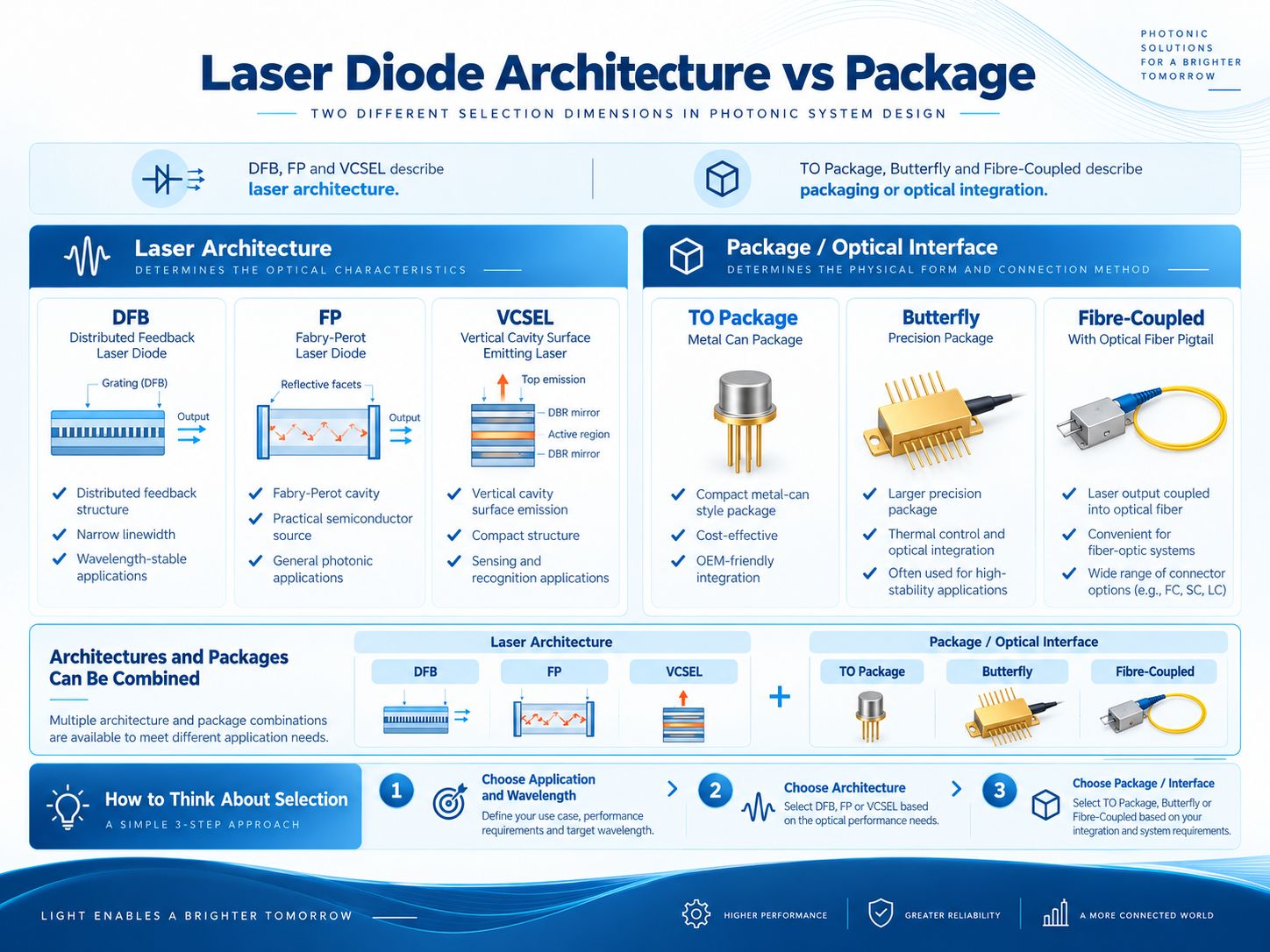
Find the Right Emission Technology
Start with the spectral characteristics, beam geometry, modulation and optical-system requirements.
DFB Laser Diodes
Distributed feedback provides wavelength-selective emission and is widely used in TDLAS sensing, communications and precision optical sources. Exact linewidth, tuning and power depend on the device.
View DFB solutionsFP Laser Diodes
Fabry–Pérot lasers serve a range of optical-source and fiber-test requirements. Available Lumi directions include QCW models at selected telecom and test wavelengths.
View FP solutionsVCSEL Laser Diodes
Vertical-cavity surface-emitting lasers offer compact surface-emission designs. Lumi has selected 795nm, 850nm and 940nm products for specialized sensing and optical integration.
View VCSEL solutionsExplore Lumi Laser Diode Products
Browse actual WooCommerce products. The latest published devices from our WooCommerce Laser Diode category are displayed below and update automatically as new products are added.

Choose a Package for Your Instrument
The same laser architecture can be integrated into different mechanical and optical configurations.
TO-Can
Compact metal-can packages for selected laser architectures, with options depending on the device for thermal control, monitoring or fiber pigtails.
TO-Can laser diodes →Butterfly
Precision housings commonly used where fiber output, integrated TEC, thermistor or monitor photodiode functions are required.
Butterfly laser diodes →Fiber-Coupled
A defined optical-fiber output for simpler integration with downstream fiber-optic systems; SM/PM fiber options depend on the exact module.
Fiber-coupled laser diodes →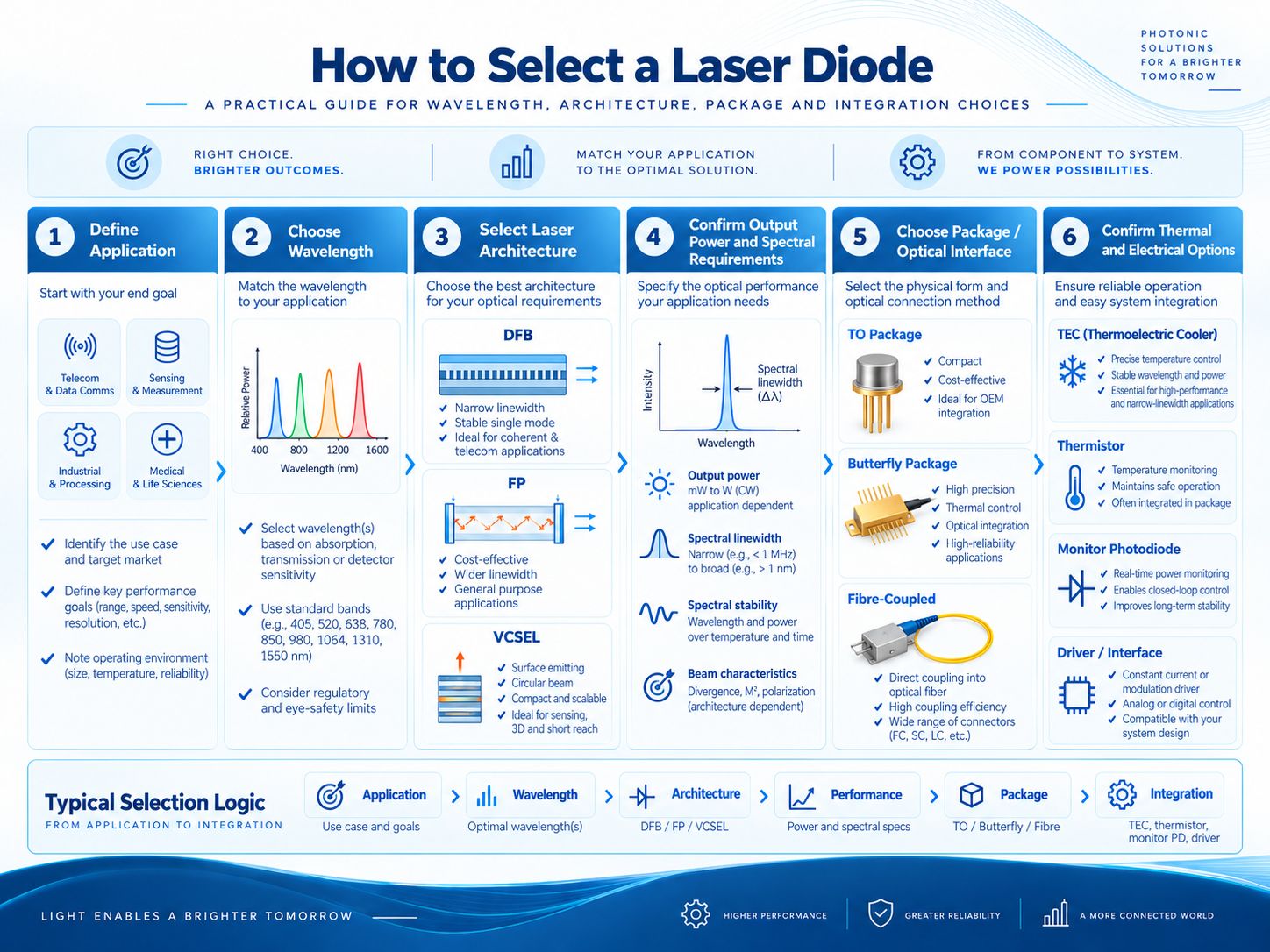
How to Specify a Laser Diode
- Application and wavelengthIdentify the absorption line, fiber band, detector response or required optical function.
- Optical performanceDefine output power, linewidth, wavelength stability, beam geometry and modulation where applicable.
- Operating conditionsConfirm CW / QCW / pulsed operation, drive current, ambient temperature and cooling needs.
- Mechanical interfaceChoose package dimensions, pin configuration, free-space optics or fiber connection.
- QualificationReview individual datasheet limits, test conditions, volume and OEM validation requirements.
DFB vs FP vs VCSEL at a Glance
General engineering tendencies — final optical specifications must be taken from each product datasheet.
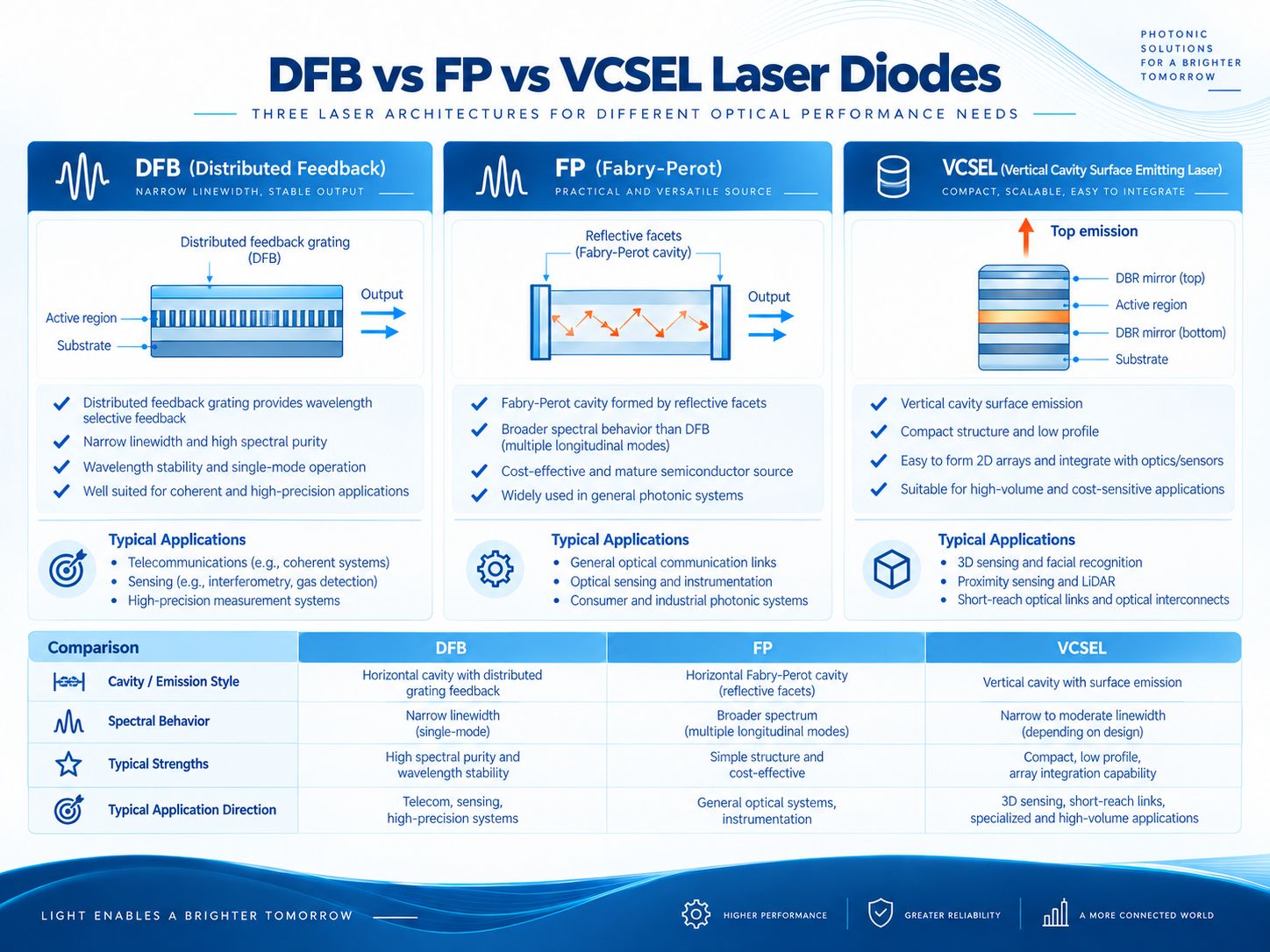
| Consideration | DFB | FP | VCSEL |
|---|---|---|---|
| Cavity / emission | Distributed feedback, edge-emitting | Fabry–Pérot resonator, usually edge-emitting | Vertical cavity, surface-emitting |
| Spectral approach | Wavelength-selective designs; often narrow linewidth | Commonly multiple longitudinal modes, depending on design | Compact surface output; spectral properties vary by device |
| Typical applications | TDLAS, wavelength-sensitive links, precision photonics | Optical sources, OTDR and selected instrument designs | 3D/proximity sensing, atomic optics and compact modules |
| Product selection | View DFB | View FP | View VCSEL |
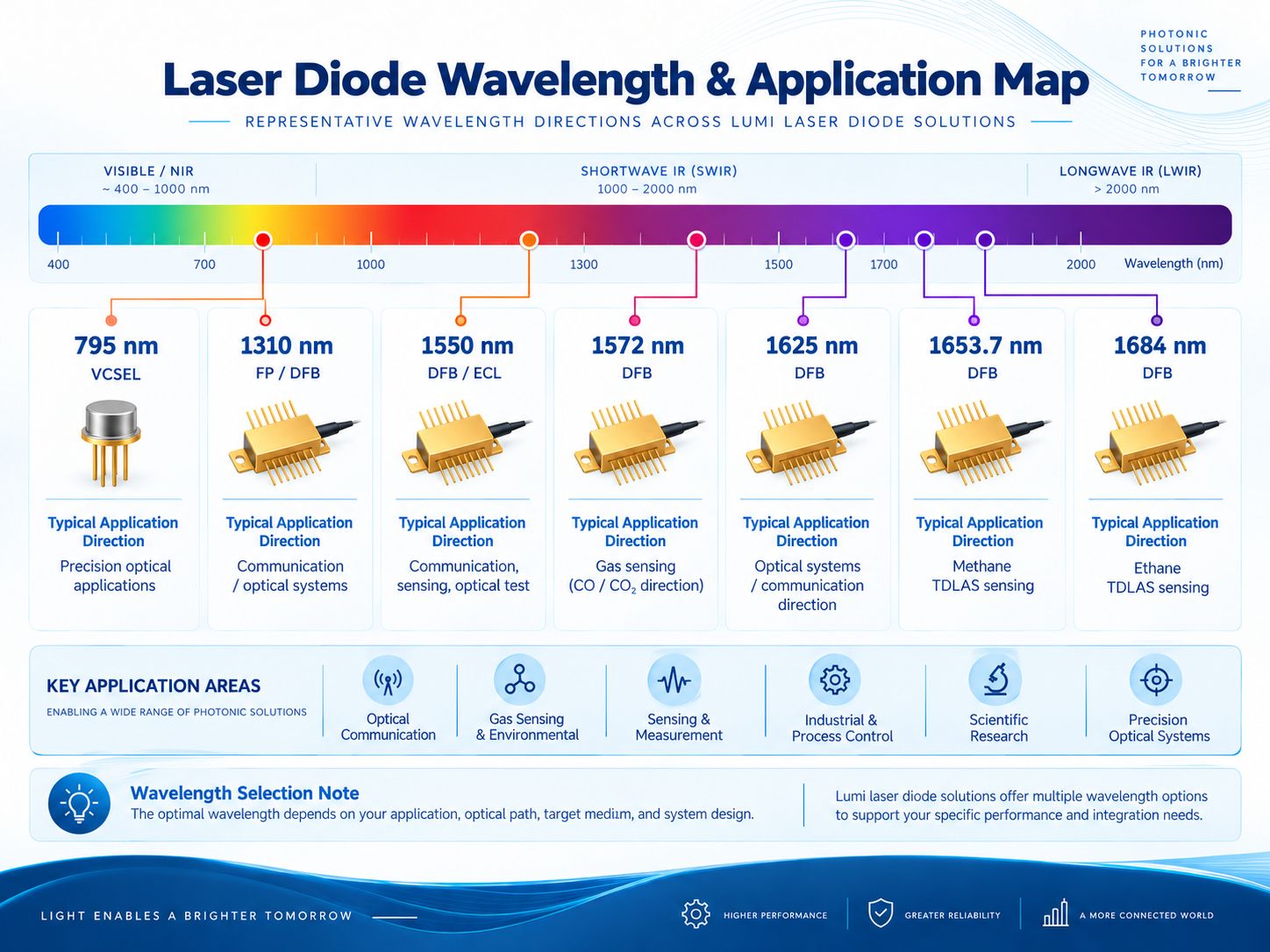
Representative Wavelengths and Design Uses
A wavelength alone does not establish device suitability. Match the exact component, optical requirements and system wavelength tolerance.
TO-Can, Butterfly and Fiber Output
TO-can and butterfly are package types; fiber-coupled is an optical output/interface description. They do not form three mutually exclusive package categories.
| Type | Primary consideration |
|---|---|
| TO-can | Compact electrical and mechanical integration |
| Butterfly | Precision package, often with thermal and fiber options |
| Fiber-coupled | Fiber alignment, type, connector, length and optical delivery |
Laser Diodes for Sensing, Communication and Measurement
Application engineering starts with the operating principle and the specific device requirements, rather than only the nominal laser wavelength.
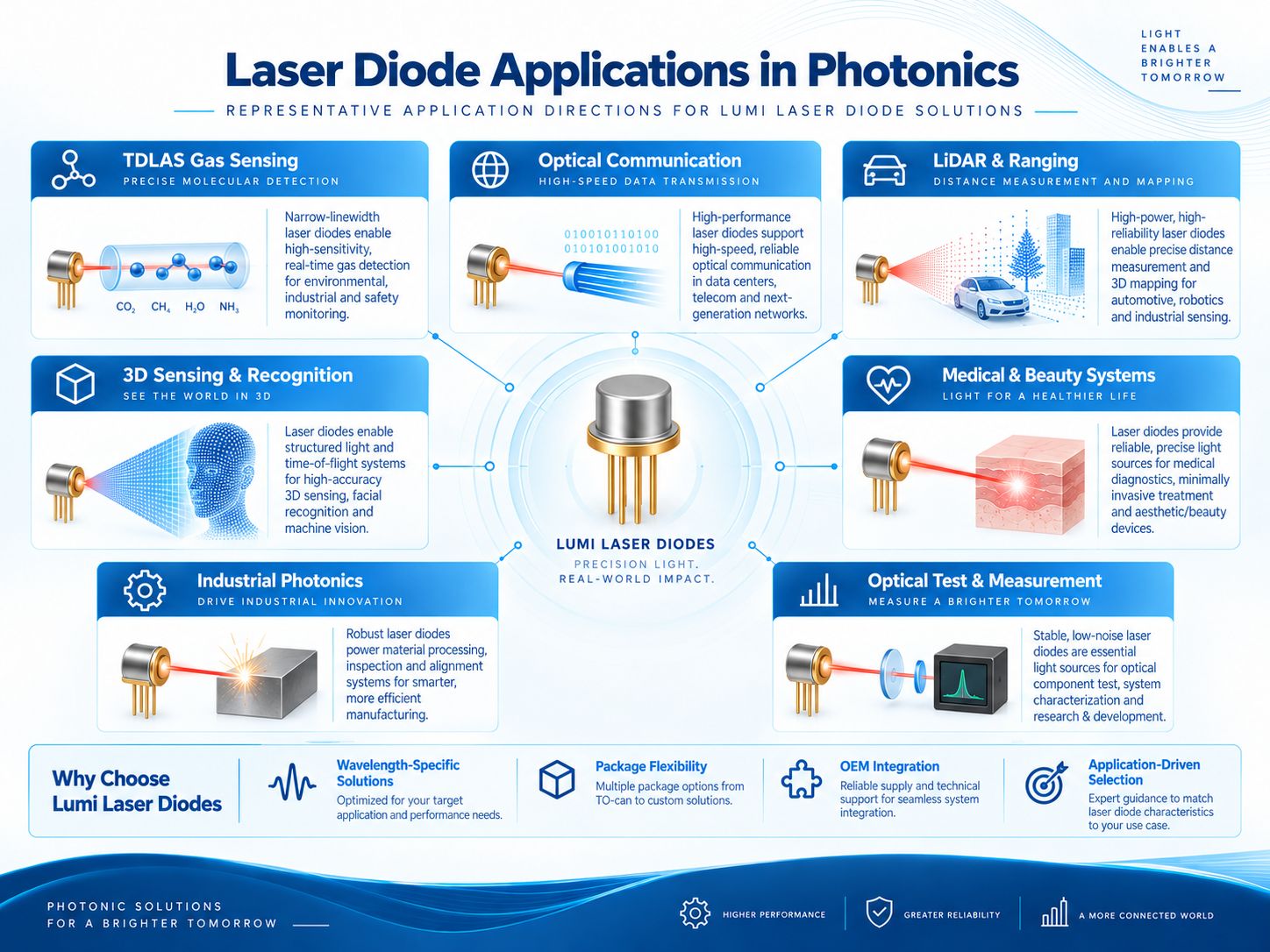
TDLAS Gas Sensing
Wavelength-selective sources for absorption spectroscopy such as methane and CO₂, subject to specific absorption-line matching.
Optical Communication
Semiconductor laser sources and packaged optical interfaces for fiber-optic communication designs.
OTDR & Fiber Testing
Selected FP and DFB sources in telecom wavelength bands for optical test instruments and fiber monitoring.
LiDAR & Ranging
Laser-source specifications depend on system ranging architecture, linewidth, power, modulation and eye-safety design.
3D & Proximity Sensing
Compact VCSEL sources for near-infrared sensing applications where emission geometry and package matter.
Industrial & Precision Optics
OEM laser modules and customized packaging evaluated against power, cooling, beam and integration requirements.
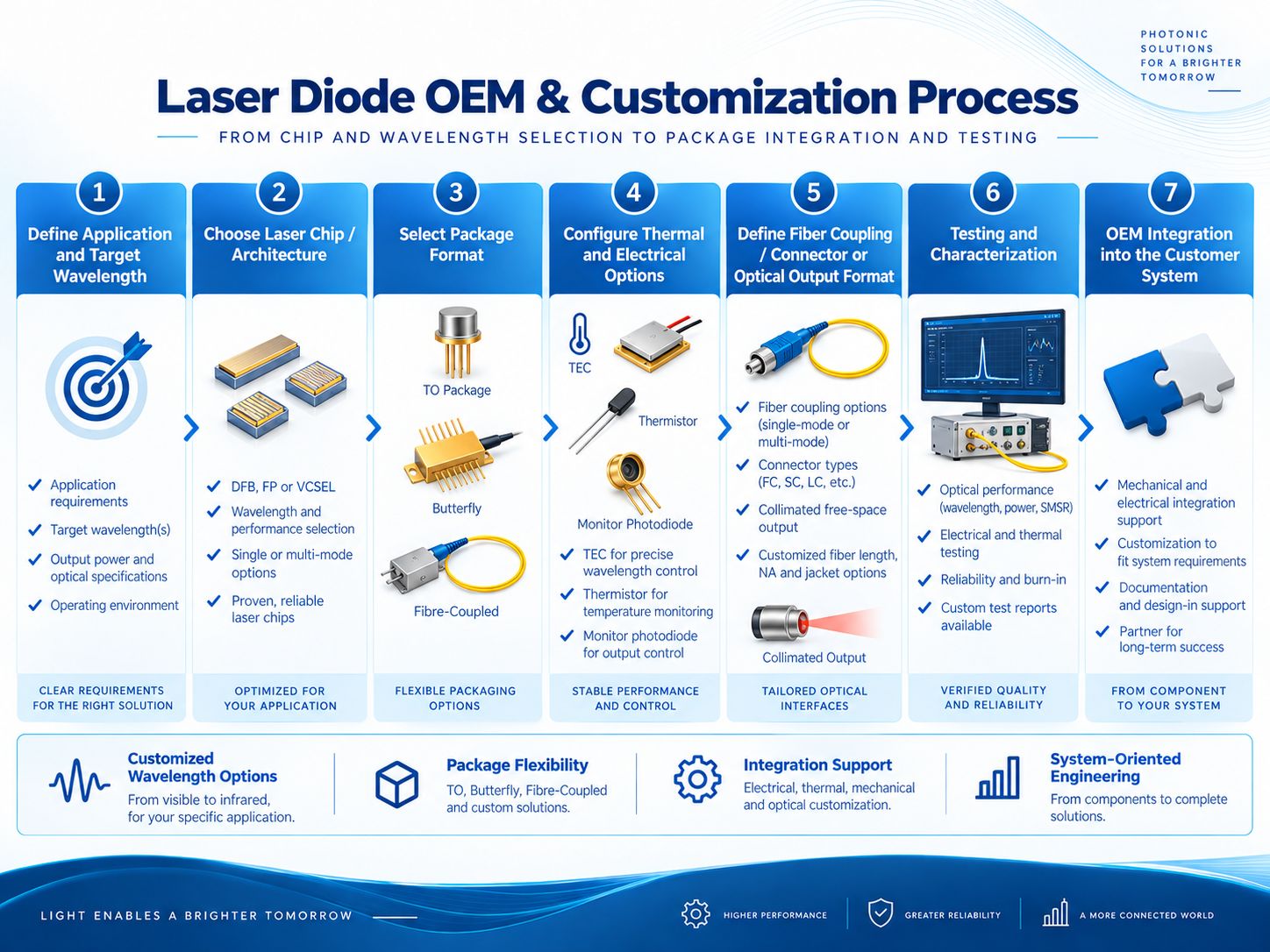
From Component Selection to Custom Integration
Some projects require more than a standard laser diode specification. Lumi can discuss device selection and available configuration options for OEM instruments and photonic systems.
- Target wavelength, tuning and optical power requirements
- DFB, FP, VCSEL and selected high-power device directions
- TO-can, butterfly, SMD and application-specific packaging
- TEC, thermistor and monitor-photodiode requirements
- Fiber type, pigtail, connector and output interface
- Datasheet, sample evaluation, anticipated volume and test conditions
Laser Diode FAQs
What is the difference between a DFB and an FP laser diode?
DFB devices use a distributed-feedback grating for wavelength-selective emission. FP lasers use a Fabry–Pérot cavity and commonly support multiple longitudinal modes. The correct choice depends on linewidth, optical power and application requirements.
Is a fiber-coupled laser diode a separate architecture?
No. Fiber-coupled describes how light is delivered. A fiber-output module can contain a DFB or another compatible laser architecture and may use a TO or butterfly package.
Can I choose a gas-sensing laser by wavelength alone?
No. The target absorption line, temperature tuning, line width, output power and detection-cell architecture must also match the measurement design.
Which information should I provide for an OEM quotation?
Include the application, wavelength, optical power, emission or linewidth requirements, operating mode, package or fiber interface, operating conditions, quantity and qualification expectations.
Are TEC, thermistor and monitor photodiode available in every package?
No. These options vary by product and package. Check the exact model datasheet or discuss a suitable configuration with the Lumi team.
Find a Laser Source for Your Next Design
Send your target wavelength, optical performance, preferred package and estimated quantity for an application-oriented product discussion.