

A laser diode package provides the mechanical, electrical, thermal and optical interface between the semiconductor laser chip and the OEM system. Common package formats include TO-can, butterfly and SMD, while fiber-coupled and free-space more accurately describe how the optical output is delivered.
That distinction is fundamental to laser-diode selection:
- DFB / FP / VCSEL = laser architecture
- TO-Can / Butterfly / SMD = package
- Free-space / Fiber-coupled = optical output interface
A DFB laser can therefore be supplied in a TO-can package with free-space output, in a TO-can package with a fiber pigtail, or in a butterfly package with SM or PM fiber. A VCSEL can be integrated into an SMD package for PCB-level assembly.
The package is not simply a protective shell around the semiconductor chip. It can determine how the laser is mounted, how heat leaves the junction, how the device is electrically connected, whether temperature control is integrated, whether a monitor photodiode is available, whether the output is free-space or fiber-coupled, and how much downstream optical alignment the OEM must perform.
For OEM engineers, the most useful question is not “Which package is best?” It is:
Which package gives my system the required optical, thermal and electrical functions with the lowest total integration complexity?
What Does a Laser Diode Package Actually Do?
A bare semiconductor laser chip is small, fragile and difficult to integrate directly into equipment. Packaging turns that die into a practical component that can be electrically driven, thermally managed, mechanically mounted and optically aligned.
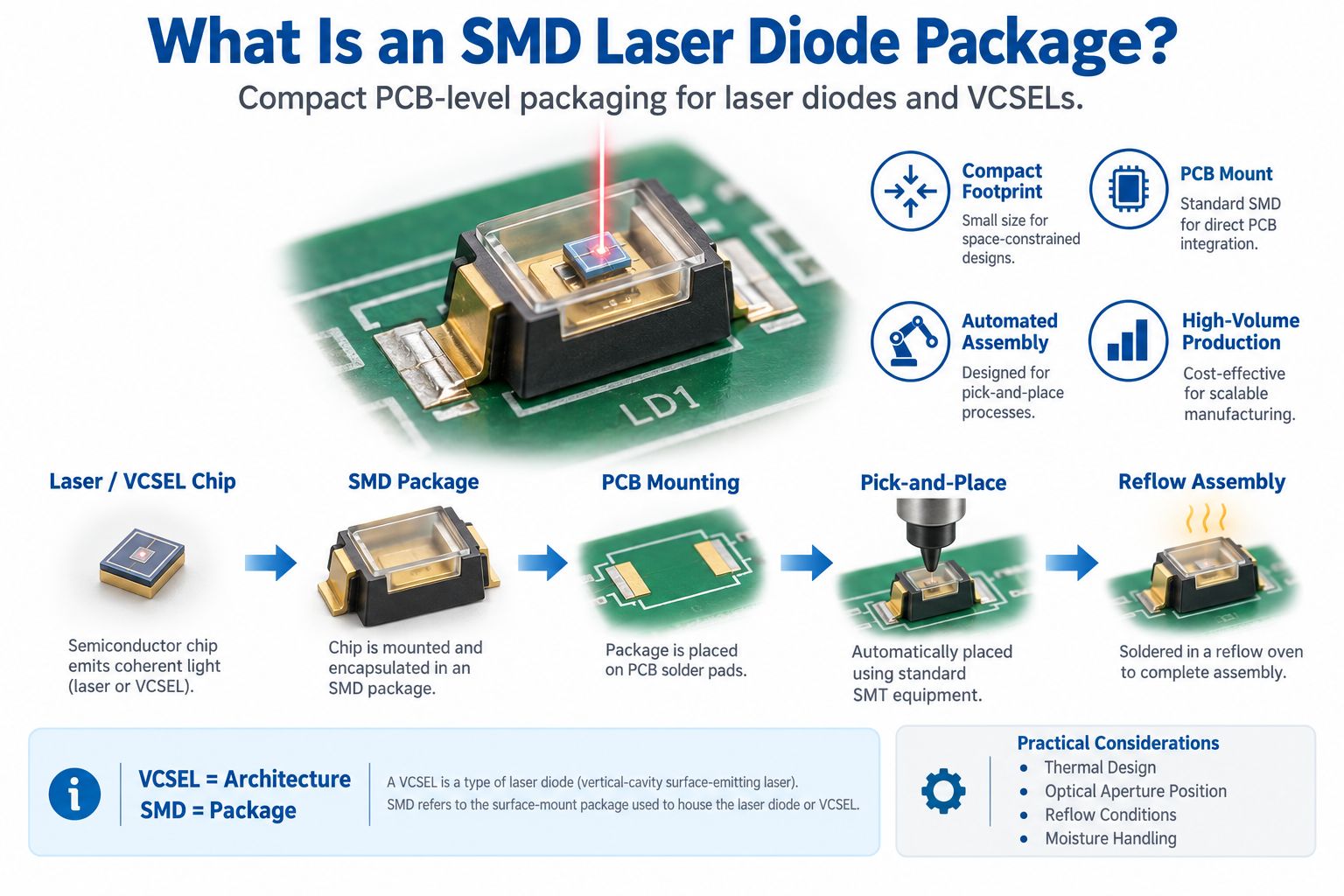
Mechanical Protection
The semiconductor chip and its optical facets can be sensitive to mechanical contact, dust, moisture, assembly residue and vibration. A package provides a rigid structure around the chip and internal wire bonds.
Electrical Connection
A bare laser die normally provides microscopic bond pads. The package converts those contacts into practical pins, leads or surface-mount pads that can connect to the laser driver, TEC controller, thermistor or monitor photodiode circuit.
Thermal Path
Laser-diode performance depends strongly on junction temperature. The package establishes part of the thermal path:
Laser Junction → Die Attach → Submount → Package → System Heat Sink
A package does not eliminate system-level thermal design. Even a device with an integrated TEC still needs the heat generated by the laser and TEC to be removed from the package.
Optical Interface
The package can define the location and form of the optical output. It may include a window, lens, collimator, fiber-coupling optics, optical isolator or fiber pigtail.
Environmental Protection
Packaging can help protect the laser against humidity, particles and contamination. Depending on the product, the housing may be hermetic or otherwise sealed.
A laser diode package is part of the optical and thermal design, not merely a protective enclosure.
Laser Diode Package Types at a Glance
| Format | Main Advantage | Integration Level | Common Optical Output | Typical Fit |
|---|---|---|---|---|
| TO-Can | Compact and economical | Low–medium | Free-space or fiber pigtail | Sensors, compact instruments, OEM modules |
| Butterfly | High integration | High | Fiber-pigtailed or precision free-space | Telecom, TDLAS, spectroscopy |
| SMD | PCB-level compact integration | Medium | Surface-emitting optical aperture | VCSEL sensing, datacom, compact electronics |
| Chip-on-Submount | Maximum packaging flexibility | Low | Bare emitter | Module manufacturers, custom photonics |
| Fiber-Coupled | Optical output interface rather than strictly a package | Depends on package | SM / PM / MM fiber | Fiber-based sensing and communication |
Fiber-coupled is not strictly a package type. It describes how light leaves the device. Fiber output can be combined with TO, butterfly or another package architecture.
TO-Can Laser Diode Package
A TO-can is one of the most established semiconductor optoelectronic package formats. It is a compact metal housing with a header, pins and a cap, and it is widely used for laser diodes, photodiodes and other optical semiconductor components.
Inside a TO-Can Laser Diode Package
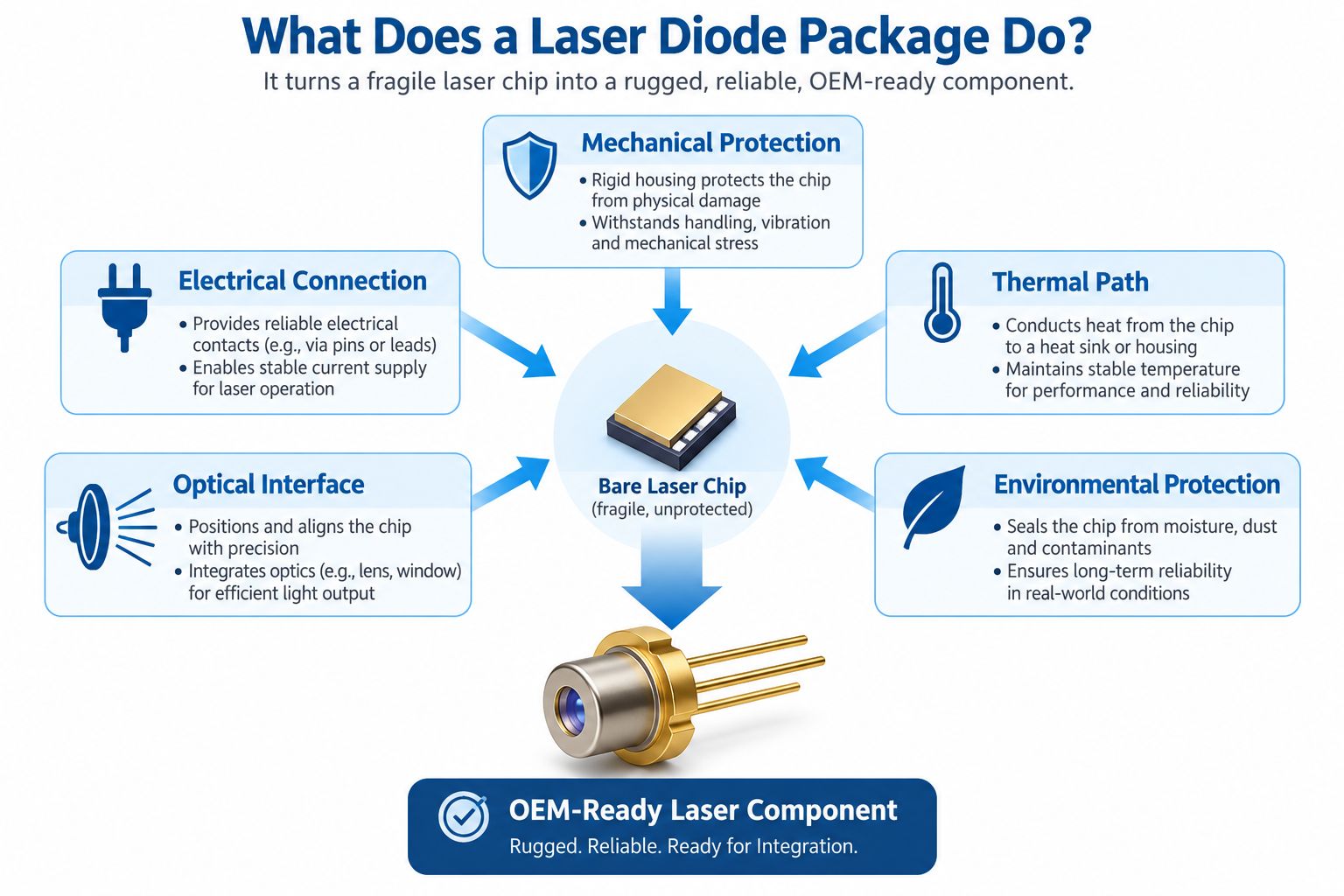
A typical TO-can laser diode can include a metal cap, optical window, laser chip, submount, wire bonds, monitor photodiode, header and pins.
Metal Cap and Optical Window
The cap protects the internal components and may support a flat window, ball lens or application-specific optic. Some designs are hermetically sealed.
Laser Chip and Submount
The internal laser may be FP, DFB or another edge-emitting architecture. The chip is often attached to a thermally conductive submount that supports mechanical positioning and heat transfer.
Wire Bonds and Pins
Wire bonds connect the chip and internal components to the package pins. The pins may connect to the laser diode, monitor PD, thermistor or other internal functions.
Monitor Photodiode
Some TO-can designs include a monitor photodiode for automatic power control or optical feedback.
Can a TO-Can Include a TEC or Fiber Pigtail?
Yes.
A common mistake is to assume:
TO-can = simple free-space laser with no thermal control
That is not always true. Depending on the package size and design, TO-packaged lasers can include a TEC, thermistor, heater, monitor PD, lens or fiber pigtail.
TO describes the package format; it does not restrict the device to free-space output.
Main Advantages of TO-Can Packages
- Compact footprint
- Mature package technology
- Relatively economical
- Easy to mount in compact modules
- Good fit for OEM optical instruments
- Can support free-space or fiber-output designs
Main Limitations
- Less internal space than butterfly packages
- Pin count can be limited
- Complex optics are harder to integrate
- External thermal control may still be required
- Free-space versions can leave more alignment responsibility to the OEM
Typical Applications
- Gas sensing
- Optical instruments
- Compact measurement equipment
- General optical modules
- Communication
- Laboratory systems
- Industrial sensing
For current products, see TO Package Laser Diodes.
Butterfly Laser Diode Package
A butterfly laser diode package is larger than a typical TO-can, but the extra volume allows much more functionality to be integrated around the semiconductor laser.
Butterfly packages are especially common in optical communication, TDLAS, spectroscopy, precision measurement and fiber sensing.
Inside a Butterfly Laser Diode Package
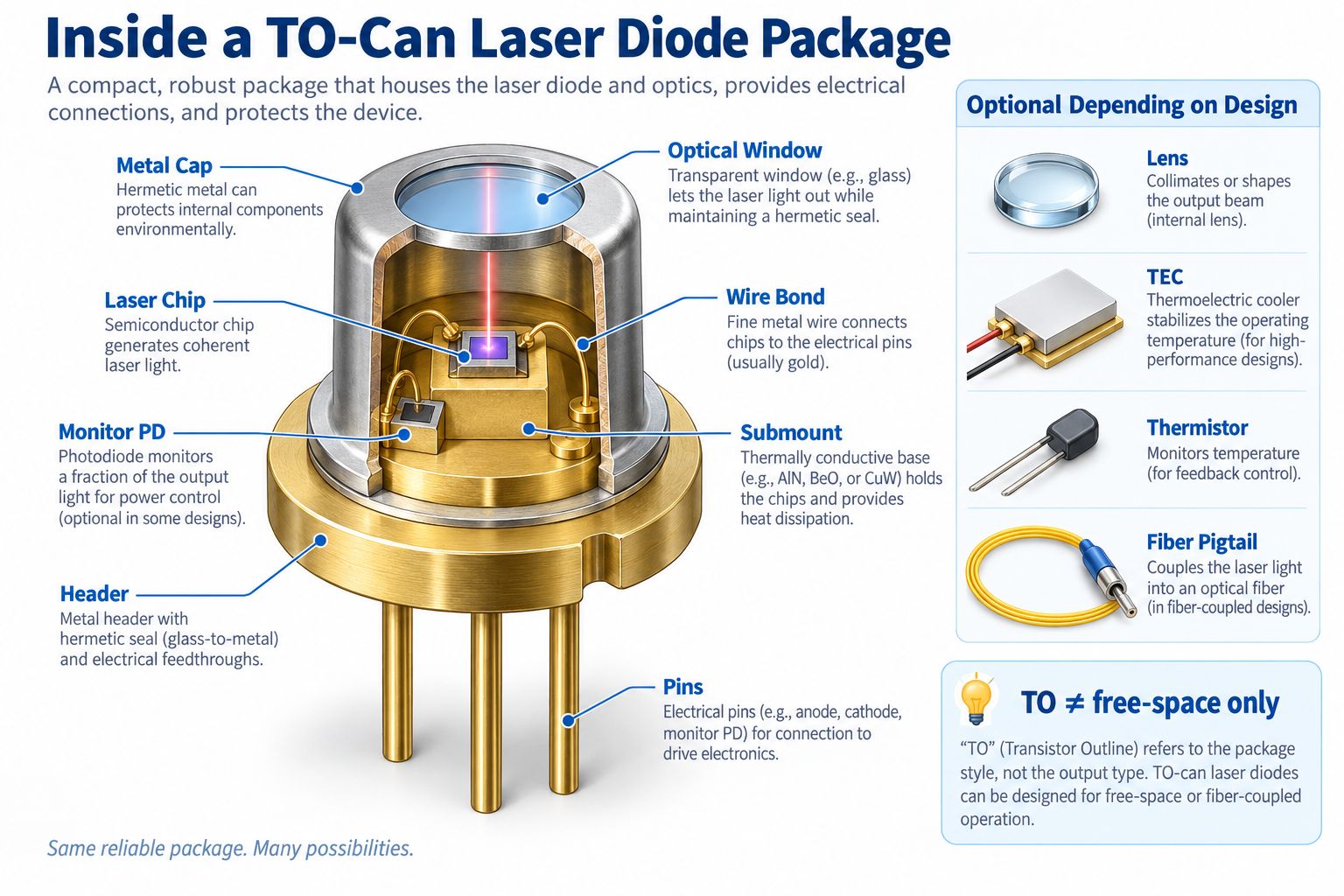
A high-integration butterfly device may include a laser chip, submount, TEC, thermistor, monitor photodiode, coupling optics, optical isolator, fiber pigtail and multiple electrical pins.
TEC and Thermistor
An integrated thermoelectric cooler can actively control internal temperature, while a thermistor provides temperature feedback.
This is especially useful when wavelength stability, DFB tuning or operation across a wide ambient range matters.
Monitor Photodiode
A monitor photodiode can support optical-power feedback.
Coupling Optics and Fiber Pigtail
Precision lenses can align and focus the laser into SM, PM or another specified fiber.
Multiple Pins
A typical butterfly package can provide separate electrical connections for the laser diode, TEC, thermistor, monitor photodiode and case.
Why Butterfly Packages Support High Integration
The major advantage is internal integration space.
A larger package makes it easier to combine the laser, thermal control, optical monitoring, fiber coupling and optical isolation. This can reduce OEM assembly work because several critical source-level processes are completed by the supplier.
Main Advantages
- Strong thermal-control capability
- Easy integration of TEC and thermistor
- Factory-aligned fiber output
- More electrical connections
- Good platform for narrow-linewidth DFB devices
- Strong fit for precision sensing
Main Limitations
- Larger footprint
- Higher component cost
- More complex electrical interface
- TEC requires external control
- Fiber handling must be managed
For a detailed comparison, see Butterfly vs TO-CAN Package for a Gas Sensing Laser Diode.
What Is an SMD Laser Diode Package?
An SMD laser diode package is designed for surface-mount assembly directly onto a PCB.
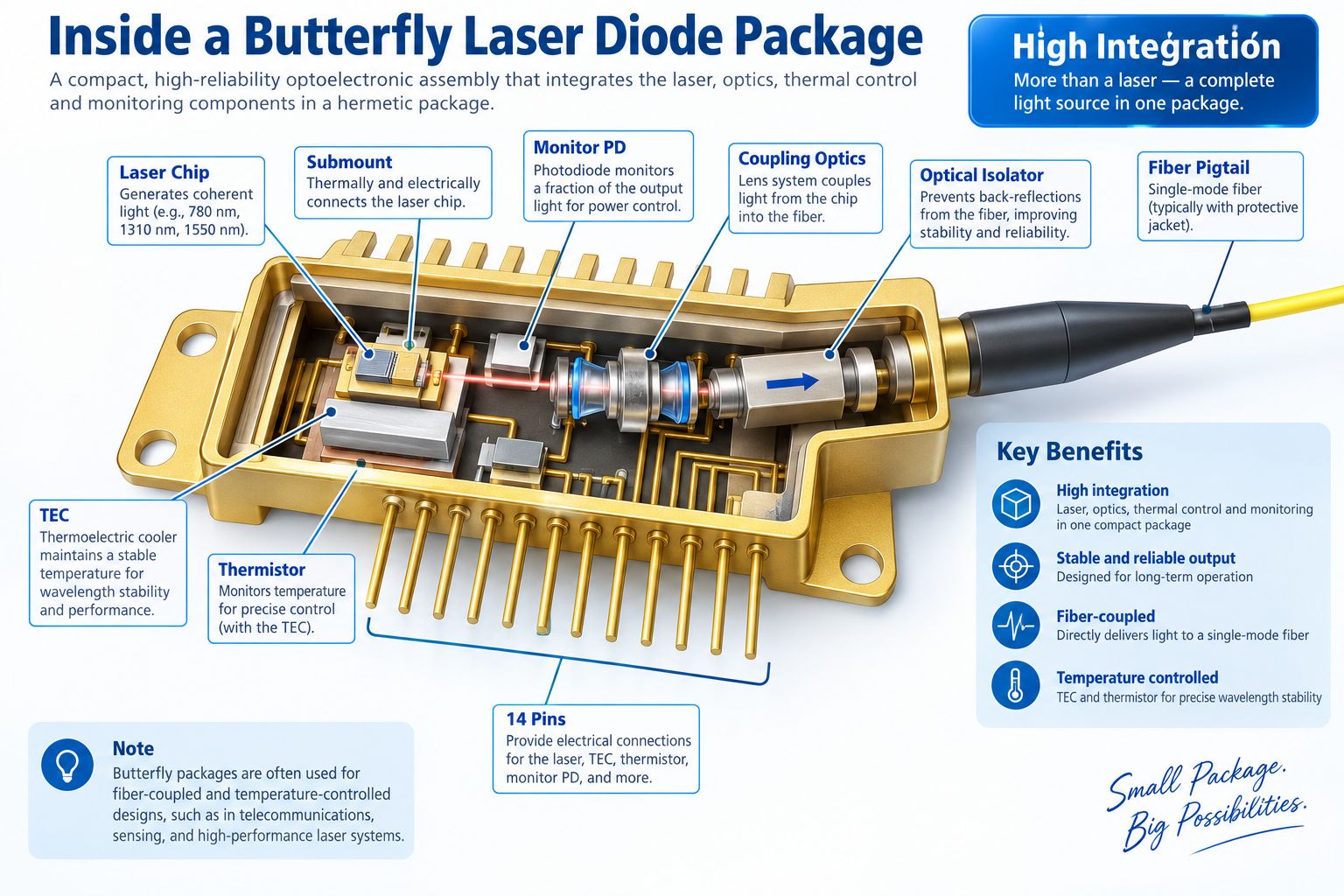
A common mistake is to confuse SMD with VCSEL.
VCSEL = laser architecture
SMD = package
A VCSEL chip can be placed inside an SMD package. The term SMD does not define how the internal semiconductor laser creates optical feedback.
Why SMD Packaging Matters
SMD packaging supports:
- Automated pick-and-place
- PCB soldering
- Compact layouts
- High-volume manufacturing
- Reduced manual assembly
- Small optical modules
This can be especially valuable in proximity sensing, 3D sensing, consumer electronics, compact datacom and industrial sensor modules.
Lumi SMD VCSEL Examples
Lumi’s 850nm 1206 SMD VCSEL – 1206ULM850-L is a clear example:
850 nm VCSEL architecture → 1206 SMD package
It combines a typical 850 nm wavelength, 2 mW typical optical output at 6 mA and a minimum 3 GHz modulation bandwidth at 6 mA.
Lumi also offers the 940nm 1616 SMD VCSEL & Photodiode – 1616VCA940R8-PD0224-Z.
That product combines:
940 nm VCSEL → 1616 SMD package → integrated photodiode
This shows that a package can add system functionality without changing the laser architecture.
Main Advantages of SMD Laser Packages
- Very compact
- PCB compatible
- Automated assembly
- High-volume production potential
- Suitable for embedded optical sensors
- Good fit for VCSEL-based systems
Main Limitations
- Limited internal volume
- Less room for TEC or large optics
- PCB thermal design becomes important
- Optical aperture placement must be controlled
- Reflow conditions matter
- Moisture-sensitivity handling can matter
Is Fiber-Coupled a Laser Diode Package Type?
Strictly speaking, fiber-coupled is primarily an optical output interface, not a package format.
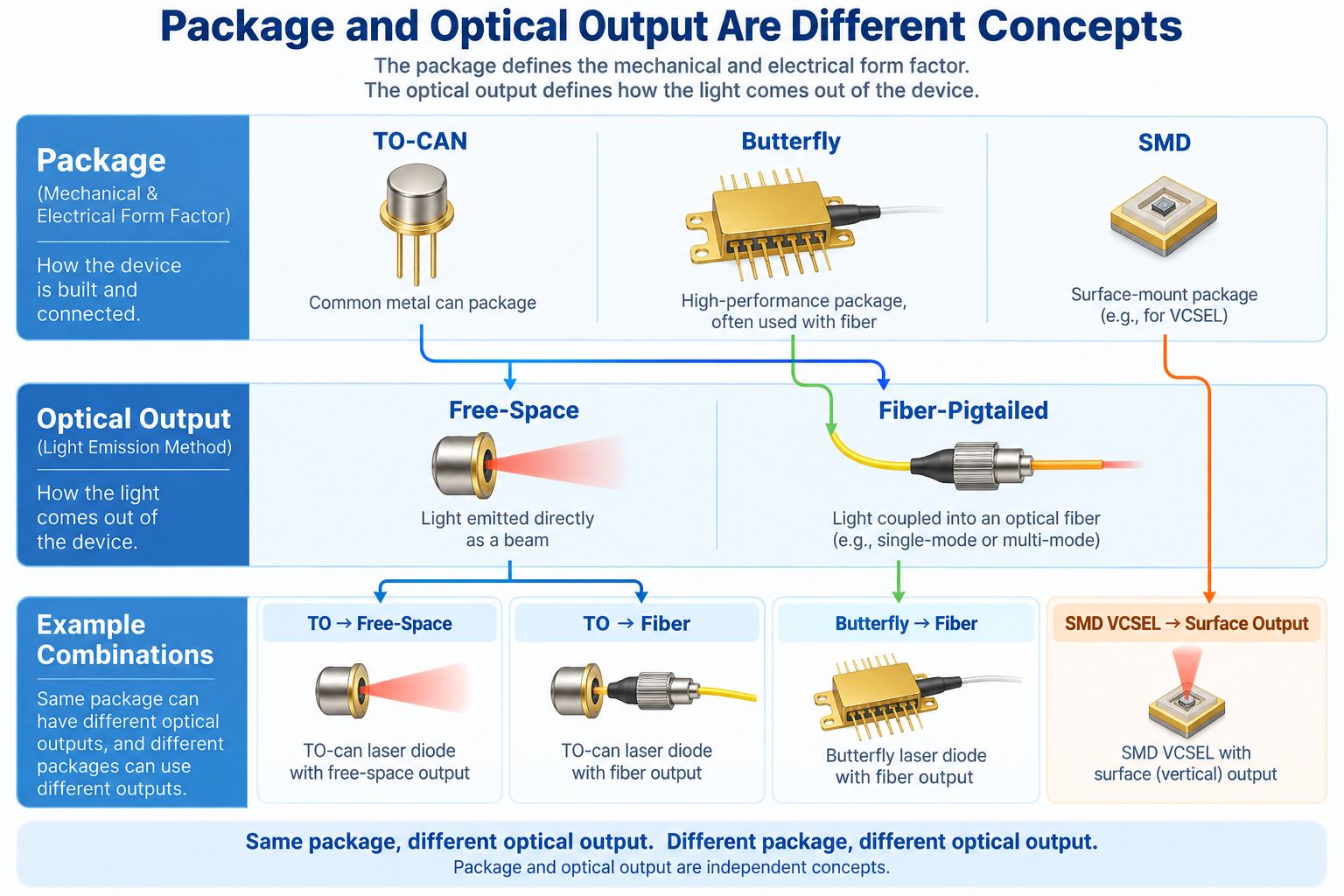
The same package can support different outputs.
For example:
TO-CAN → Free-Space
and:
TO-CAN → Fiber Pigtail
are both valid.
Similarly:
Butterfly → Fiber
is common in telecom and precision sensing.
An SMD VCSEL may provide:
Surface Output
through an optical aperture above the PCB.
This means the correct hierarchy is:
Laser Architecture
Examples:
- DFB
- FP
- VCSEL
Package
Examples:
- TO
- Butterfly
- SMD
Optical Output
Examples:
- Free-space
- Fiber-pigtailed
- Surface output
For a complete guide to SM, MM, PM fiber, connector selection and pigtailed vs free-space output, see What Is a Fiber-Coupled Laser Diode?.
Free-Space vs Fiber-Coupled Output
| Feature | Free-Space Output | Fiber-Coupled Output |
|---|---|---|
| Beam access | Direct | Defined by fiber |
| Source-to-system alignment | OEM handles | Supplier can complete |
| Routing | Mirrors and lenses | Flexible fiber |
| Remote optical head | More difficult | Easy |
| Optical flexibility | High | Defined interface |
| Coupling loss | Added later if fiber is used | Included in fiber-end output |
| Typical applications | Custom optical bench, compact free-space sensors | Telecom, TDLAS, spectroscopy |
A free-space source can be better when the OEM wants complete control over optics.
A fiber-coupled source can be better when repeatable fiber delivery simplifies the instrument architecture.
Neither one is universally superior.
SMD vs TO-Can: Are They Alternatives?
They can be alternatives in some compact optical systems, but they solve different manufacturing problems.
TO-Can
TO packages are discrete optical components. They provide a mechanical package, pins and optical aperture and can be mounted to an optical bench, heat sink, socket or custom fixture.
SMD
SMD packages are designed for PCB-level manufacturing. They provide surface-mount pads, pick-and-place compatibility and high production density.
The core distinction is:
SMD is chosen primarily for PCB assembly architecture; TO is chosen primarily as a discrete optoelectronic component package.
TO-Can vs Butterfly Laser Diode
| Requirement | TO-Can | Butterfly |
|---|---|---|
| Compactness | Strong | Larger |
| Typical cost | Usually lower | Usually higher |
| TEC integration | Possible | Very common |
| Thermistor | Possible | Very common |
| Monitor PD | Possible | Very common |
| Fiber output | Possible | Very common |
| Pin count | Limited | Higher |
| Precision sensing | Strong in suitable design | Strong |
| OEM optical alignment | Often more | Often less with factory fiber coupling |
The key point is:
Butterfly provides more integration space; TO provides a more compact component form.
That does not mean only butterfly packages can support TEC or fiber output.
What About Chip-on-Submount and C-Mount?
The broader laser-diode market includes additional packaging levels beyond TO, butterfly and SMD.
Chip-on-Submount
A chip-on-submount device sits between bare die and a fully packaged laser. The supplier has already mounted the semiconductor chip onto a small submount.
The OEM may still need to complete wire bonding, optical alignment, lens integration, fiber coupling and final housing.
For a broader explanation, see Laser Diode Chip vs Packaged Laser Diode.
C-Mount
C-mount packaging is common in higher-power semiconductor-laser applications. It typically provides open optical access, a strong thermal path and direct mounting.
It is less central to Lumi’s current compact sensing and communication portfolio, but it is useful context when discussing the wider laser-diode market.
For a broader industry reference, see the Wavelength Electronics application note on common laser diode packages.
How Package Choice Affects Thermal Management
Every semiconductor laser has a thermal path:
Junction → Die Attach → Submount → Package → Heat Sink
The package determines only part of this chain.
TO-Can Thermal Design
TO packages can provide a compact metal path from the semiconductor die into the package header. The OEM may still need a temperature-controlled mount, heat sink or external TEC.
Butterfly Thermal Design
Butterfly packages often integrate a TEC, thermistor and a large metal base. This gives the system designer a more complete temperature-control platform.
However, the external package base still needs a heat sink.
The TEC does not make heat disappear. It moves heat from one side of the thermoelectric element to the other.
SMD Thermal Design
For SMD devices, the PCB becomes a major part of the thermal system.
Important factors include thermal pads, copper area, PCB layers, vias, duty cycle and ambient temperature.
Integrated cooling changes where thermal control is performed; it does not remove heat from the system.
How Package Choice Affects Optical Alignment
TO-Can
A free-space TO source may require an external collimator, lens holder, beam alignment, gas-cell alignment or fiber coupler.
A pigtailed TO device moves the source-to-fiber alignment into the supplier’s packaging process.
Butterfly
A butterfly source often arrives with a factory-aligned fiber pigtail. This can remove a difficult alignment step from the OEM assembly line.
SMD VCSEL
A surface-emitting SMD VCSEL typically sends the beam perpendicular to the PCB. The system may place a lens, diffuser, DOE or detector optics above the package.
This geometry is especially useful for compact sensing modules.
How Package Choice Affects Electrical Integration
TO-Can
The device may have several metal pins for the laser diode, monitor PD, thermistor or case connection.
Butterfly
Butterfly packages provide more pins and can separate the laser, TEC, thermistor, monitor photodiode and case.
SMD
SMD devices use PCB pads. This supports pick-and-place, reflow, dense electronics integration and short electrical paths.
For high-speed VCSEL applications, PCB layout becomes especially important.
Package Size vs Total System Footprint
The smallest laser package does not always create the smallest system.
A TO-can can be physically compact but may require external lenses, a TEC mount, fiber coupler and monitor electronics.
A butterfly package is larger, but may already contain the TEC, thermistor, fiber coupling, monitor photodiode and optical isolator.
Compare total system footprint, not package footprint alone.
Laser Architecture vs Package vs Output Interface
These three levels should always be specified independently.
Architecture
Examples:
- FP
- DFB
- VCSEL
Package
Examples:
- TO
- Butterfly
- SMD
Output Interface
Examples:
- Free-space
- Fiber-coupled
- Surface output
Real combinations include:
1653.7 nm DFB → TO → Free-Space
1550 nm DFB → Butterfly → PM Fiber
940 nm VCSEL → SMD → Surface Output
This classification framework makes product selection much easier because each decision solves a different engineering problem.
Which Laser Diode Package Should You Choose?
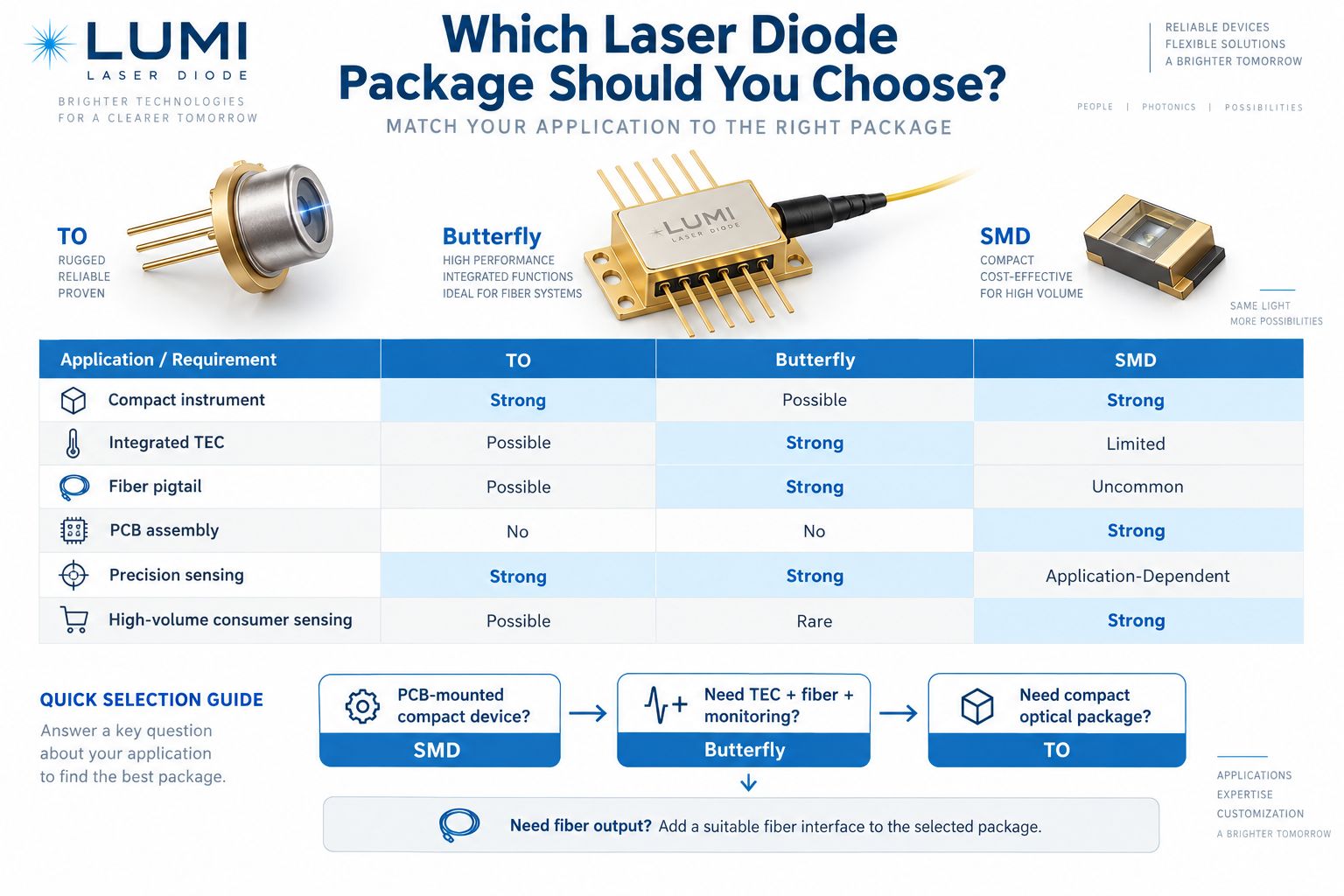
| Application / Requirement | TO | Butterfly | SMD |
|---|---|---|---|
| Compact instrument | Strong | Possible | Strong |
| Integrated TEC | Possible | Strong | Limited |
| Fiber pigtail | Possible | Strong | Uncommon |
| PCB assembly | No | No | Strong |
| Precision sensing | Strong | Strong | Application-dependent |
| High-volume consumer sensing | Possible | Rare | Strong |
| Custom free-space optical bench | Strong | Possible | Application-dependent |
| Stable fiber-fed spectroscopy | Possible | Strong | Rare |
| High-speed compact VCSEL system | Rare | Rare | Strong |
Choose TO-Can When
Start with TO when you need a compact optical component, moderate integration level, free-space output, a cost-sensitive OEM design or external control over surrounding optics.
Choose Butterfly When
Start with butterfly when you need an integrated TEC, thermistor, fiber pigtail, monitor photodiode, optical isolation, stable narrow-linewidth source or reduced source-side alignment work.
Choose SMD When
Start with SMD when you need PCB-level assembly, a compact embedded optical source, automated production or high-volume VCSEL-based sensing and datacom.
Add Fiber Output When
If the system needs remote beam delivery, fiber routing, SM/PM/MM output or fiber-optic system integration, select a compatible package and add the appropriate fiber interface.
Package Selection Checklist
Before requesting samples, define:
- Laser architecture
- Wavelength
- Optical power and measurement point
- Free-space, fiber-coupled or surface output
- Package size
- TEC, heater or passive thermal control
- Thermistor / monitor PD requirements
- Fiber type if applicable
- Mechanical mount or PCB assembly
- Operating temperature
- Pinout and grounding
- Production volume
Common Laser Diode Package Selection Mistakes
Mistake 1: Treating DFB, FP and VCSEL as Package Types
They are laser architectures.
Mistake 2: Treating Fiber-Coupled as a Completely Separate Package Class
Fiber-coupled primarily describes the optical interface.
Mistake 3: Assuming Every TO-Can Is Free-Space
TO packages can include a lens, TEC, thermistor or fiber pigtail depending on the design.
Mistake 4: Assuming Only Butterfly Packages Can Contain a TEC
Butterfly packages commonly integrate TECs because they provide more internal space, but cooled TO devices also exist.
Mistake 5: Choosing the Smallest Package Without Considering External Optics
A smaller package may require more lenses, heat sinks, fiber couplers and mounting fixtures.
Mistake 6: Ignoring Pinout and Grounding
Two physically similar packages may use different electrical pin assignments.
Mistake 7: Selecting an SMD Laser Without Checking Reflow and Thermal Requirements
SMD optical components need manufacturing conditions compatible with reflow temperature, moisture sensitivity, PCB thermal path and optical-aperture protection.
Lumi Laser Diode Package Examples
TO Package Laser Diodes
Lumi’s TO-package products include FP and DFB devices across multiple wavelengths.
Explore TO Package Laser Diodes.
Butterfly Laser Diodes
Lumi butterfly products include DFB laser chips, 14-pin packaging, TEC integration, fiber pigtails and SM or PM fiber options.
Explore Butterfly Laser Diodes.
SMD VCSEL Products
Representative SMD products include:
These products illustrate how VCSEL architecture can be packaged for automated PCB assembly.
Fiber-Coupled Laser Diodes
Lumi also supplies fiber-output devices in both butterfly and TO configurations.
Explore the Fibre Coupled Laser Diode category.
Frequently Asked Questions
What are the main laser diode package types?
Common laser diode package types include TO-can, butterfly, SMD, chip-on-submount and higher-power formats such as C-mount. Fiber-coupled is more accurately described as an optical output interface that can be combined with several package types.
What is a TO-can laser diode?
A TO-can laser diode is a semiconductor laser mounted inside a compact metal transistor-outline package with electrical pins and an optical window, lens or other output interface.
What is a butterfly laser diode package?
A butterfly package is a larger precision laser package that can integrate a laser chip, TEC, thermistor, monitor photodiode, fiber coupling and other optical components in one assembly.
What is an SMD laser diode?
An SMD laser diode is a laser component packaged for surface-mount assembly onto a PCB. SMD describes the package, while the internal laser architecture may be VCSEL or another design.
Is fiber-coupled a laser diode package?
Not strictly. Fiber-coupled primarily describes how the light is delivered. A TO-can, butterfly or custom package can be designed with fiber output.
Can a TO-can laser diode include a TEC?
Yes. Although standard TO packages may be simpler, some TO laser designs integrate TECs or other thermal-control elements.
Can a TO-can laser diode have fiber output?
Yes. TO-can devices can be supplied with a fiber pigtail or integrated into a fiber-coupled assembly.
What is the difference between SMD and TO-can laser diodes?
SMD is designed for PCB surface-mount production, while TO-can is a discrete optoelectronic package with pins and a metal housing.
Which package is best for TDLAS?
Both TO and butterfly packages can work. TO is useful for compact free-space or controlled OEM modules, while butterfly is a strong starting point when the system needs integrated TEC control, fiber output and reduced source-side alignment.
Which laser diode package is best for OEM integration?
There is no universal best package. The correct choice depends on optical output, thermal control, mechanical mounting, production volume and required integration level.
Choose the Package from the System Architecture
Laser diode packaging becomes easier to understand when the design is separated into three independent decisions:
Laser architecture → Package → Optical output
For example:
DFB → TO → Free-Space
DFB → Butterfly → PM Fiber
VCSEL → SMD → Surface Output
TO, butterfly and SMD each have a clear role:
- TO for compact discrete optical components
- Butterfly for high-integration, temperature-controlled and fiber-coupled systems
- SMD for PCB-level compact and high-volume optoelectronics
Fiber coupling can then be added to an appropriate package when the system needs a defined fiber interface.
Lumi supports laser chips and packaged laser diode solutions for OEM projects across TO, butterfly, SMD and fiber-output configurations.
Explore the Lumi Laser Diode product range or contact Lumi with your wavelength, architecture, package, output interface, thermal-control and production requirements for project evaluation.
